

Five Questions: Barry Wesley
Lineman's identity not tied to the game he plays
Mike Brohard
You can call him a football player, and Barry Wesley will understand.
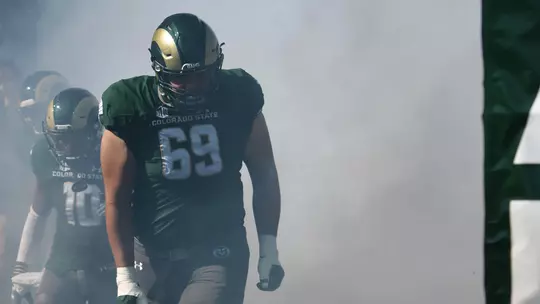
He plays, and he’s really good. He’s started every game of his career on the offensive line and is so versatile he played all five positions throughout the 2018 campaign, his redshirt-freshman season.
Just don’t say it and assume that is who he is, however. Wesley was going to come to Colorado State, football or not. Football is not his existence. His depth as a person goes much deeper, as the Rams are just one of his groups.
“I can go to these different places and talk to other people, hear other perspectives and kinda come together and just talk, really,” Wesley said. “I don’t want my identity to be football.”
He was part of Green and Global, a program designed to give CSU athletes a chance to learn about the world. He’s involved with the John Mosley Student-Athlete Mentoring program, created to help student-athletes navigate everything from time management to meeting community leaders and developing leadership. He is one of two student-athletes on the President’s Multicultural Student Advisory Committee, created to give cultural groups on campus a voice. He’s a mentor with the Key Communities, helping other students navigate collegiate life. And this January, for the third consecutive year, he will represent Colorado State at the Black Student-Athlete Summit, to be held this year in Austin, Texas.
What has being involved with PMSAC meant to you?
“My first meeting, I didn’t say a lot. I just kind of sat and listened and got a viewpoint of how everyone’s thought process has been,” he said. “It’s my third year now, so new members are coming, and being able to tell them your opinion matters. Don’t be afraid to say what you want to say. I was definitely scared to say what I thought. It definitely helped shape me and become a better person who is involved at CSU, because there are so many different opinions. I’ve learned my opinion matters and my voice matters.”
Green and Global gave you a chance to see the world. What did you learn?
“Culture shock, for sure,” he said. “Petersfield, Westmoreland Parish, Jamaica, the people there love what they have, because they don’t know anything else. The first thing I noticed was water pressure and internet access. Clothing, like shoes. Washer and dryer, and houses. Their houses are a lot brighter and represent each person’s identity. I stayed with Momma Staples and she had a hot pink and lime green house, and that was representative of what she was. Everyone, they’re happy with what they have. They understand they could have better, but they’re not complaining about what they have.”
What have you gained most from your Mosley involvement?
“It’s perspective. A lot of the mentors in John Mosley were ex-athletes. They came here to CSU and graduated, spent their time here and now they’re involved in the real world. I feel like a lot of those perspectives are helping us, the people involved, to get ready for that transition once we’re done with athletics. It’s the only thing we’ve known, if you think about it. None of us work a 9-5 job, at least not like that. The mentorship has definitely given me thoughts of what I want to do once I’m done.”
Your role has changed with Key. What have you gained most from that?
“I just remember when I first got here, you don’t see everything. You just think it’s a class, and you’re doing this because they’re making you. Now that I’m in the role I’m in, it’s to teach them there is more to your sport, and there’s definitely resources here on CSU’s campus you can take advantage of just because you are a student-athlete. Other students don’t have that opportunity to have. I didn’t have the perspective when I was first a Key student.
“A lot of them are like, ‘this guy doesn’t know what he’s talking about.’ I tell them, ‘just give it a couple of years. A year is going to go by, and boom, sophomore. Boom, junior. Then boom, senior. It goes fast, and that’s’ what I tell them. Take advantage of what you can, because athletics is definitely taking advantage of you.”
How big of an honor is it for you to represent CSU at The Black Student-Athlete Summit?
“It’s amazing. The first year I went, I was really the only athlete who went. A lot of the other members who went were part of the Black/African-American Cultural Center, so they didn’t really understand the athletics side of it. My second year, I went with a bunch of teammates and people I knew from athletics, and being able to represent athletes from Colorado State and just talk about the issues we’re dealing with, I realized we have a lot more resources we can go to to help us with whatever we’re dealing with as compared to other universities. That’s not just Power 5 schools, that’s universities across the nation, DII and DII schools, HBCUs (historically black colleges and universities). It was realizing CSU has a lot of great resources that a lot of people on our campus are not aware of. The first year I noticed that. The second year it was how can I express my ideas, tell them what’s working well for us and what’s not working for them. It was the networking and bouncing ideas off each other.”