

Sports Performance Department Adjusts to Keep Student-Athlete Needs First
Near or far, CSU staff taking note of physical and mental care
Mike Brohard
Even with student-athletes spread out across the globe, the mission didn’t change.
The process obviously had to for Colorado State’s sports performance staff, regardless of the area of expertise. Medical needs and physical therapy had to continue. Nutritional challenges of being quarantined without consistent workouts had to be addressed. The mental strains of remote learning and the pandemic were of great concern, as well.
Terry DeZeeuw, the senior associate athletic director for health and performance, was in the same position as the rest of the country, with a constant stream of updates and dos and don’ts coming in waves. He and his staff not only navigated the present, but understood they needed a plan for a future where the rules were likely to be rewritten.
That’s how they spent their spring break. With so much remaining unclear, the idea was to start with what could and should remain consistent. What they gained was a starting point.
“Our information was changing so quickly, we really didn’t know what it was going to look like,” DeZeeuw said. “As we gained a better understanding -- a realistic view of what the picture was going to look like and that we were going to be going online -- there was a high probability most student-athletes would at home, not allowed to train.
“We inventoried every student-athlete, current conditions, looked at everything from more urgent, things which needed intervention, and then we addressed it from are they local or outside of Fort Collins. We then put a plan in place for student-athletes.”
No matter the area, the one thing they all miss is the personal interaction they have with the student-athletes. Technology has allowed them to stay in touch and keep important practices in place, but the daily back-and-forth of ideas, of being able to conduct a conversation with the ability to read body language or the inflection of a voice is mostly gone.
So they adjust. There’s some trial and error, but the goal of helping the student-athletes advance remains at the core, leading to necessary adjustments. To that end, DeZeeuw is proud of the effort from both sides of the equation.
In truth, some of what is taking place now will move forward when the Colorado State campus is once again vibrant with activity. Some of the courses of care which have been forced into action are not preferred, but for the most part, a rhythm has been gained.
“The first week was a challenge. I think I’d equate it to starting a new job to some degree: Everything is different, so you’re learning new procedures and protocols, what you can do and what you can’t do,” DeZeeuw said. “Your normal efficiencies that you’ve established, that’s all changed. That was the first challenge, and we spent a lot of spring break planning for that first week back, so I don’t feel like we had a lot of lost time. Honestly, once we got rolling that first week, it took some time, but now we’re a few weeks into it, I feel like we have some procedures established collectively across the board in the health and performance units.”
It’s been challenging for everybody, but at the end of the day, you center it back to our student-athletes and try to do what’s best for them. I think they know that, and hopefully they feel it.Terry DeZeeuw, CSU Senior Associate Athletic Director for Health and Performance
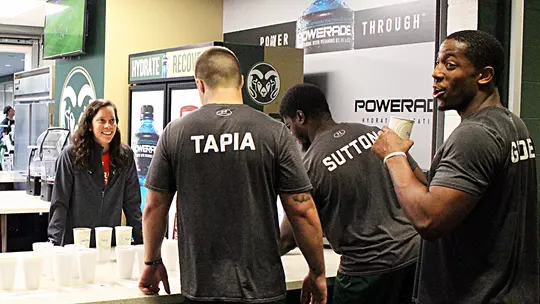
Eating Right
We’ve all done it. Stuck at home with a blown routine leading to extra time in the day, the thought of settling on the couch with a bag of chips or a sleeve of cookies and binge watching something on the television sounds pretty good.
It’s not exactly conducive to staying in shape, a fact Julie Sinkovitz, the director of sports nutrition, is stressing to the student-athletes. Hydrate. Eat correctly. Alter due to circumstances.
“The good thing about all of this is it kind of allows us to do a lot more education. What we’ve been trying to work on is doing more educational handouts we can post or send out to our teams,” Sinkovitz said of the work she and sports dietitian Sammi Gwin are doing now. “Most of our teams have a separate teams group where we can upload files. It has been nice to do stuff like that. I know a lot of what we’re trying to work on is mindful eating, because a lot of athletes have also reached out to say they’re bored at home and they tend to go to the fridge or go to the cupboard and snack on stuff all day.
“It’s being aware of when they’re actually hungry versus their just bored.”
Sinkovitz and Gwin have always developed menus and shopping plans for their Rams, and they continue to send out those reminders to the teams they work with directly. They also find they are answering more texts and email questions, keeping open a string of dialog with those they reach out to – or who reach out to them – for guidance.
They have also sat in on virtual team meetings to answer questions and provide tips on how to maneuver through the current climate, stressing mindful eating. It stems from the workouts student-athletes are currently doing lacking the same punch as those delivered by the staffs of strength and conditioning and the athletic trainers when at school. That leads to the alteration of what the staff calls the “performance plate,” with the ratios of carbs and proteins needing to be altered, as well as portion size.
They also touch on snacking, the amount, what’s being eaten and the time of day. If anything, simple encouragement not to attack the cookie jar, and specifically, stay away from documentaries about eating.
Being at home can present problems, Sinkovitz said, as mothers generally love to feed their children all of their favorite moods. No longer on their own budget, student-athletes are finding more food, and some of it straight from the “comfort food” section of Mom’s best recipes.
For some football players, Sinkovitz noted, it may actually be a blessing. For others, a constant temptation they don’t need.
“We’re definitely more concerned with any of our athletes who are trying to lose weight,” she said. “It’s a double-edged sword. If they’re home, it’s better for our weight-gain guys. They’re home, parents are buying them food, and they’re most likely going to have better meals. Vice versa, there are guys trying to lose weight, and the parents are making them their favorite meals because they’re happy their kids are home.”
What I try to get across to them is whatever you’re feeling is normal. So, if you have a meltdown today, that’s not something about your character, that’s something about your nervous system.Jimmy Stewart, CSU Mental Health Counselor
Mental Guidance
Everything has been altered, but it’s not the sudden change CSU mental health counselor Jimmy Stewart thinks of first. Instead, it’s the transitions we all are going through and how they affect the student-athletes.
No longer in class, they are learning on line. For many of them, living at home instead of on their own is a major change, especially since it wasn’t a scheduled break. The structure and routine of workouts is out the window.
Coaches have reached out to Stewart to sit in on virtual team meetings, allowing him to explain the triggers they are feeling and how to regain a bit of comfort for themselves. At each one, he gives out his phone number – then repeats it – stressing is cell phone will be on for them any time of day.
He stressed what they are feeling – whatever it may be – is normal. He goes over triggers, such as physical danger, unknowns, incongruence (mixed messages) and should/coulds.
“What I try to get across to them is whatever you’re feeling is normal,” Stewart said. “So, if you have a meltdown today, that’s not something about your character, that’s something about your nervous system. That’s what fight or flight does. It makes us meltdown.
“If you go put your head under the cover and sleep for three hours, that’s normal. You don’t have to stay there, and you can help yourself get into a different place of safety and connection.”
He offers up simple remedies, ones he uses himself. Cold water to the face. Pressure to the body, even if it means pressing up against a wall or applying pressure to the head. Taking deep, calming breaths.
And it’s not just student-athletes reaching out to him, but coaches as well, as he’s had conversations with program leaders on how to remain personally sharp for those they mentor.
For Stewart, the here and now is very real, but his eye is also on the future, when the quarantines are over and society returns to what we remember to be our normal lives. His outlook is his phone may ring more when that transition takes place.
In times of disaster, he notes there are four phases: Heroic, honeymoon, disillusionment and reconstruction. The heroic is happening now, and he sees it with the university doing its best to solve problems and find solutions. Stewart understands people don’t see washing hands and social distancing as “heroic” as actively participating in care, but he stresses the effects are equally important.
The honeymoon phase will follow the six months after, as people start to deal with the emotions of the quarantine; the disillusionment happens as people start to recover and feel strong emotions of anger and disappointment; followed by the reconstruction of all types, from emotional, physical and even economic.
“I think what we’re going to do is we’re going to find the after affects are going to catch up with us. A lot of times … In my experiences with Hurricane Katrina, which were different, but similar in the standpoint of transitions and changes, what you saw is people just mobilizing initially, and one of the escapes is we go into fight or flight,” said Stewart, who lived in New Orleans when the hurricane hit. “Part of it was mobilize and let’s go get it. The difficulty with this from an emotional-psychological human doing standpoint, is that this virus creates a feeling of anticipatory or impending doom, so to speak. We’re not seeing things we can fight and clean up. You’re sitting there and you have this impending doom, but it’s not something necessarily you can put your hands on and go fight in the traditional sense of the word.”
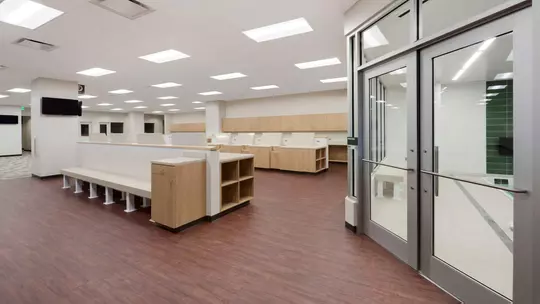
Physical Care
Regardless of the current situation, DeZeeuw and his staff had a full schedule of student-athletes they were treating. Some needed care for nagging injuries, others were on the road back to recovery from surgery.
The immediate concern was to make sure none of the crucial work came to a halt, so as to not impede the progress of rehabilitation.
“I really think our staff has done a good job of surrounding our athletes with the resources to help them with whatever condition they were dealing with,” he said. “Not only did we want to take care of the things we had to intervene with, because it was going to affect their outcome, but continue to support those needs which were ongoing and provide the resources we could.”
There are still a few athletes who remained in the area, and Colorado State’s sports performance group locked into the current health-care recommendations to continue the care. Schedules have been altered so there are not too many people in one place at the same time. Masks and gloves are worn, everything is constantly sanitized and treatment areas have been spread out so if there is more than one student-athlete being taken care of, there is not just proper, but an extra amount of work spacing.
For those who moved back home, treatment plans were set up with local physicians to continue the sessions which were being conducted on campus. In some cases, the athletes could follow their plans at home on their own.
For others, virtual treatment became an option. As DeZeeuw noted, the health and legal guidelines for those techniques require and extra layer of protection, which CSU’s staff has taken extra care to follow for the welfare of the student-athlete.
The plans for each individual differ, but he’s been impressed with the attitude of his staff and those they are caring for to meet the challenge at a time when it can’t be business as usual.
“We talk about it at our meetings, and we try to address problems that come up,” DeZeeuw said. “I really think there’s been a tremendous effort by everybody on board that I work with daily. I’m really proud of the effort that everybody has given, and their ability to connect with our student-athletes and try to provide the best possible support we can given a really unpredictable situation.
“It’s been challenging for everybody, but at the end of the day, you center it back to our student-athletes and try to do what’s best for them. I think they know that, and hopefully they feel it.”