
Getting it All Back Weighs on the Mind of Swimmers, Divers
Aerobic training can't be duplicated on land, nor can diving motions
Mike Brohard
She hopes the information was just a scare tactic ingrained to her in club swimming, but right now, Kristina Friedrichs is not so sure.
“I always had a coach tell me, take the amount of time you’ve missed in the pool, multiply that by two and that’s how long it’s going to take you to get back to where you were,” the junior from Woodstock, Ga., said. “It is a little stressful, because I don’t know the scientific facts behind that. I don’t know if that’s just something to scare us to get us to practice, but either way, it imprinted on me.
“I’ve been carrying that with me through all this, so that is definitely been on my mind a lot. I’m sitting here thinking I’ve been out of the pool for two, three months, I’m not going to be looking at improvements necessarily until December. That’s definitely stressful to think about for me.”
This may not help: Colorado State coach Christopher Woodard has heard it, too. He’s not sure he believes it fully, noting Rams legend Amy Van Dyken took off years, then in four months of training came back for a successful 2000 Olympic Games.
She’s also Amy Van Dyken. And swim coaches in general are notorious for painting pictures to encourage their athletes to make practice sessions in the summer, sometimes twice a day and on Saturday mornings.
The proven science Woodard knows deals with the aerobic aspect of his sport, and that’s where swimmers across the nation are at a disadvantage from their athletic counterparts. Roads have been open since the coronavirus pandemic hit and backyards have been available for soft toss or throwing around a ball, but pools are just now starting to unlock doors. Right now, it’s just in certain parts of the country.
The aerobics of running don’t translate into the pool, so putting in three miles around the neighborhood is not keeping in swimming shape. Research between the two sets of athletes has shown as much, a lot of which centers around the positioning of the body and water providing six-times more drag to the exercise. Because of this, research has proven the hearts of runners and swimmers react differently.
“Cardio on a bike or running doesn’t really translate very well to the water,” Woodard said. “There’s that element of being horizontal or dealing with drag. That’s probably the only thing that concerns me from a training standpoint is, even when we have kids depart for the summer and maybe they’re not super-serious about training, they’re never fully out of the water for weeks and months on end, and that can take a pretty heavy toll on their aerobic base. I think that’s the one thing we as coaches, Lisa Ginder and I, will have to deal with. How do we best reestablish an aerobic training base after months of not swimming?”

I’ll be honest, when we come in for that first workout, I likely will not have written up anything. I’m just going to get them in the water and see where we’re at. I think it’s more evaluation than saying this is our starting point.Christopher Woodard, Head Women's Swimming and Diving Coach
Swimmers will talk about the feel for the water, and getting that back isn’t as easy as sliding on the goggles, not after months of a break. They’re used to constant training, which builds up muscle memory for flip turns, streamlining and dolphin kicks.
Even if they are lucky enough to have found open water in reservoirs or lakes, there is no black line at the bottom, no walls to turn at and training strokes outside of freestyle will each have their own special battles against the waves. Even in outdoor pools, backstrokers can get lost in the clouds until they see the flags.
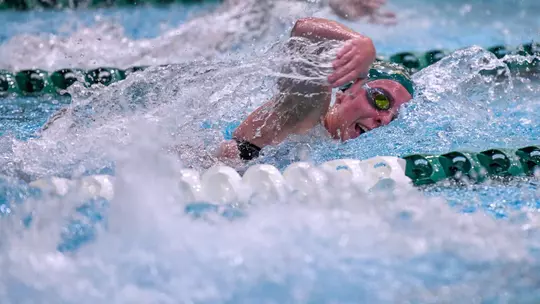
“Swimming, it just feels smooth and peaceful is how I think about it. I kind of zone out and all I can hear is my breathing and the water hitting my ears, feel the water as I’m gliding through it,” Friedrichs explained. “I think I just miss that. As hard as practices are with Woody, and as much as he does push us, there is that point in practice where you’ll hit and you’ll feel at peace and in your groove. I’m just completely focused on swimming and being there in that moment. I just kind of miss having that time to just escape. I haven’t found it anywhere. I’ve been running and doing at home workouts and workout videos and exercising with friends. None of it brings me that calm and peace and the feel of just gliding through the water.”
If there is a group of athletes who share the same longing, the swimmers can find the in their own locker room. Divers. Pools being closed includes diving wells, and again, one cannot just head to the backyard and simulate the same motions or training. If they’re lucky, they have a trampoline in the backyard to help ease the burden, but even then, not fully.
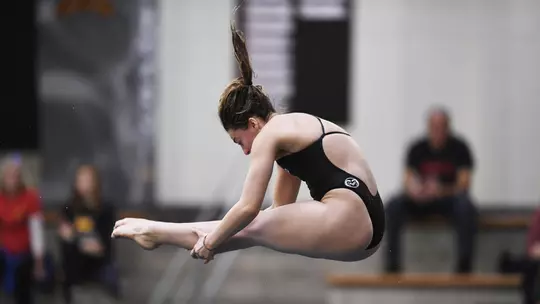
In a different way, sophomore Jessica Albanna is asking the same question as Friedrichs: How long will it take to get it all back? While the aerobic part isn’t at the top of her list, the motions and movements are. She ponders that from a physical and emotional perspective.
“I’m mostly worried about the mental aspect of diving, because it’s such a big part of it. I’m worried it’s going to be hard to get back to some of my newer dives back,” Albanna said. “Obviously I’ll be a little bit shaky when I first get back on the board, but I’m more worried about the mental part. Just letting myself jump off a board and do a back two and a half again, do the harder dives again. Just letting myself do that again, I’m worried about that.
“I feel like my body will know what to do, but my confidence in letting myself do that is probably a lot lower now. I’m sure it won’t be as easy, but overall, my muscle memory will still mostly be there. It will be whether I let me being scared get in the way of it. I’m sure like any other sport we’ll ease back into it and just do basics for the first little while, but I definitely won’t be able to do any crazy dives the first day or the first week I’m back.”
Which is hard to come to terms with for her. By the end of the season, she was starting to feel better about a few new dives she and diving coach Chris Bergere had worked on, and she was beginning to see some real results, or at the very least, gaining confidence and control in having them in her set.
The tougher dives, she said, require “thousands” of reps, in practice and during the pressure of meets, to gain the level of confidence needed to climb the standings. At the moment, she can “model” in her home, an exercise divers do before practice and meets, a chance to put their bodies through the motions of what comes next. Still, that doesn’t mimic the approach steps, and the floor is not springboard.
For now, she has her fingers crossed. Pools are close to opening in her home at Albuquerque, N.M., and her club coach has considered taking the team across the border for a training trip in Arizona, where the restrictions haven’t been as strenuous. In the meantime, she’s been able to take advantage of gyms opening to build up her strength.
She’s excited, and nervous for the moment of truth.
“I am. It’s definitely been very weird not having any sort of organized sport,” she said. “I’m excited to get back into a pool and get back on to the board. Im worried my knees are going to give out. I’m mostly excited about it, so it will be good.”
So is Woodard. He’s gone from worried at the start, to gaining some serenity during the stay-at-home orders. Naturally, he and his staff were looking at the hypotheticals of it all, then realized it was an exercise into madness.
He has no idea what to expect, so he’s stopped trying to visualize the first day. Even the first week. He always has a season planned out, at least what workouts will look like throughout the season. Normally by this time, the first weeks of sets would be on paper.
Now, he doesn’t see the point. Part of it stems from the wide range of needs on his roster. If he was say, a position coach in football, where the group is working on the same skill sets, it would be different. But in the lanes of the Moby Pool, he has athletes working on all or a few of the four strokes. Some of them are sprinters, some are distance swimmers.
Instead of a set plan for all, he now focuses on contingencies.
“We’re still working on a plan for the year, but knowing that can change, too,” he said. “I don’t want to spend all of our time coming up with four or five different options, because we have no idea what we’re going to be presented with. Let’s just think about what their needs are going to be and address that when we see them. Then continue to program them each week so we’re giving them things they can engage in.
“I’ll be honest, when we come in for that first workout, I likely will not have written up anything. I’m just going to get them in the water and see where we’re at. I think it’s more evaluation than saying this is our starting point.”
His swimmers are just as curious. Friedrichs started to look for positives, and she thinks they are helping. She understands she’s not the only swimmer out of the lanes, and she fully comprehends people in other walks of life are just as affected – if not more so – than she is at the moment.
She’s also looked at areas where she knows she lacks, such as kicks off a wall, and hopes the time away will give her a rejuvenated focus to improving. Yet, improving is still what has her the most curious.
How fast and how soon will she see it? Coming off the Mountain West Championships, where she placed in three events, reached the championship final in two and posted the fourth-fastest time in the 100-yard freestyle (50.07), she was eagerly looking forward to spring and summer training to build off the performance.
Now she’s just hoping her club coach was messing with her to get her to morning workouts.
“I definitely had big plans for spring training and even this summer,” she said. “The stuff I had planned, I was just really excited to carry that momentum already into the next phases of prepping for conference in 2021. It was hard to have that get put on hold and have no access to anything at all.”
Woodard is hoping for the same. He knows an aerobic base will have to be worked on, technique polished. Swimmers aren’t used to taking long stretches off. Growing up, August was their time away, four weeks between season-ending meets for long-course and the restart of short-course training.
What he does believe will happen is they will come back stronger in the mind. Those hard days in the pool will not seem so bad, not after so much time away. The scale of what’s a small issue and one which is big will be altered.
It happened for him already.
“I’m finding myself oddly calm about it, which is weird,” he said. “I have more faith that when they return, they’ll be so happy to be back in that environment and with their team, I think they’ll have more of an idea that minor things will not get in the way. This was a major thing that prevented us all, but minor things are going to be nothing. I didn’t have a good day, who cares, I get to swim today. I’m actually kind of hopeful this time off is feeding the fire for a lot of these kids to really be present in every situation that they’re at, and I think they will be.”