
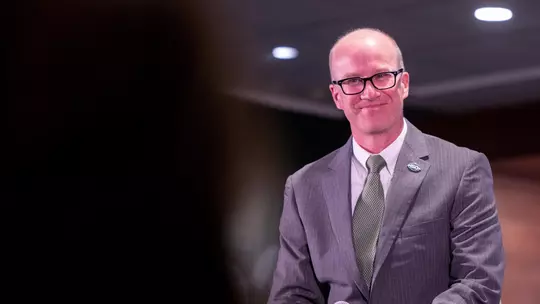
Parker Serves as Mentor in NCAA Pathways Program
Ukaegbu of TCU asked for CSU athletic director to be his guide
Mike Brohard
FORT COLLINS, Colo. – The first meeting had been scheduled, but out of the blue, it was preempted.
Joe Parker was on the line, about a week earlier than expected, and he just wanted to get to know Ike Ukaegbu a little bit.
“Joe on his own called me out of nowhere and we had a good, long conversation just about what we’re doing this summer, personal lives, that type of thing,” Ukaegbu said. “Before our first scheduled meeting to talk business, it just meant a lot that he just reached out just to check in on me and see how things are going. It further cemented his character, and in our first meeting, it was supposed to go an hour. It gets to 11:55, and I’m like, I feel like we’ve been talking for 15 minutes and an hour is almost over. I was bummed, because we had to wrap it up.”
Through the NCAA Pathways Program – a mentorship designed to help aspiring athletic department employees a chance to reach their goals of becoming athletic directors – the two had been paired together. Ukaegbu, the senior associate AD for compliance at TCU had a hand in who he would be coupled with, which DeeDee Merritt, the director of the NCAA Leadership Development staff, said sets this program apart from others.
When Ukaegbu was accepted, he was asked to produce a list of names to work with, and Merritt would do her part to match. Ukaegbu was told to think about people who led in the manner he expected to, somebody who would guide him with a management style which fit his personality and goals.
He’s worked with Texas AD Chris Del Conte in the past and with Jeremiah Donati currently, and both men suggested Parker, somebody Ukaegbu had met briefly a couple of times at Lead1 meetings.
“One of the most integral aspects of the program is the mentor part of it. The mentors are key,” Merritt said. “The Pathways participants get two mentors, an athletic director and a presidential mentor. One of the things we do is as soon as our candidate is chosen, I reach out to our DI people and start asking them about those qualities that they themselves believe they possess that would make them a good athletic director. Those same qualities, or some areas they’re looking to improve in, someone with a leadership style they admire in the profession so they can have the opportunity to reach out and work with that person potentially.
“What our Pathway participants will do is think about those things, but they also reach out to their peers, their current athletic directors and ask who is someone in the industry you feel is really making a difference in the lives of our student-athletes, who is someone I could potentially ask for the opportunity to work with, and Joe was that person.”
For Ukaegbu, Parker was his top choice, which the Colorado State athletic director was not aware of at the time.
What he has promised to Ukaegbu is to be an open book about his five-year tenure with the university and all he has learned to lead him to this point.
“I told him that I would be transparent, that if there was anything he wanted to understand better that’s happened in the last five years since I’ve been at CSU in the role of the athletics director, if there’s anything that’s timely he’s hearing about or learned about, if he wants to get a little more insight into why we made decisions and the way we’ve made them, I’m willing to tell him everything,” Parker said. “That’s what people have done for me in the past.
“The way you make (decisions) easy is to really focus on your values, trying to balance all the best interests of everyone involved. I told him I’ll give him as much as I’ve learned through the whole experience and who I’ve learned from, and I want to serve in that capacity for him.”
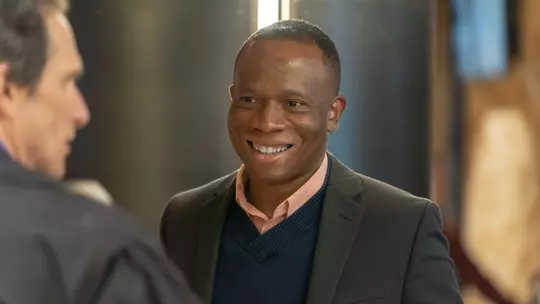
The way you make (decisions) easy is to really focus on your values, trying to balance all the best interests of everyone involved. I told him I’ll give him as much as I’ve learned through the whole experience and who I’ve learned from, and I want to serve in that capacity for him.Joe Parker, Director of Athletics
The Pathways program has benefitted the NCAA to great degree. Now 22 years old, annually it selects 20 candidates – 10 at the Division I level, 10 throughout Division II and III. Last year alone, six of the Division I participants had landed AD jobs before the program had come to the yearly conclusion.
They are scheduled to meet in person four times through the course of the year, gatherings centering around NCAA functions and seminars, giving the candidates an up-close view of how decisions are made by allowing them to sit in on governance meetings. The first scheduled meeting is for October, which is tentatively still on the books, but the virtual aspect of what everybody is involved with through the coronavirus pandemic is helping the participants remain in touch, Merritt said.
Ukaegbu was born in Nigeria and moved to Laramie, Wyo., at a young age. His father was the head of the international studies program at Wyoming, and was also a professor of sociology. As a youngster, Ukaegbu grew up on the Border War, serving as a ball boy for the men’s basketball team.
So Parker’s first step was obvious.
“We’ll have to spend some time deprograming him before we can really share the roadmap to his future,” he joked.
Why Ukaegbu chose Parker and what he hopes to learn from him over the course of the year was very much intentional. He has developed an ability to build relationships in his role as a compliance officer, which isn’t always the easiest task. He also sees himself as somebody with a cool and calm demeanor, traits he was told Parker carries with pride.
Already, Ukaegbu is thrilled Parker accepted the offer serve as his mentor. In Parker, he sees an athletic director having great success in managing a department in a style he hopes to emulate.
“From Joe specifically, I want to learn from him and get some guidance from him in regards to how to set a culture and how to create cultural expectations and how you utilize your personal values and have that impact with the culture you’re trying to set in an athletics department,” Ukaegbu said. “I’ve already had a couple of meetings with him – one was informal, one was a scheduled meeting – and we talked about cultural expectations and how he tried to set his culture. I found a lot of similarities in terms of how he and I think. He explained shared leadership, for example, and how he operates through this shared leadership model. That’s how I operate now, that’s how I expect to operate if I’m ever given the opportunity to be an AD.
“That along with how to handle crises, how to handle any type of chaos and how to be resilient. In terms of meeting him and what I’ve heard about him and how he handles people, how he handles issues and keeping a calm demeanor and temperament, I really admire that type of leadership.”
To the student, this carries greater importance, as both of them are keenly aware this year’s classroom will be like no other in the past two decades of the Pathways program. As part of his research, Ukaegbu talked with former Pathways participants, many of whom told him it was “transformational” for them. Yet, many of the conversations in the past in dealing with chaos or crisis were all hypothetical.
At this point and time, they are very real. The COVID-19 outbreak has created a myriad of layers of challenges for athletic departments to navigate. This summer’s push for social justice – with many of the student-athletes they serve becoming active participants around the country – has added to the conversation on campuses nationwide. Parker said the education which stems from their partnership will not be one sided.
“It’s certainly not the typical opportunities and challenges you face with when you’re dealing with a pandemic and the focus you would place, and rightfully so, on race and social justice,” Parker said. “It’s a unique lens to be looking through this year at. I look forward to learning from him. I think that’s what’s really cool about this program is obviously we have people of color on our staff, but it’s a nice opportunity to really open up a relationship, and I look forward to the end of the year and have a deeper understanding of who he is as a person and the experiences he’s had.”
Already, the two men have discussed how both of their departments are mapping their paths and how their personalities and departmental cultures are shaping the decisions being made. Ukaegbu has seen Parker remain steadfast in his core values and beliefs through an important time.
The resiliency and resolve Ukaegbu has seen in Parker already has him excited about what he can learn this academic calendar.
“He gave me such valuable advice, and we talked about cultural expectations and his idea that everyone is a leader,” Ukaegbu said. “With me being a compliance person, he also let me know as part of his culture he expects everybody to know and follow the letter and spirit of rules. He expects people to collaborate when it comes to decision making, because that produces the best results. He talked about how he promotes teamwork and brings energy and passion and just a shared leadership. A lot of what he talked about honestly is right on point with how I feel, what I believe. That’s how I hope to oversee an athletic department someday.”