
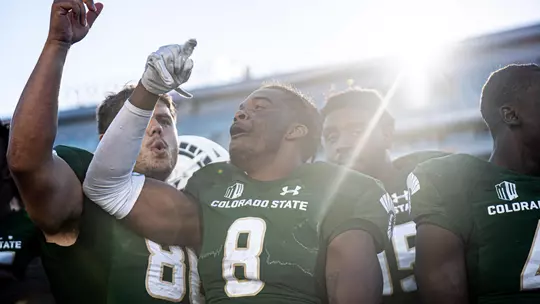
Francis Continues to Grow Through Life Experiences
Safety feels shaped by his past; excited about what the future will show him
As a kid, what you know as normal is what you see everybody else doing.
Packing up the car and moving to Georgia for a spell, that was normal for Tywan Francis. By the time he was 5, he was leaving in a caravan with his family and friends, about 13 cars in all, heading out of the New Orleans area to beat the storm.
Hurricane Katrina was so destructive, that wasn’t the end. Before long, he and the rest of the family were on their way to Houston, now a member larger, as his mother, Laura, gave birth to his younger brother, Arnold Barnes.
It’s what everybody was doing.
“At the time, I was so young. It was kind of like a road trip for me and my cousins,” Francis said. “I reflect back on it, and not too many people have had it like that. It was really a movie. In my life, I felt that was normal. I thought that’s how life was supposed to go. That’s all I was seeing. Everybody around me was experiencing the same thing. That’s how we grew up.”
But it does change a person. In the moment and over time. Because the effects of Katrina were with him and his family for a long time. The storm didn’t just move through the area, it uprooted lives forever. It destroyed houses and lives. It uprooted families.
Even now, he can still see the pictures in his head. Six to seven months after leaving his home, he returned. His house was damaged, as were most of the places the rest of his family lived. So his stepfather, also Arnold Barnes, a construction worker, did what he knew he had to, and he took two of his sons with him.
Francis and his brother, Erksine, as well as a cousin, Ivan, had never seen their home in such disarray, nor had they seen death so close up. As they worked, the Red Cross came around and gave them food, water and moral support. Not everybody was doing it, but a lot of people were.
“Some job we were hired, but most of the houses we did were for family members and friends. That’s what most of it was. That was us taking care of our family,” his stepfather said. “Katrina was a different story. That was something I had never seen before, so it was something they’d never seen before. We had a lot of storms, but they were smaller. And my wife was pregnant, and we had our baby son Arnold in Georgia. She was due two days after Katrina hit.
“At that time, I was doing construction work, so I came back home and started to do some work. I used to take them on the jobs with me so we could gut out houses. I had them doing the kitchen, stuff like that, bringing the trash to the front. I started them pretty young, learning how to make money and trying to make a living for themselves, so he would have the hustle in him to get what he wants.”
Teammate Mikell Harvey is the one teammate Francis has who really understands. The two first met early in their teens and played sports together in Slidell, La., and when the storm him, Harvey and his family went in another direction, to Lafayette. They stayed in a hotel at first, then in a trailer home. They didn’t return for more than a year.
“We went through something a lot of people don’t know what it’s like to go through,” Harvey said. “We were away from home, and he told me how he and his dad worked, saw dead bodies. You get a different side of things, you’re grateful for a lot of things, and that’s something we both cherish and realize.”
In a way I’m blessed, but in some eyes, I may not be. Me, the things I’ve seen have prepared me and shaped me and given me tools for life not a lot of people have.Tywan Francis
Francis certainly does, and some of it has taken some time to fully embrace. But what he learned when he was younger, he still holds close to his heart.
The work he did after the storm, he appreciates it all. The work ethic it developed at a young age is a definite plus. Along the way, as he helped clear out the trash as the floors and walls in his home were repaired, he held tight to the messages Arnold kept repeating to him.
“Your input is your output.”
“How you do anything is how you do everything.”
“Even around the house doing chores, we couldn’t half do anything,” Francis said. “My mom was like that, too. If you washed dishes and you left a smudge on a plate and went to sleep, then you were getting woken up and cleaning all the dishes again. My daddy would take us on jobs, and he was getting paid, so he was hard on us. My parents were tough on us, but I applaud them. They prepared me for a lot of stuff.”
He was also prepared for something new, which he found at Colorado State. Having grown up in Louisiana, Francis was ready for something new. He craved new. Not just a place to live, a different school, but experiences he had never had.
His story is different, he knows. Not just because of Hurricane Katrina, but where he lived. Going somewhere different was going to expand his horizons, not just through what he saw, but who he met.
He understands his childhood helped form him. He also knows he’s not yet complete. He called it an 80/20 split – what he’s already seen and all which still awaits him.
“I feel everything I’ve seen and been through, in a way I’m blessed to have seen the things I’ve seen, because I’m more aware in a lot of situations in life,” he said. “In a way I’m blessed, but in some eyes, I may not be. Me, the things I’ve seen have prepared me and shaped me and given me tools for life not a lot of people have. My experience in childhood was different from Jack (Howell) and Henry (Blackburn). I know things they don’t now, and they know things and have seen things I haven’t. It’s constant learning.”
True to form, football has had the same effect on him, and now he’s seeing the benefits of learning to clean up and move forward.
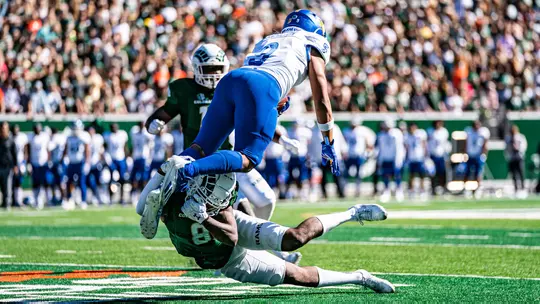
He has started four games at safety this year, the four games he’s been healthy. He stands second on the Rams’ list of tacklers with 30 and has forced a fumble this season. Reaching the point hasn’t been easy for him, and it’s taken an ability to grow as a player and a person, sometimes in equal measure.
He had started a few games in the past, played some safety and also some nickel, but he had never been a regular on defense before this season.
“You can’t get discouraged. I’ve been here four years, and it’s my first time with a legit role,” he said. “I felt like I had a lot to prove. Not to everybody else, but to myself. There was a time I was told I was a bad tackler, so I went out there and had to handle my business. Whatever else they tell me I can’t do, I’ll work on it. I’m trying to become a complete player. People have been saying there are things I can’t do, so I took it personally, so I got to the point where there is nothing out there I can’t do. That’s how I approach things.”
When the coaching change at Colorado State hit, Francis played with the idea of leaving. He had other teammates exploring other opportunities, but to him, it all meant doing the same thing – proving himself at Colorado State, a place he had come to like, or somewhere else. Either place, same process.
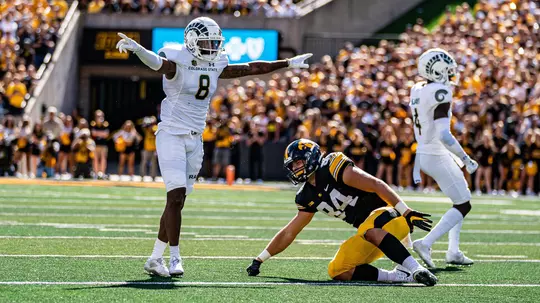
So he stayed. Coach Steve Addazio wasn’t sure if Francis would adapt, but he loves the person and player he is, so he was rooting for it to take hold. Now, he’s enjoying the payoff as much as Francis.
“He’s come a long way,” Addazio said. “Here’s the deal. He loves football, he loves ball, and he’s highly competitive. That’s where love and trust comes in. I feel like, me personally, I have a really good relationship with Tywan. He knows I love him, and I respect his energy and his passion for the game, and I think he also knows I’m going to call him out on some of the little things. I don’t want to take his passion away, but some of the stuff, you want to grow up a little bit with and get out of there. He’s come a long way with all of that.
“My sense would be he’s quite happy, and he understands and trusts us in his development. I think you’re seeing him develop into a heck of a football player here.”
What Addazio loved was the energy Francis brought to the field, even in practice. He admired the work habits he had, but sometimes the blend of the two with a New Orleans flair didn’t always mix into the defensive system.
Harvey saw it, but he understood it, because players from his home have heard it before. It still brings a smile to his face. The way Harvey explains it is the energy is different back home, and sometimes it is perceived as immaturity. It was with the previous coaching staff, too. Harvey also knew his friend had to hone it in, and he’s seen it happen.
“I would say his hunger has gotten stronger every year,” Harvey said. “He’s chasing his goal to make it to the NFL, and he focuses in on it every season. He’s exact in his progressions, he works hard in the weight room and he’s always watching film; he always has his iPad with him.”
Francis is happy for his teammates who left and found success, the same way he’s proud he stayed to work through the changes in Fort Collins. While he is pleased with his progress, he continues to focus on where he needs to improve.
He has embraced the message of both Addazio and defensive coordinator Chuck Heater where self-reflection can lead to his greatest improvement.
“There are still a lot of things I can do better. It’s a work in progress,” he said. “Like Coach Addazio says, you have to attack each day, but you have to look yourself in the mirror and see what you do wrong and what you do well. Your flaws will hurt you. You have to be mature enough to admit you have flaws before you can fix them. Coach Heater tells us all the time, you have to know there’s a problem to fix the problem. I’m trying to make sure everything is clean, that I’m in the right spot, my eyes and communication. That’s just pre-snap. Then post-snap, I have to make sure I’m flying to the ball and tackling with the right fundamentals and my technique is crisp. Those are things I’m honing in on as we practice, so in the game, you don’t have to think about it.”
Part of the reason he came to Colorado was to see and feel things he never had in life, then be able to go home and share them with his family. He’s been to states and cities he never imagined he would visit, and he hopes someday his mother can come out, too.
Until then, they are his stories to share with them, which he did the last time he was able to head home. While he was there, his stepfather gave him another uplifting message: He was proud of the young man he had become. His son was now somebody who inspired him.
“To see his progression, to see he has his head on his shoulders to where he knows what he wants to go after, and to see where he came from as a little boy to a young man -- staying out of trouble and loving his family and having goals -- it’s been wonderful,” he said. “It’s very important, to know how to value life. That’s all I’ve been trying to teach them, to value life. Tomorrow is not promised. You have to go fight for what you want to be, because tomorrow is not promised. He knew all those values.”
The 20 percent Francis references still has plenty of empty space to fill, the way he views his life. Eventually, he’d like to go home, to be able to make a difference. But now is not the time, and probably not right after college. There are still places to visit, feelings to overcome him and experiences unknown to him he wants to embrace.
Football holds the same promise. He has so much to learn to become a better player, to make the plays he seeks out each and every game. His growth has not gone unnoticed, not as a player, or as a person.
Both parts of him now have a new normal, which he finds wonderful. He’s experienced death, as both his birth father and an uncle were shooting victims. He’s seen crime in his home town and suffering in those streets.
“Anything you can think of, I grew up seeing. Everything you’re supposed to be afraid of, that’s the norm where I grew up,” Francis said. “When I came out there, I was like, I don’t have anything to be scared of. I can’t be scared of my potential either. You have to embrace that. I feel everything I’m supposed to be scared of is behind me.”
Here, his normal has changed. At Colorado State, he’s learned to look forward with anticipation.