
One Time. So Much Meaning
Hamer's All-American run puts him on country's grandest stage
One time. So many layers.
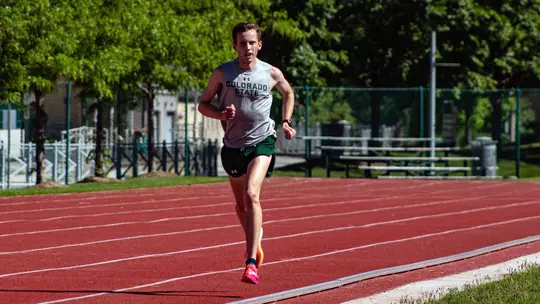
As he peered through wet eyes at Hayward Field in Eugene, Ore., Eric Hamer had little time to digest exactly what the 27:44.87 meant at the close of his 10,000-meter run at the NCAA Track and Field Championships on a Wednesday evening.
Truth was, he really couldn’t see the board clearly.
The time made him an All-American with his fifth-place finish. It also represented a school record, one he already held, but lowered by 24.08 seconds in a nearly ideal setting to run such a race. By being south of 28 minutes, it also meant he had qualified for the upcoming US Olympic Track and Field Trials, to be held on the very same track later.
All impressive on their own. None of them even close to being the first thing which caught Hamer’s attention.
“At the end of the day, it’s my PR. It’s my time. It’s what I did in college,” Hamer said. “The implications carry across a lot of different things, but I get to leave a really sturdy mark on CSU in those books, and that’s pretty cool. I like that was always the goal. It wasn’t, ‘Eric, go qualify for the Olympic Trails.’ It wasn’t, ‘Eric, go get this place.’ It was, ‘Eric, go run as fast as you can run, and then when you finish the race and you look at the time you get to think it means all of these other things, the extra bonuses.’”
Rain had hit Eugene through the championships, and it was there for his race. One never knows how a race is going to play out in these settings, not until the gun goes off, and right off the bat, this was going to be a quick pace. That had Hamer excited.
As it played out, he knew a lot of good things were going to unfold, and with two laps remaining, he took a peek at the clock, did some quick math and a confidence pulsed through his body. But when it was done, he was spent. He felt like he was trying to wake up. He was fighting the urge not to throw up, which he had told his trainer the day before he had not done in a long, long time.
It was fast, that he knew. How fast, however, was crazy. And his mind and eyes just couldn’t focus in the moment, but his coaches could, and Art Siemers and assistant Andrew Epperson were ecstatic.
“Place is always the No. 1 thing for me at the championship meet; that’s just how it is,” Siemers said, and Hamer became his first top-eight finisher at outdoor nationals. “He knew that, and he was trying to race to get as high as he could. But once the pace was fast, we knew some big things were going to happen and he was going to make the Olympic Trials unless he fell down with a few laps to go. We knew the time was pretty special.”
The night before, Epperson had Hamer registered for the US Olympic Trails -- held June 18-27 – just in case. Hamer’s race is the first night, this Friday at 8:25 p.m. (MT). But he didn’t know he had qualified until his coaches actually told him.
It wasn’t a time standard he’d been chasing for the past couple of years. There were always other things and times on the list in front of him, and it has somewhat been that way for him throughout his career. Such as when as a prep he qualified for the World Championships in cross country. Or qualified for indoor nationals the past two seasons, placing second in the 5,000 this year.
The Olympic Trials were not on his radar, but not chasing times felt like a regret, if just for a moment and only very briefly, this season. He saw other collegians chasing times at meets in California, and wondered why his coaches didn’t have him doing the same. He felt a tinge of a grudge setting in for a spell.
He had gone to California once with that purpose, but the race didn’t pan out. The rabbit out front didn’t hold a pace very long, and in turn, Hamer had to lead the pack himself, which is a tough ask.
But there was a plan, and Eugene was also a big part of the equation.
It was important to Siemers, who said good things couldn’t happen to a better person.
“We knew at Eugene, the weather tends to be a little more conducive to fast times in June as opposed to pretty much anywhere else they would have the national championships,” he said. “We knew that possibility was there. If it was in Austin., Texas, like it is periodically, he’d have no chance. We knew that, and we knew with COVID-19, we had restrictions on how much we could travel. We took him alone to California, and we thought that race would be better than it was.
“We tried to give him a good opportunity, but after that, we knew it wasn’t worth it to chase times when you’re trying to run a 5K-10K double, which is one of the toughest doubles in track and field. And you have to do it at the conference meet to help the team win, then you’re going to do it at (NCAA) first rounds to try to qualify and do it in the finals. We know it takes its toll, and with traveling and COVID-19, so we just made those calculated decisions and hoped for the best. The stars aligned for him, which is awesome.”
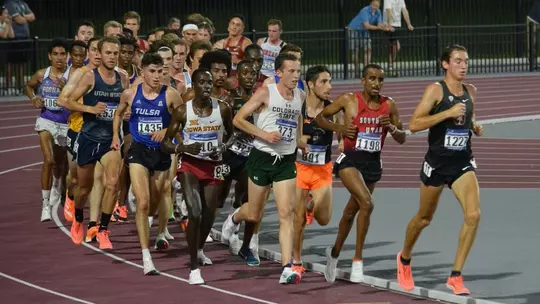
You’re wanting to be competitive and you want to be on the front side of that pack, but you want it to be hard, you want it to be fast, because it’s the U.S. of A.Eric Hamer
Hamer knew what the plan was all along, and he wanted to do well at the Mountain West Championships as the CSU men were chasing back-to-back titles. Hamer did his part, being named the male athlete of the meet after winning both the 5,000 and 10,000. Then it was off to the NCAA West Preliminaries, where he ran the same two races to qualify in both for the NCAA Championships.
Where he ran both races, adding a 14th-place finish in the 5,000 to double up on his All-America honors.
Because the goal was to get him to peak there.
“The thing was, they were preparing me for the meet that mattered, knowing if I showed up and raced the race it would all take care of itself,” Hamer said. “That’s just the mental game of the athlete.
“It was a matter of remembering we wanted to get through it, and I was going to do a double there, and regionals and double there, and I even wanted to double at nationals and do the 5K as well. It was going well, and the coaches saw the bigger vision the whole time.”
Now, Hamer has to jump back into his head once again. The NCAA Championships were the target, as big races always should be. The fact it earned him a trip to the Olympic Trials is a bonus, but with the turnaround so quick, he doesn’t have the chance to build up and be in prime form at that race, too. It’s an impossible task, and Hamer’s smart enough not to play the game.
But the trip, which took some finangling to arrange on short notice, holds plenty of purpose. With places to stay booked long in advance by many, Hamer was fortunate to have a family of a college friend, Dylan Austin, living close by and ready to let him stay there with them, cook his meals and get his needed rest.
That helps, but as for the training, being at his best so soon after a key meet is likely not in the cards. So Hamer is shooting for the best he can be under the circumstances. He was afforded one really good workout this week. Other than that, eat well and rest accordingly.
“It’s remembering a couple of things,” he said. “It’s remembering at this point nothing I can do will necessarily make me any better. There are no more hard workouts, there are no more 100-mile weeks, there’s nothing like that. It’s being very content with where I’m at fitness wise, and I can invest in things like sleep, eating well and just relaxing.
“Another thing to remember is the NCAA Championships was always the goal. While the pros and the non-collegiates have had the opportunity to build up for this race and prepare for this race and have the nerves ready for this race, the best case scenario for the college runners was we were going to peak for the NCAA and that was the goal. I don’t have to feel – I don’t know if guilty is the right word – just being, ‘oh, shoot, I’m going to this race and my preparation could be better.’ I can be, ‘no Eric, everything you’ve set out to do, you did it perfectly and this is a bonus.’ Just enjoy that.”
He won’t be the only Ram there, or the only Ram vying for an Olympic spot. Former Rams Marybeth Price (Sant) will run in the 100 meters, and Hunter Price will compete in the decathlon.
Fellow teammate Lauren Gale was invited to the Canadian Olympic Trials, but due to pandemic protocols, will not compete, yet still has an excellent chance to make the team, which is selected on prior results. The same is the case for throwers Shadae Lawrence (Jamaica) and Mostafa Hassan (Egypt), both of whom have hit the Olympic standard for their countries.
Hamer’s sights have long been set on running professionally after his college career, and the Olympic Trails are the best place to put that in motion. Friday, he will be in an elite field, the best group of 10,000 runners the country can assemble, and Hamer’s name is on that list.
That means something to him. Siemers hopes it will help to earn his pupil some sponsorship opportunities. Hamer knows seeing the best the country has to offer gives him an exact target of who he is chasing in the future.
The end game is to become the one being chased. This is not that time, but the experience will become invaluable.
Even if this is not the perfect set up, Siemers knows Hamer is ideally built for these situations
“The great thing with Eric, even when he’s a little off his game, he’s so tough and he doesn’t quit,” Siemers said. “It’s easy for people to say their tough and I never quit, but to actually do that on a consistent basis … he does.”
So from his living room at home, Siemers will watch Hamer run his race and look for signs. Primarily if he’s enjoying the process. That will mean Hamer is running with the front group, especially in the first half of the race. That will tell Siemers if Hamer is enjoying the moment, and that his competitive juices are working.
Because perfectly primed or not, Hamer is not looking for just an experience or a participation ribbon. He’s not looking to win, but he’s definitely out to compete. He is expecting – craving, really – this race to be his ultimate test, especially for those reasons.
“You’re wanting to be competitive and you want to be on the front side of that pack, but you want it to be hard, you want it to be fast, because it’s the U.S. of A,” Hamer said. “What I’d like to get out of it, which is the same thing I did my entire college career, I wanted to see who the best was, then I could set my sights on what it took to be that good. That’s what it meant to have good teammates, and go to nationals and get roughed up a little bit. You want to have no illusions of what it takes, so when you get to run in a stacked field, everybody is both looking to do their best and be the best. If we have a healthy sense of developmental reality, we’re looking at the guys who do have the Olympic standard and going to be making these teams and be like, ‘alright, that’s where I want to be.’ I’m glad I have them to get there.”
When he looks up at the board this visit, his reaction will be much the same. Whatever his time may be, it will once again leave one of the most decorated distance runners in Colorado State history with so much to consider.