
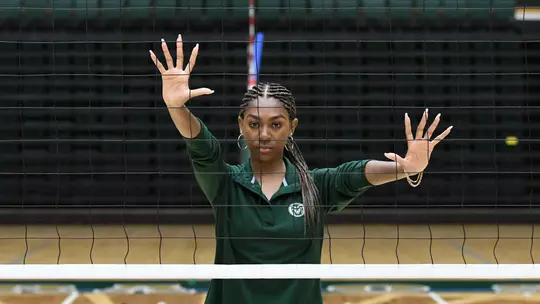
No Longer on the Court, Boles Remains Part of the Team
Ailment sidelines a promising career, but not her drive
Sometimes, the hardest conversations to have are the internal ones. Getting your head straight to what logically is the right thing to do while the heart continues to intensely oppose the notion.
Diagnosed with lupus at the age of 13, Madison Boles said she used the sport of volleyball to hide everything. How it derailed her auto-immune system. The pain in joints and muscles, the disturbances to her blood stream. The better she became at the sport, nobody would ever think she was dealing with a serious illness. So she shined at Life Christian Academy in Tacoma, Wash., and for her club team.
The mask was secure, and nobody really had to see what was going on behind the scenes.
Colorado State coach Tom Hilbert recruiting her because he saw a vast potential, understanding she was going to have to be developed. She was a smaller outside hitter, but she could rise above the net and displayed a fast arm swing. As part of the plan, she redshirted as a freshman in her first campaign in 2019.
But then COVID hit the back half of her freshman year and she went home. Gyms were closed, making it difficult to do the things she knew she had to do to be physically prepared for the demand. And the demand at college was definitely greater. Practices were more frequent and intense. She was a full-time student-athlete being pulled in multiple directions.
But the first year, she was coping. Returning from the COVID break, her body wasn’t prepared to just jump back in to the workouts. Then she was diagnosed with the virus, and months later her body was still fighting off the effects, impacted more by the auto-immune struggles due to lupus.
And it led to her missing practice. Not just a day or two at a time, but weeks, and Hilbert was growing more concerned.
“It became a deal where there were constant flair-ups and then she’s going to miss three weeks. It became evident halfway through her second year it was going to be a challenge and she’d have a hard time thriving,” he said. “She needed development. She wasn’t a kid who comes in and plays right off the bat. I never questioned her ability or desire to grind, she wanted to do it, but it just wasn’t happening.
“Every athlete wants to look at a situation and go, ‘I’m contributing what everybody else is contributing. I’m able to do what they’re doing.’ I don’t think they want to be held back. I could tell that was creating anxiety for her and creating mental health issues. It’s hard.”
So they talked, and then Boles had to have a heart-to-hear with herself.
To her, it wasn’t just giving up her jersey, but a way of life, her routine she had built. There was the team itself, what she called a community of people she did everything with, on and off the court. Those friendships meant the world to her, and so did being a teammate.
She was going to feel a vulnerability.
“I felt for me I had to do a lot of self-reflection about who I am outside of my jersey,” she said. “It wasn’t that I allowed the program or the sport to become that, it’s because so much the sport did for me health wise it became such a mask for me to cover my illness that it was like if I let go of that then I was exposed. This year was such a disturbance.
“I couldn’t practice, I couldn’t finish, I couldn’t even get through warmups. That messed with me mentally. They were literally seeing what was taking place even though I told them things would get better. Once I let go of volleyball, I didn’t realize how much of my confidence I left with that.”
It’s such a phenomenal program, because you see the change in the individuals coming in every year. It’s touching and it’s huge to be a part of it.Madison Boles
Alyssa Bert was her roommate at the start, and now is again. Watching it all take place broke her heart, but she never lost sight of the fighter in Boles.
Bert knew deep down her friend was trying everything she could to avoid what was becoming obvious, and that only made it harder to watch.
“It’s heartbreaking, because you can see how badly she wants to be able to do the workouts and the practices,” Bert said. “Even before she retired, it was hard all the time to see – not just your teammate, but your friend – not be able to physically do things and really want to.
“Maddie is a tough cookie, and she doesn’t want to show anyone she’s struggling, and out of anyone, I’m probably the one she shows that to most. It was becoming a trend for her to get sick and better and then sick and better. It was a recurring thing.”
For a player who needs practice, taking two steps forward then 10 back is not a path which works. Physically it was demanding, and if that was all she had to counter, it would have been easier. It just wasn’t that simple.
She was feeling the anxiety. Boles has always had to be well organized to deal with her illness, sticking to a strict diet, getting in extra warmup before practice to prepare for the demand of practice and requiring more sleep than the normal person.
She feels she made a mistake to try to place volleyball first at Colorado State. In turn, that eventually had her putting more pressure on her role as a student, and trying to keep up with everything started to take a mental toll.
When she and Hilbert sat down and spoke about the obvious, she was still trying to find solutions which were not there, already knowing she was taking a high dose of mediation twice a day. And what hurt her most was exactly what Hilbert expected.
“I kept pushing backwards. The frustrating part was I was becoming unreliable,” she said. “I’ve never had the feeling a coach or teammate couldn’t rely on me to be present or to finish, to be the power I was used to being.
“Not being able to be a part of that was very uncomfortable. To really know I wasn’t in the mind we can trust her and she will be present, that was tough for me.”
So she talked to herself, and listened to her body. Her heart finally came to terms with the realization. What she did find in her decision, eventually, was peace.
And together, she and Hilbert came up with an alternative route for her volleyball career. One of team manager.
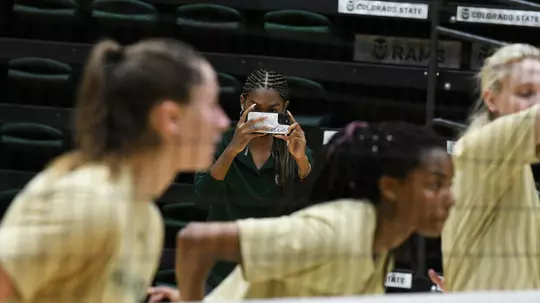
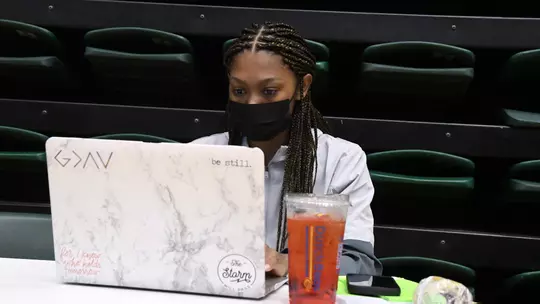
She helps with everything. She will chart drills. She handles the Instagram stories for the team. Behind the scenes, she’s learning what the staff does to organize practices, meals and road trips. She seeing a different side of volleyball, and as a former player, Hilbert feels it’s an ideal setup for all involved.
“I think it’s beneficial for a number of reasons. No. 1, she wants to be involved. We want to help her be involved,” he said. “No. 2, it’s good for a player to get the perspective of what’s happening on the coaching side and the organizational side. She still has friends on this team, so if somebody starts complaining about the restaurants or the hotel, she can be, ‘hey, that’s not easy to do.’”
Bert said no one really looks at her as a manager, but still as a teammate. They see her courtside behind a computer, or they see her taking videos she’s going to post. She’s good at it, too, Bert says, and her understanding of the team and the sport makes it even better.
Most of all, she’s thrilled to see her friend happy and not fighting herself.
“I was huge on making sure I would ask the players and my teammates, what is Maddie doing, making sure she’s going to be here,” Bert said. “She deserves to be here, because she works hard and she deserves a role on the team. She seems happier not having to stress about the physical all the time.”
This isn’t what Boles envisioned for her volleyball career. As a freshman, she was already looking forward to having a senior year, of playing a role in the program’s success. Initially, when hanging up her jersey, she figured all of that and even more was gone.
What she has in her new role is a way to hold on to the aspects of being part of the Colorado State program she sees as the most rewarding, well beyond wins and championships. The details which fulfil a person’s life journey.
“What I’m cherishing most is the character development and the freedom, the freedom and the joy this sport brings to young women,” Boles said. “There are so many life lessons that these girls have already learned within a year, these freshmen becoming sophomores. What the seniors and juniors have learned. Just being able to be present and to see the smiles and the joy of it, and to not have pain in it, is amazing to me. Having the ability to come back was exciting, because I know I can still bring something. It’s such a phenomenal program, because you see the change in the individuals coming in every year. It’s touching and it’s huge to be a part of it.”
This year, she can go to class and not feel the stress. She doesn’t have to be anxious about what practice will do to her mentally or physically. Boles can focus on her classwork, eat properly and get the amount of sleep she needs.
She can do all of that and still be part of the Colorado State volleyball team. She can cheer with every “Point Rams” at a match and feel she was in some way part of making it happen.
She has her friends. She has her teammates, which is a really good feeling for her to carry. She didn’t want to give it up, and she most definitely didn’t want to be forced into that corner.
“I’m thankful. I wasn’t ready to leave,” she said. “I know I never saw the court, but the people, the community, the culture, there is just so much that I love about it. I saw myself grow as a woman, as a person, as an athlete, but also how loving they are. It’s a family. Coming here, you feel the love they bring.”