
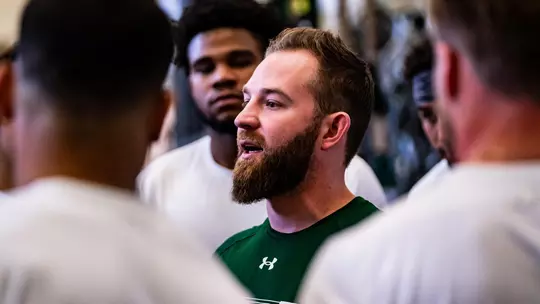
Simmons Includes Himself in Transformation Process
Relationships help strength coach build the overall person
His job is all about transformation.
Getting football players stronger. Faster. More explosive. That’s just the physical part. With as much time as Jordon Simmons and his strength and conditioning staff will spend with the Colorado State football team, the mental component is just as vital.
They will instill discipline and dedication. Simmons will ignite the spark which leads to developing leaders for the team. The overall goal is not just to make a player look good in the mirror, but in the locker room, on campus and in the community.
Complete the person. Complete the player.
What Simmons found early in his career was transformation could not be limited to the student-athletes. He had to take part, too.
“It’s interesting year after year, I watch myself change, too. When I got here, I wanted the players to know from the very beginning that I wanted to know them and that it was a two-way street,” Simmons said. “We talk about respect and accountability and hustle all the time, and I think a lot of times staffs, coaches, individuals, will talk about stuff a lot, but they don’t show it; it doesn’t come across in their actions.
“I told the players from the beginning, this is going to be a two-way street. It’s going to be a transparent process. I’m going to hold you all accountable and you do the same to me. I don’t think you can do that, and I don’t think it can be received and reciprocated if you don’t get to know them first.”
When Nevada took a chance on Jay Norvell by hiring him as a first-time head coach, Norvell did the same with Simmons. They had a background from their days at Oklahoma, but Simmons had never been the man in charge. He learned from some of the best, including his father, Jerry, who spent more than two decades in the role at the NFL level.
He absorbed knowledge from all of them. He carried some of those aspects forward, discarded others, creating a philosophy and system which is always under construction. He grows with the times, as well as with the players. His face will remain constant; those of the athletes he works with will change annually.
Norvell wanted some specific characteristics from the man in the role, and the bond between the two has only grown.
“The most important thing with our strength and conditioning coach is I wanted a coach. I didn’t just want somebody to make somebody lift weights,” Norvell said. “That position is so critical, and Jordon’s role is so big, because he spends so much time with the players. I wanted somebody in that position who had the qualities of a coach, who was teaching them discipline, teaching them accountability, because those are the core foundations that will help develop our team when we play the game. I wanted somebody who was really demanding with the players to focus on details. That’s what we get with Jordon, and his role has really grown over the last five years with me. He’s really instrumental and become our assistant head coach and our leadership development, as well. That where I think he’s different that most strength coaches.”
The players will tell you it’s where Simmons has changed the most.
Gray Davis, an offensive lineman with all-conference accolades, followed Norvell from Nevada. He will be a graduate student and has been under Simmons’ guidance nearly since the first day, coming in during the summer after the initial season at Nevada.
The man who inspires him now is not the same person he met as a true freshman.
“That first year I had him, he’s what most people would imagine is what is a stereotypical strength coach -- he’s gonna yell and get on you and try to motivate you by getting on your butt, but there were a few guys at Nevada who weren’t receptive to that,” Davis said. “That’s when he started to do more individual conferences with people. I swear, since he’s first started, he’s changed his philosophy every year, more to suit the player and what’s going on to get the best out of them.
“He started those meetings my second or third year at Nevada, but every year with those meetings, he’s able to more fine tune what he’s looking for from us to get the most out of the players. I can only speak to my meetings, but I can tell in my meeting alone he was really interested in me as a person, what makes me tick and what motivates me versus what will make me shut down. Some coaches overlook that. They think it’s their way or the highway, but I know he definitely makes you know he cares about you and what matters to you in those meetings.”
I’ve seen enough over the previous five years, I’ve seen dudes make great transformation. If they buy in, he’s got to some good stuff in store for them.Gray Davis
Davis said he’s had coaches who didn’t exactly inspire him to set the alarm for a time before the sun appeared and make him want to jump out of bed to work. He’ll do that for Simmons. When he goes to the facility early in the morning, he does so feeling inspired. He does so feeling somebody has his best interests at heart.
As a young coach, Simmons found not every player carried the same motivations into workouts, and the way to inspire them could be as unique as the numbers on their jerseys. Talking to them in the weight room helped, but he wanted to delve deeper into each and every player, which is where the idea of individual meetings at the start of the year developed. He had been intentional about the impromptu conversations, but he wanted to add structure to allow him and the players more time to have deeper conversations.
When he first arrived in Fort Collins, he let every player know his door was open to all for a quick meet-and-greet. Then he set up individual meetings with every player. They were scheduled for 15 minutes, but some of them reached 30.
Those meetings carried on for two weeks.
“I have a list of questions I ask them, and it ranges to who is the most important person in their life, most influential, what makes them keep going when they want to quit, their favorite athlete, favorite movie,” Simmons said. “I just want to know who they are, where they came from. I ask them about the biggest adversity they’ve ever overcome.
“Getting there, it was a deal where I knew I had to get to know the guys. I don’t think I knew how to go about it. Throughout the past five years, year after year and learning and growing and seeing what worked and what didn’t, it was no, this needs to be the forefront, before training, before bringing guys in and evaluating them, no, I need to get to know them.”
In turn, the players were free to ask questions of him, and he likes to share his stories. He’s honest and open about his prior experiences – positive and negative – so they come to understand what motivates him. For Simmons, knowing what buttons to avoid is just as important as understanding the ones to push. Workouts are designed to get the players to reach what they think is their maximum output, then help them realize there is another level. At some point, they will feel like stopping. Simmons and his staff, by getting to know the players personally, know how to encourage them to march forward.
Burn the Boats is a mantra in the room for a reason. It comes from Sun Tzu’s “Art of War.” In the Rams’ sphere, a player with no path to retreat will keep moving forward.
For older players returning on the roster, a change in strength and conditioning coaches isn’t new. All of them have the same general goals, but philosophies and strategies change. They’ve already found Simmons to be different.
Linebacker CamRon Carter likes the fact they don’t use belts or straps, which tells him the new staff is very keen on core strength and proper technique. Carter said there were some sore backs, but that’s through learning, and in time, he believes it will develop stronger cores in all of them. Besides, he won’t wear one on the field.
Carter likes the changes, especially the personal meetings. To him, it will only help push the process along that much quicker.
“For the older guys, I think it’s easy. We’ve been through this with two coaches, coach Mike Bobo and coach Steve Addazio,” Carter said. “For the younger guys, it might be a little harder to pick up. With the older guys, it’s like we’ve seen it all, so we’re hitting the ground running. I feel like he wants to know each and every player. He wants to know everybody’s first name and last name, he wants to know how our family is doing. He’s a real personal guy. He asked us all of that. In the weight room, he picked out songs for us to lift to.
“They did it at Nevada, so I know it’s going to work here. I also know they have more stuff to work with here. We use dumbbells a lot, every day. That’s a bit different. We do more work with them, about three-fourths of our workout.”
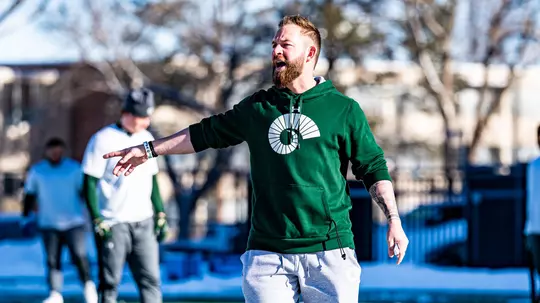
Simmons is a fan of the dumbbells, that and the Kaiser machines in the room. But the dumbbells, as basic as they are to some, are so important to him.
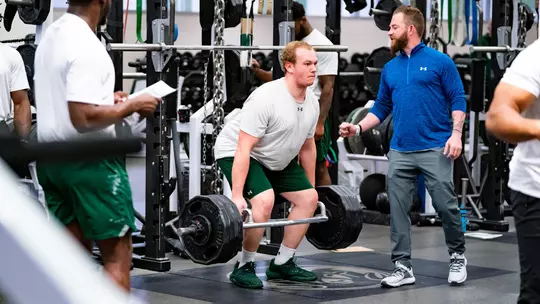
Simmons said they force the person to use the stabilizing musculature, which translates to staying healthy. Instead of fixed weight they can’t control, the player engages everything in the lift. It fits in perfectly with Norvell, who said one of the most important abilities a player can have is availability. If they’re hurt, they can’t practice or play.
As they’ve all found, Simmons will challenge them daily.
“They’re in for a tough time, because he takes the time to understand what each athlete needs to get better on mentally, with their dedication and accountability, that stuff,” Davis said. “He’s really not going to shortchange you in that department. He’s going to try to get the best out of you in every way, and you have to be receptive to it. He’s only going to do what he thinks is best for the team and what’s going to make you better as a man and a football player. But if you’re not receptive to it, at least attempt to buy in to what he’s talking about, it’s not going to happen for you. I’ve seen enough over the previous five years, I’ve seen dudes make great transformation. If they buy in, he’s got to some good stuff in store for them.”
What they were doing in Reno wouldn’t perfectly slide to Fort Collins. The teams had been taking different approaches and were at different stages. Simmons had to find the right starting point, so evaluation was key in the early going. From there, his process will start to take hold for all of them, and soon enough, the transition from phase to phase and season to season will become smoother.
He approaches it all with a base in triphasic training, but nothing about it is really pigeonholed. He’s melded what he’s learned from his father, as well as stops at Alabama and Oklahoma. The speed aspect of training was important to what was done when both he and Norvell were together with the Sooners.
He wanted to find imbalances at first, then move from there. There was a ton of teaching at the front, but not in a do-this approach. As part of his growth, he’s become a proponent of explaining each lift, drill and run, not just how it is done right, but why they do it and where it will translate to their game. The more the player knows, he’s found, the more receptive they are to the training.
As players progress, they’ll be put on certain tracts. He’s spent his career compiling data on the top players at each position in the combine. He charted stages – unacceptable, acceptable and elite – and the players can see where they fall, and it can be a great motivational tool.
Each phase is different, too, to create a build and maximize the work done to get the players and the team at their peak when wins and losses are on the line.
“You see a lot of results in the winter, but the summer, that’s when it really opens you’re eyes and you’re like, ‘oh, wow,’” Simmons said. “For the players as well. At that point its power, it’s speed, it’s explosiveness every day. What I’ve stared to do, which I think is something when I talked to the players they’re kind of excited about, at the end of the winter and summer, I’ll do an evaluation for every player.
“Spring ball, you see it on the field. Then you get to summer and I love the summer, because watching guys and how explosive they get is unreal. Ultimately it has to translate to wins. It does matter how I made them look to perform in a workout setting, if it doesn’t translate, then I’m not doing something right.”
This is a new relationship, and each one has to be built. Simmons isn’t naïve to the fact there is likely some chatter behind his back, some positive, some not so much. He’s fine with it, too. As he is learning them, they have to learn him, too.
What he’s feeling right now is encouraged. For him, it’s a great starting point.
“One thing I’ve seen from them is they’re giving us a chance,” he said. “They’re attentive, respectful, wide-eyed and looking us in the eyes. They are responsive and bring energy. I believe they’re trying to follow this blueprint we’re trying to lay out for them.”
The blueprint they all hope brings the one transformation everyone is really looking for, which is an upward trend for the program.