
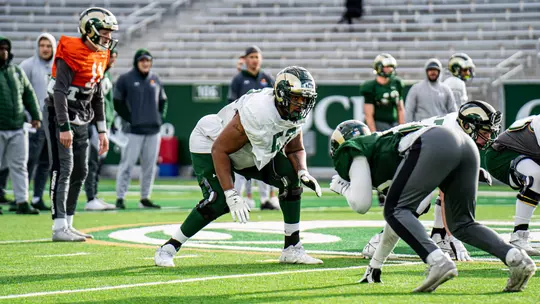
Summer Project: Lining Up 10,000 Extra Reps
Offensive linemen take individual approach to request
Mike Brohard
Bill Best knew about the topic, just not where he originally came across the idea.
Maybe it was Twitter, the great think-tank of social media. It could have been a book, too, which is where the origination of the Rule of 10,000 came from -- “Outliers,” written by Malcom Gladwell in 2008. In it, the author suggests if anyone were to dedicate 10,000 hours to something they could become an expert.
“We’ve talked about it as a staff, so I thought that applied to the O line,” Best said. “Some of them, it’s the same thing, but there’s a variety of things each player needs to get better at. Through virtual reality, through work on the field in the chutes, taking sets … I’ve got them all documenting what they’re doing.”
Just not in hours, but in reps. Best, Colorado State’s offensive line coach, figures a good 10,000 reps in the preseason buildup will have his group on track for the start of fall camp. He presented the challenge to his room on May 1, giving them until Aug. 1. It broke down to 111 reps per day.
“It definitely seems daunting, but when you realize that it was the first week of May and you have three months, I figured as long as what I was supposed to be doing every day, I’ll get it done,” Gray Davis said. “If you get focused and locked in, it shouldn’t take you more than 20-30 minutes every day.”
Seems easy enough when broken down that way, but then again, Dontae Keys had other factors to consider. The transfer from Florida International wasn’t just acclimating to a new program and town, he had added fatherhood to his plate with the addition of Dontae Jr., who is now a robust 3-months old.
As all new parents come to realize, finding time to get in extra work while searching for a few hours of unencumbered sleep isn’t always easy. It made him question the request at first, but it’s actually worked out pretty well. Young Dontae is usually awake when dad returns from morning workouts and he’s more than happy to watch daddy with a curious eye.
“Whenever I get home, he’s up, and that’s normally when I get my work in,” Keys said. “He’s kinda quiet, so it works out pretty good. It’s a big adjustment, but he’s a blessing.
“Once you get in the groove of things, it’s not really that hard, especially if it’s something you actually want to get better at. The rule of 10,000, a lot of it is mental, to perfect your craft and getting in the mode and mindset, be it a pass set or run blocking. It works out pretty good once you get in the mode.”
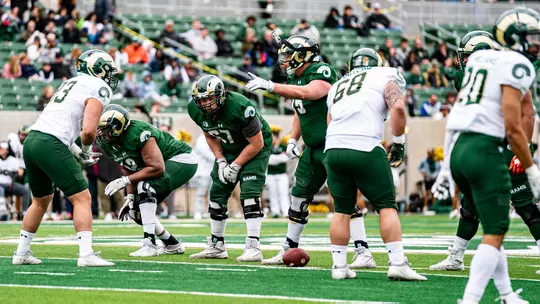
Each of Best’s linemen has their own particular marching orders, a list of individualized tasks created from watching spring camp. But there are also some base items on the list for all to work on, mainly the pass-rush sets and using of independent hands.
The former is the bread-and-butter for the Air Raid, the latter a better, more up-to-date technique in Best’s mind for keeping the quarterback upright.
“The old-school mentality on the offensive line is the two-hand punch, and if you look at it, you punch, your body will follow your hands; you lunge, you get off-balance, you get beat,” he said. “As much as we throw the football, we can’t be doing that. Independent hands is a big deal, playing long. We recruit these big guys with huge, long arms – not necessarily tall, but long limbs so the reach is really good. We want them to be able to control what’s moving and with bend and being able to use their hands independently of each other. That’s really awkward, and it takes a lot of reps to master it. That’s the major emphasis across the board.”
We do well when we’re encouraging people and keeping them accountable and being able to call people out when we need to.Dontae Keys
For the part of the group which followed him from Nevada, they’re on board. So too is Keys, who’s been using the technique since high school. The others, not to much. There were some bright spots in spring camp, but also some growing pains. Then comes the third stage of it all for Best, and that’s the play ending in a bull rush. It’s a positive, because it means a lineman has shot down the two best moves a rusher has, but it’s also a drain, as it means a fully grown man is desperate and has resorted to just blowing through a lineman who absorbs it all.
When it comes to the Rule of 10,000, not all of those reps have to be dedicated to independent hands, but a good majority should for some. The rest can be used elsewhere, and it may involve the virtual-reality system the line uses, or simple footwork in the apartment.
For Davis, his target required him to hang out a bit more a Canvas Stadium and the practice facility. There, he can use the chutes the linemen use to stay low in their drive.
“Mine was pad level in the run game, so in the chutes, you can only stand up to 70 percent, so it forces you to stay low,” he said. “So, every day I would do the chutes. When I’m out there with the unit, I feel way more comfortable and more envisioning what he wants in the run game. I’ve never had a problem staying low, it’s just my muscle memory from bad habits and getting away with it. The 10,000 has really helped me coming out low and fast.”
Davis and Keys both have found that the Rule of 10,000 works hand in hand in replacing a bad habit with a good one. The extra repetitions have paid off, and no matter what they’re working on, they’ve already seen gains.
What his offspring has watched him work on is keeping his shoulder square and keeping his feet low to the ground, and even just six weeks into the process, the results are noticeable.
Not just to him and his feel, but to Best and those who regularly check in to the group chatroom. They share texts, videos and pictures of what they’re working on. The result is feedback from their teammates, with old and new alike holding each other accountable and offering tips.
More importantly to Keys, it’s a positive space for all of them.
“It’s more of an encouragement. I think that’s why we’re getting a lot better as a team,” he said. “We do well when we’re encouraging people and keeping them accountable and being able to call people out when we need to.”
When Best first floated the number out to his room, it hit hard. It’s a big number, but broken down over three months, it felt more manageable. Then put into practice, the 20 or 30 minutes it took to accomplish became part of the daily routine.
Best believes it will give the offensive line a great jumping point when camp opens, and by the time the season starts, heck, they may just become experts.