
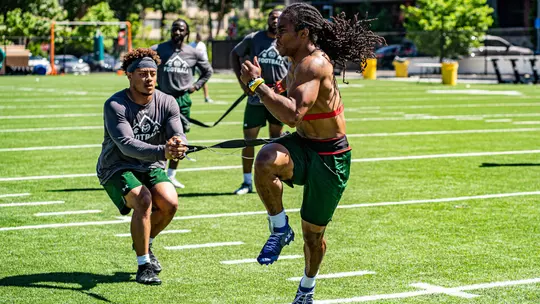
Summer Project: Protecting The Rock At All Times
Being off balance is not an excuse for backs
Mike Brohard
Jeremy Moses wants his backs to put themselves in compromising positions because eventually, they will be in a game.
They will be carrying the ball and be off balance. Or trying to regain their balance. Either way, the danger is the same, to make sure they can absorb the defender’s blow and still maintain control of the football.
Of course, the Colorado State running backs coach wants his guys to do it as safely as they can in the comfort of their own homes, but their summer task is to use down time to remain upright while protecting their valued property.
“It’s been ball security, and with ball security comes balance. With our ball-security drills, a lot of times when the ball comes out it’s in the process of either losing balance or trying to regain balance,” he said. “I try to fit drills to put them in a position where they’re losing balance and maintaining good ball security or put them in a spot where we can regain balance and maintain ball security. Then we come to live situations, we’re already going to be prepared.
“I’ve given them simple drills. You can have anything, a pillow in the living room you can jump back and forth over. I’ve given them all a set of cones to take home with them. They are simple drills which can be done in their living room, their backyard, their garage. If it’s a confined space, they can still get in their work.”
A’Jon Vivens prefers to do this in privacy with no one around. Avery Morrow incorporates a pillow to leap back and forth over, ever so cognizant of where the ball rests on his body. They know what they’re doing, and they know nobody has to bear witness to what may happen. And so far, no furniture has been sacrificed.
“For example, if we have a pillow, we keep the ball high and tight, jumping over it and putting your body in awkward positions to get used to it, because as a running back, you don’t know what could happen,” Morrow said. “A D lineman can come off his block and hit you in the shoulder, so anything to put your body in awkward positions to be ready for it when the time comes.
“What he tells us is making sure there is no gap behind when we run the ball. If your elbow is too low, the ball is going to be poking out. What he wants from us is keeping the elbow tight.”
Which is another added layer to the drill. When they tuck their elbow, Moses tells them to use something thin – a hand towel, a T-shirt, even a tissue – to put between the elbow and their side. If the item comes loses and falls to the floor, they know they have to keep it tighter.
It’s an extra tip, but by this point, the veteran backs can usually sense when the security has been breached.
“If I do, it’s a shirt or something small. It keeps you mindful, because if it drops, it will let you know that you’re losing your elbow,” Vivens said. “That’s the beauty of it, being able to work your balance also and being able to stay up right. You know when you’re not doing it right. You just know. It’s definitely a feel, because you do it so much. We definitely feel it taking hold.”
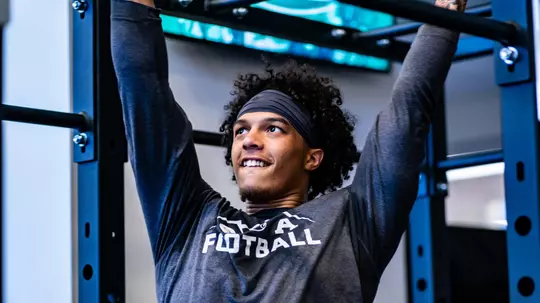
When we trip up, it’s being able to put our hand on the ball and keeping your hand tight, making it become almost second nature.Avery Morrow
During practice, this is much easier to replicate. Moses said it’s rarely the defender a back can see who dislodges the ball, it’s the defender lurking in the shadows as they’re falling to the ground, or a foot is either leaving or hitting the ground.
With pads on at a full practice, they can use bags to knock backs off kilter and have players swat and grab at the ball. At home, it’s more about focusing on balance and the tuck.
“It’s something where we have to elevate up and over on the one leg and still maintain balance. It’s all about trying to maintain that balance on one leg, get up and over something, gain distance and not let the ball get away from our body,” Moses said. “In open-field runs, we all react and want to make that explosive cut, but we want to maintain ball security. It’s never the guy we can see that knocks it out, it’s the guy we can’t see.”
These are drills Moses has picked up over time, and the backs also employ their own methods. As long as the goal remains the same, it will work. For example, Morrow envisions the ball being an eraser and he’s trying to wipe the number off his chest. Different approach, same goal.
“That elbow up makes the biggest difference,” he said. “If it’s down, you’ll feel the ball swinging. It’s like high and tight with it, it doesn’t move. And when you go through the hole, you want to lock up on the wrist too, so the ball is secure.
“When we trip up, it’s being able to put our hand on the ball and keeping your hand tight, making it become almost second nature.”
None of this is new to either one of them. As long as they’ve been running backs, they’ve had it etched in their mind ball security is their primary concern. Running in a straight line, the task is easy. But rarely is a running back afforded a straight, clean line in a game situation.
There’s a cut to make and a wave of hands, arms and legs swinging at them. There will be hits which jar them, but don’t knock them down, and the sooner they can regain their balance, the better the chance at a decent gain. Even a breakaway.
Even then, the message remains the same: High and tight.
Working on it is best to be a solo act, however.
“The type of drills we do is when you’re working on your balance is having that ball security, being conscious of being high and tight no matter where you’re body goes,” Vivens said. “We get put in a lot of compromising positions, and that can lead to you dropping the ball. This allows us to work on keeping it up no matter what we’re doing.
“I usually do it by myself. I can’t say I do this stuff around a bunch of people back at home.”