
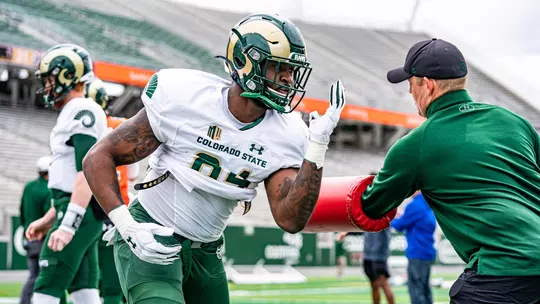
Summer Project: Making Different Feel Familiar
Changes are not difficult, but require precision
Mike Brohard
Different must be addressed. Not that any of it requires a great leap into the unknown, but there will eventually be a requirement of precision and consistency James Finley expects from his tight ends.
They will be playing without their hand in the ground most of the time, but there still is a blocking element. The routes they run aren’t anything out of the norm, but which one to run and when must be second nature.
“It will be different. It was a heavy-run offensive style last year, so they did a lot of blocking and a little bit of receiving,” Finley said. “We’ll still be running, but we’ll throw the ball more, so they’ll be asked to do more in the pass game. Blocking will be relatively easy for those guys, but we ask them to do different things in blocking, like blocking in space. It’s important for them to learn to run routes through coverage, through leverage and knowing where the safety will be if you break off a route at a certain depth.”
Even before Finley was hired to be their position coach, the tight ends on the roster knew change was coming, and they were on board. With good reason. While Gary Williams was the second tight end behind John Mackay Award winner Trey McBride, he was still fourth on the team with 21 catches and 287 yards, and he led the team in touchdown receptions with five.
From the first day of spring camp, it was as crystal clear as a message from vice principal Richard Vernon -- the tight ends were going to be out in space a whole lot more.
“The big thing is just repetitions, because we run so many routes,” said redshirt freshman Tanner Arkin, whose first collegiate reception came against Nevada. “Last year we had maybe two periods where we ran routes, and maybe we ran 10 routes. This year, we run all practice, and it’s split up, so we get that time with the QBs.”
Keeping that time is what Finley views as imperative for the group in the summer. Not just for the timing aspect of the Air Raid offense, but in route recognition. Depending on the play call and the defense, the tight ends will have a decision to make on the route they run and for the sake of the quarterback, they need to know the correct route.
So, Finley’s directive to them was to keep running routes. On air was good, against defenders is better. They could do it on their own, but a group approach will be more beneficial.
“I want them running routes., looking at coverage and running through coverage, knowing where the safeties are and the linebackers are,” he said. “I want a pre-snap read and a post-snap read, so the biggest thing is running routes through coverage and them getting better at recognizing coverage while running routes.
“There’s film study, but the main thing – like I told Tanner and Gary -- get those guys together along with the freshman Jordan Williams, stuff they can do on their own and watch film and physically getting on the field and grabbing a quarterback and say, let’s go over these routes. If they say it’s this coverage, I run it like this. Pre-snap it and post-snap it but running routes with the quarterbacks.”
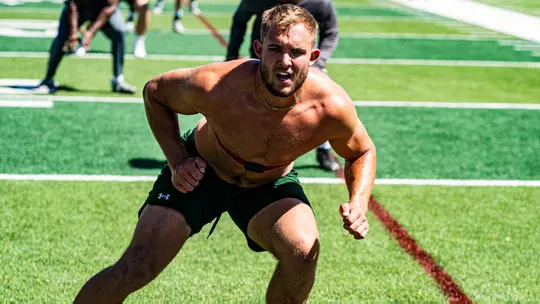
We’ve had to switch our focus. Last year it was more on blocking last year than route running or running drags or a cross. Now we have timing for it.Gary Williams
A crossing route in this offense isn’t a switch, nor is a wheel route. It’s the when and where and the understanding of the concept. A route may be designed to be a secondary target, but that’s only true for the quarterback if the correct route is run.
They can run the routes all day but running them together is key to Finley because they all can be there to coach each other. Not just the wrong route was run, but if it carried the proper depth and tempo.
“It’s most definitely different. Running routes is more of a concentration, so it’s more of a focus now,” Williams said. “We’ve had to switch our focus. Last year it was more on blocking last year than route running or running drags or a cross. Now we have timing for it.
“All of our tight ends were pretty versatile and could do both, but we’ve all gotten better at running routes. I’m not going to miss my hand in the ground. Not really at all. I like catching the football. Another big part of it is gaining the trust of the coaches and the quarterbacks and letting them know we can make plays and are versatile.”
Finley said the tight ends will be connected to the line around 10-20 percent of the time, and there are sets which require a two-tight look. He already knows they can do that, and they will continue to put in the work.
But in a system where the tight end annually averages around 50 receptions for around 600 yards and is used as a scoring option, they all want to make sure they’re up to speed to play the part. The best time to prove they can is with the quarterbacks and the rest of the offense.
“I think the main thing is captain’s practices when we all get out there together. There are no coaches, but we run 7-on-7,” Arkin said. “That’s really helpful, facing different defenses. When you just run routes, you don’t have the defense out there to see what’s going to happen in a real game. We do that twice a week, which has been good.
“Everything changes with the defense. More of our departures and how we run the route is still the same, but how we run the route, say Cover 2 vs. Cover 1, we can go to different places or sit in certain holes. There are different things we can do against man coverage.”
For all the tight ends, different is good. Different is welcome. It can be great if it is done correctly because the results from the past are enough to spark interest for their present.