
Accepting Unexpected and Welcome Guests
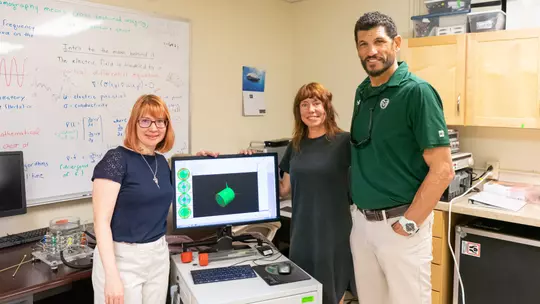
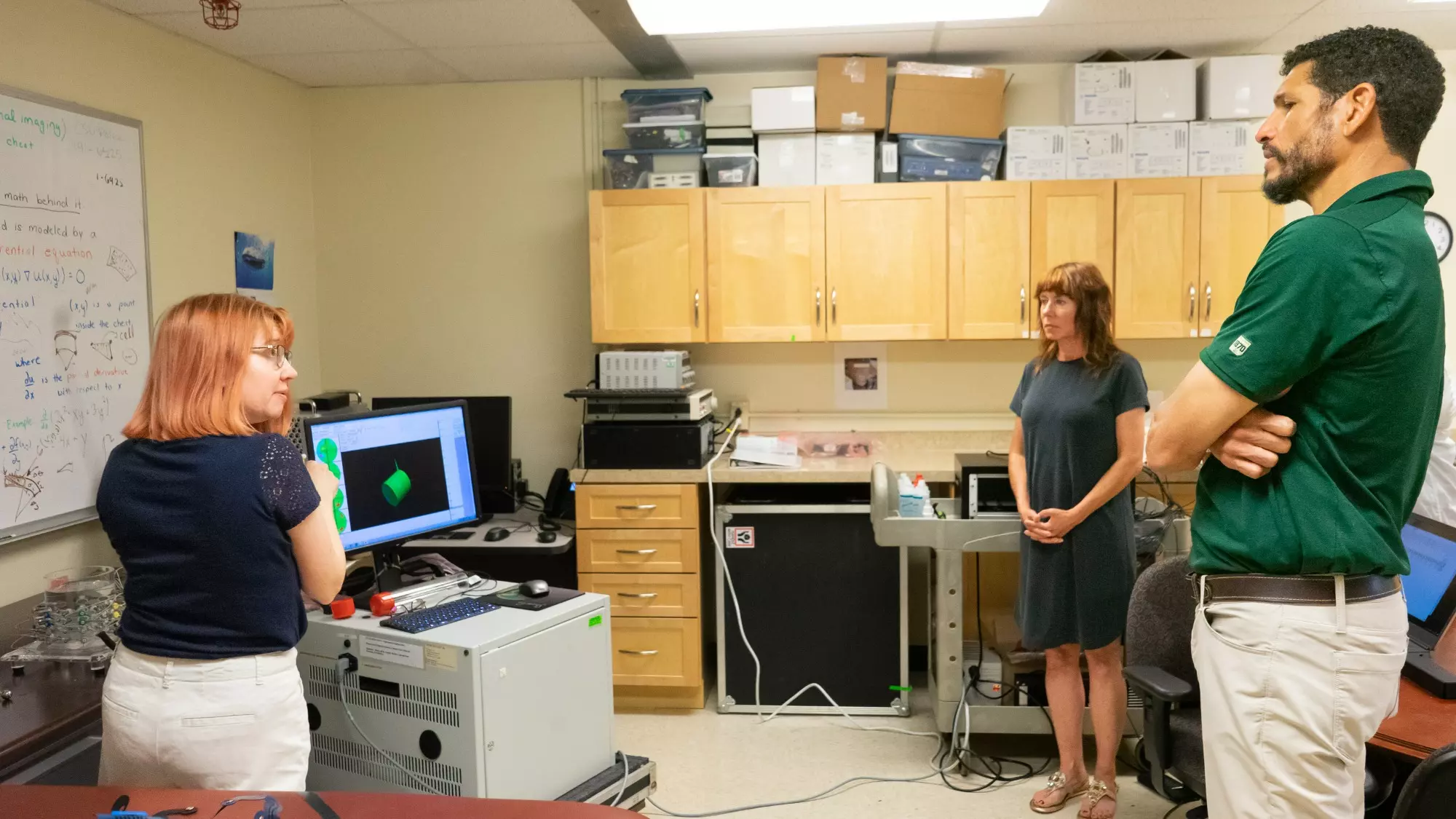
Dr. Mueller discusses her research with Jay and Kim Norvell
Mike Brohard
This wasn’t the first time Dr. Jennifer Mueller had received an email saying someone on campus was interested in coming over and talking with her about her research.
It was, however, the first time the request came from the Colorado State football coach.
“I was really surprised. You get an email the football coach wants to meet you, and you wonder why! I didn’t know at the time his wife has cystic fibrosis, which is one of the main applications of my research.” Mueller said. “And so I thought, why me? It was delightful to meet them and get to know them a little bit.”
Jay Norvell has been on college campuses for more than three decades as a football coach, but this is the first time he ever remembers where research involving cystic fibrosis patients was being conducted where he was employed. His wife, Kim, was diagnosed with the lung disease at the age of 6 months, and back then, such a diagnosis usually meant she wouldn’t reach the end of elementary school.
She’s beaten the odds, raising a son, Jaden, who is in his early 20s. She has also beaten cancer, but she’s lost a lot of friends along the way. Seeing the work Mueller is currently doing, which she feels can have a grand effect on the life of cystic fibrosis patients, opened up a new world for her.
“I’ve lost a lot of friends from back in the day, and all the things we’re benefitting from now, we didn’t have back then,” Kim said. “There are reasons they died, and I feel bad for that. The new community coming up, we’re going to have all the benefits of this stuff, so that changes everything.
“It definitely gave me hope. She explained to me the results are in real time, so, for me, if I’m doing my respiratory therapy at home, I would be able to tell right away if the therapy helped me or not. I can see real results in real time. Nothing like that has ever been available for us, and I often wondered if the treatments even worked. I spend hours and hours doing treatment and doing everything I’m told, and you don’t know if it’s working or if it’s a waste of time. Now, if I can see that myself, it does a lot for my mental state as well. If they do that for patients in the hospital, that will mean everything for them for their treatments and everything they’re doing in the hospital. It’s a game changer for sure.”
Mueller is part of a project being done in collaboration with researchers at the University of Albany and Rensselaer Polytechnic Institute developing a medical imaging technique called Electrical Impedance Tomography (EIT) for lung imaging. It is a National Institute of Health study which is focused on cystic fibrosis patients who are currently being treated at Children’s Hospital at Aurora, a group she has worked with in studies she’s been involved with in the past.
Mueller is the Graduate Director for the Department of Mathematics and an Associate Chair, as well as a Professor Laureate in the College of Natural Sciences. She is also core faculty in the School of Biomedical Engineering. Touring her lab and listening to her discuss her research was an awakening for Jay.
Mueller explained the primary goal of the study which began a few years back is to follow cystic fibrosis patients longitudinally and look for structural changes that occur as the disease progresses. In the past, those have been done using Computed Tomography (CT) scans, but those involve the uses of ionizing radiation and so are typically only performed once every three years. While CT scans are more detailed than EIT images, EIT produces dynamic images of breathing and blood flow, and can be done safely as needed. Secondly, it will use EIT to study lung structure and function pre and post pulmonary exacerbations to see if treatment is effective. The device works by applying current on two rows of electrodes around the torso of the body and computing 3D images of the lung, exposing regions of air trapping or consolidation.
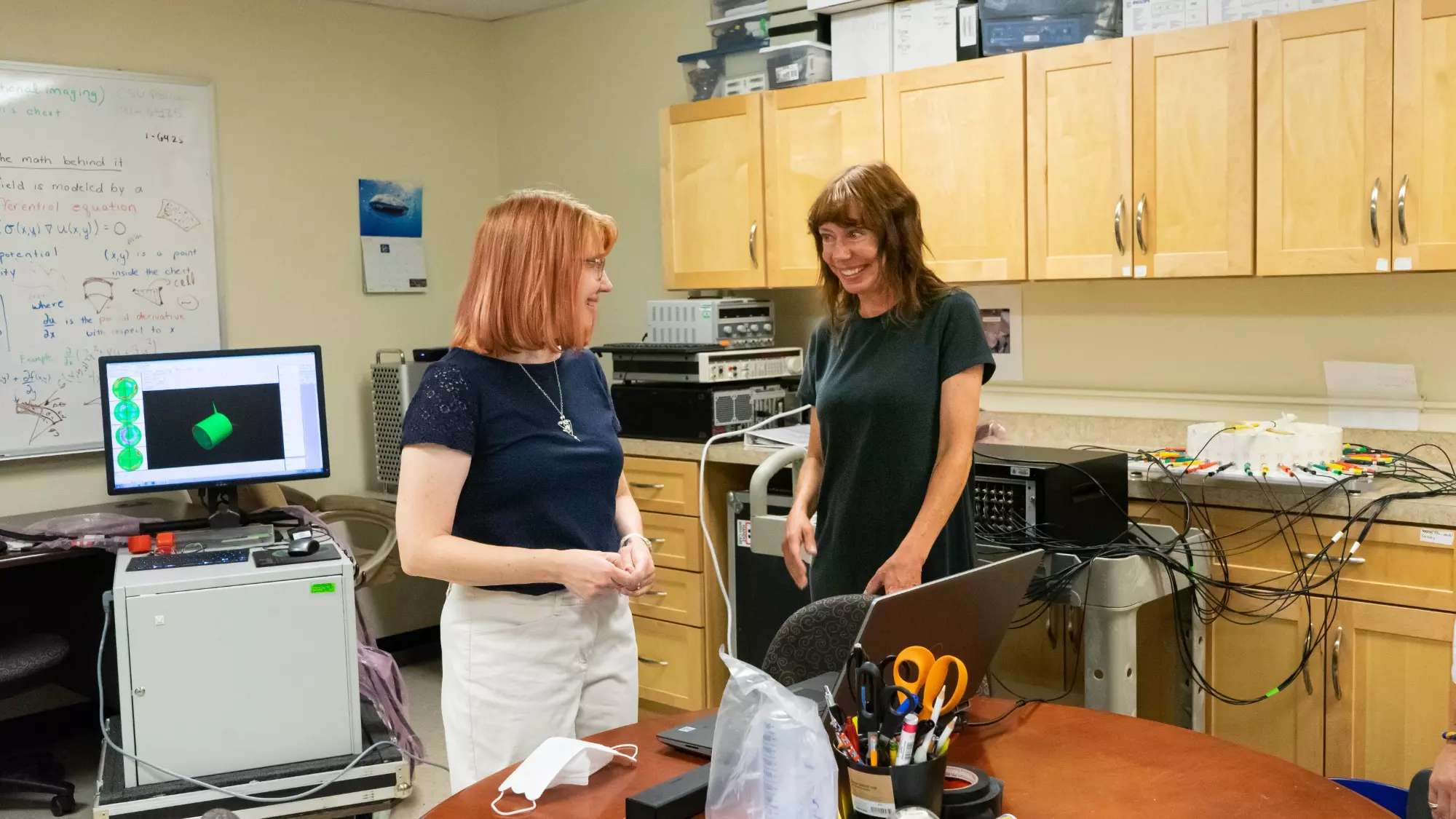
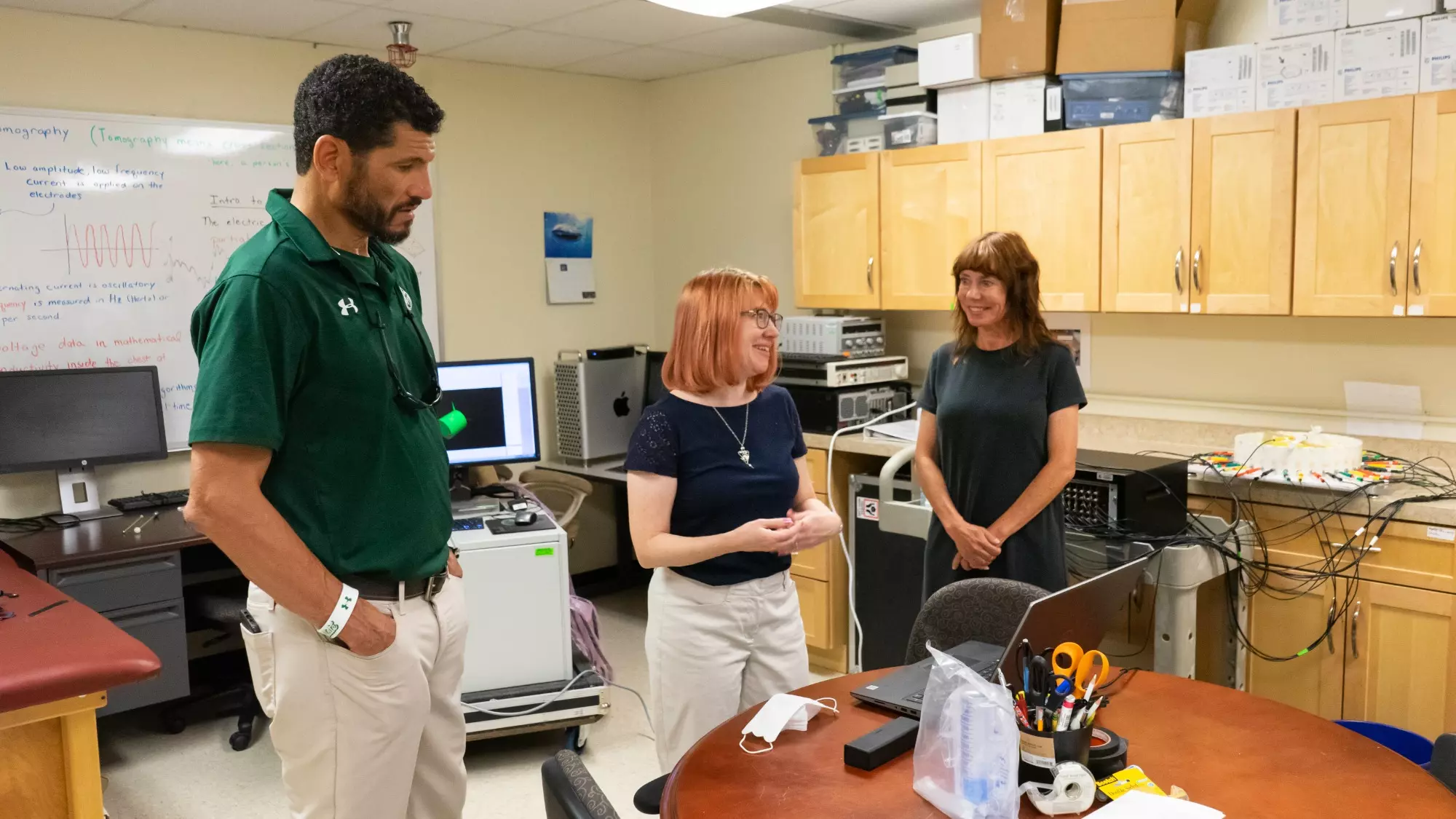
During the tour of her office, lab and classroom, Jay looked around the walls and saw all the equations Mueller had written, and while it reminded him of his workspace, what he saw left him very much amazed.
To understand that’s just happening a couple of blocks from Canvas Stadium just blew my mind. I was fascinated by our visit. I was so impressed by her humility.Jay Norvell
“It's interesting. In the basement there and the little classroom and her office, she has all these formulas written on the wall like ‘A Beautiful Mind,’ and I think of our offices, and we have all these plays and defenses drawn on the board ... The fact her mind works that way where she can think mathematically about finding these solutions to these complex health problems, it’s just amazing that happens there. You’re talking hundreds and hundreds of thousands of dollars which have gone to that research, and it’s all worth it. We’re so proud of her and want to be supportive of the work she does.
“To go over and see Jennifer and spend time with her and hear how the things she gets up and does every day and stays late and night and works on weekends to develop, how that helps people like my wife Kim, with her lung disease, and not having radiation and doing these amazing experiments to help people with health issues is so humbling. To understand that’s just happening a couple of blocks from Canvas Stadium just blew my mind. I was fascinated by our visit. I was so impressed by her humility.”
As Kim noted, what makes Mueller’s research so remarkable is does not involve radiation, making it safer for patients to use and allowing imaging to be done more frequently. While the machines in use are mainly constructed at the University of Albany with contributions from Mueller and her PhD students in the School of Biomedical Engineering, it is Mueller’s algorithms which are providing the useful data for medical professionals to use.
As part of her research, Mueller spends a good amount of time at Children’s Hospital talking to patients involved in the study. In Kim, she was able to speak to someone who very much had a vested curiosity in what results the study was producing.
“She was very excited. It was great to meet her, hear her questions. She’s remarkable,” Mueller said.
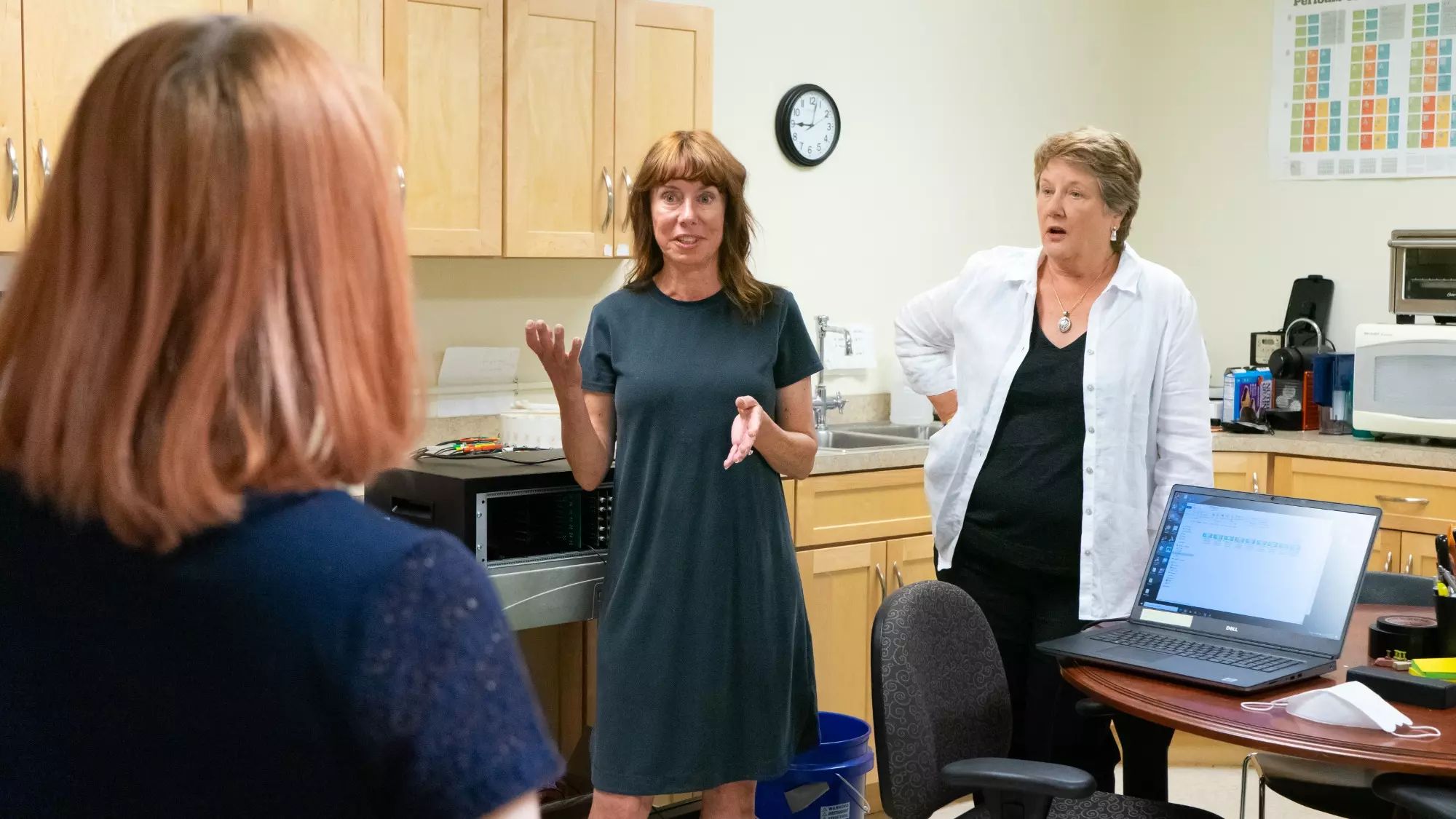
“Coach Norvell and Kim wanted to know things like how EIT works. They also wanted to know if it was just for kids, which it totally is not. When you have an NIH-funded study, you have clinical partners, and I already had connections with Children’s Hospital and the Breathing Institute there, so they were the natural clinical partners.
“I was able to show them 3D images in real time on the EIT system, and we saw movies of images taken the previous day on a healthy person in the lab. They were excited about being able to see the blood flow in real time. Seeing blood flow is much harder than seeing breathing; breathing is a much bigger signal.”
Kim called the research hopeful for her and a host of others. She wakes up every morning and goes through an hour routine where she puts on vest which shakes her and helps dislodge mucus for her to cough up, a procedure known as huffing. At the same time, she’s doing nebulizer treatments, all the attempt to give her increased lung capacity for the day. With exercise being an important part of her treatment, she walks their dog, Chip, for nearly two hours in the morning. Or sometimes he walks her, she joked.
Her visit this summer with Mueller provided her with a wave of optimism when it comes to treating cystic fibrosis.
“It’s intense to get out of the house every morning, but I’m grateful to be able to do that,” Kim said. “It’s going to be nice to see actual results when I do my treatment in real time. I look forward to it being made available to people like me. I hope it gets funded and can be off the ground. Everything takes time, and some people don’t have a lot of time. I feel like there’s an urgency for some people.”
The visit was definitely a first for the Norvells and for Mueller. Reading about research which can affect your life is one thing but being able to actually speak with the researcher and see their work was next level for Jay and Kim.
As well as for Mueller.
“It’s very motivating. It reminds you why you’re doing all this,” she said. “When you meet patients, you know why you’re doing this, but when you’re in the lab working on programs, you’re thinking about the details. When you get to meet people, it tends to fire you up.”