
Now Open to a World of Possibilities
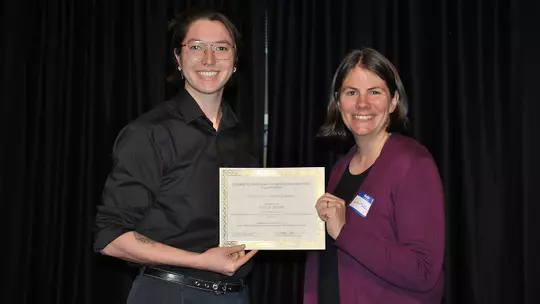
Hager named Best in Show at 2023 CURC
Mike Brohard
Considering the number of emails a person will delete in a day – many without ever being opened – the past year for Megan Hager feels a bit like a stroke of luck.
“Overall, in my eyes, this has been a blessing of so many opportunities I can pursue, all the interests I can test out, the different hats I can try on while I’m still an undergrad and don’t have to commit to specifically,” she said. “I’m thankful for it.”
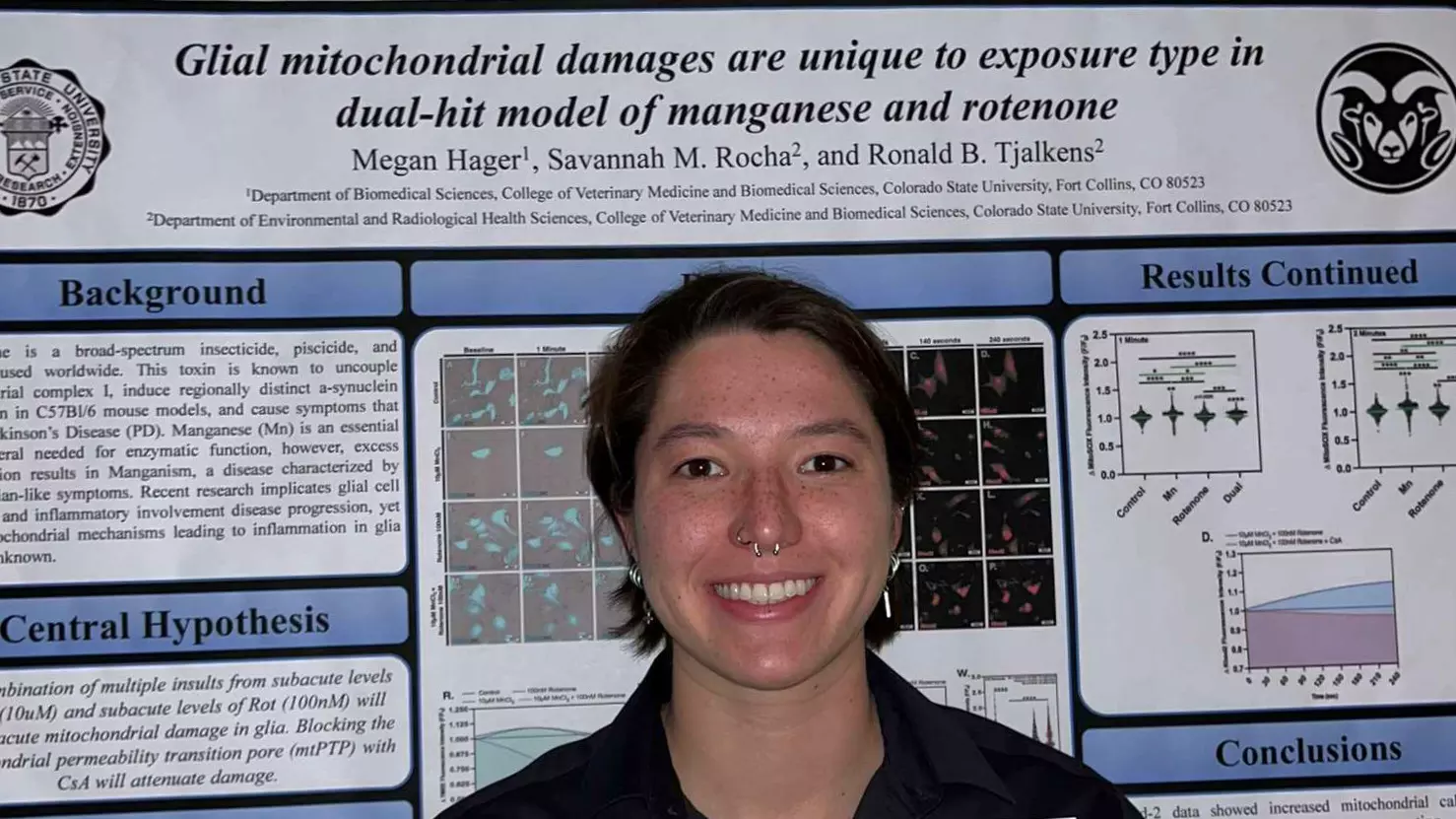
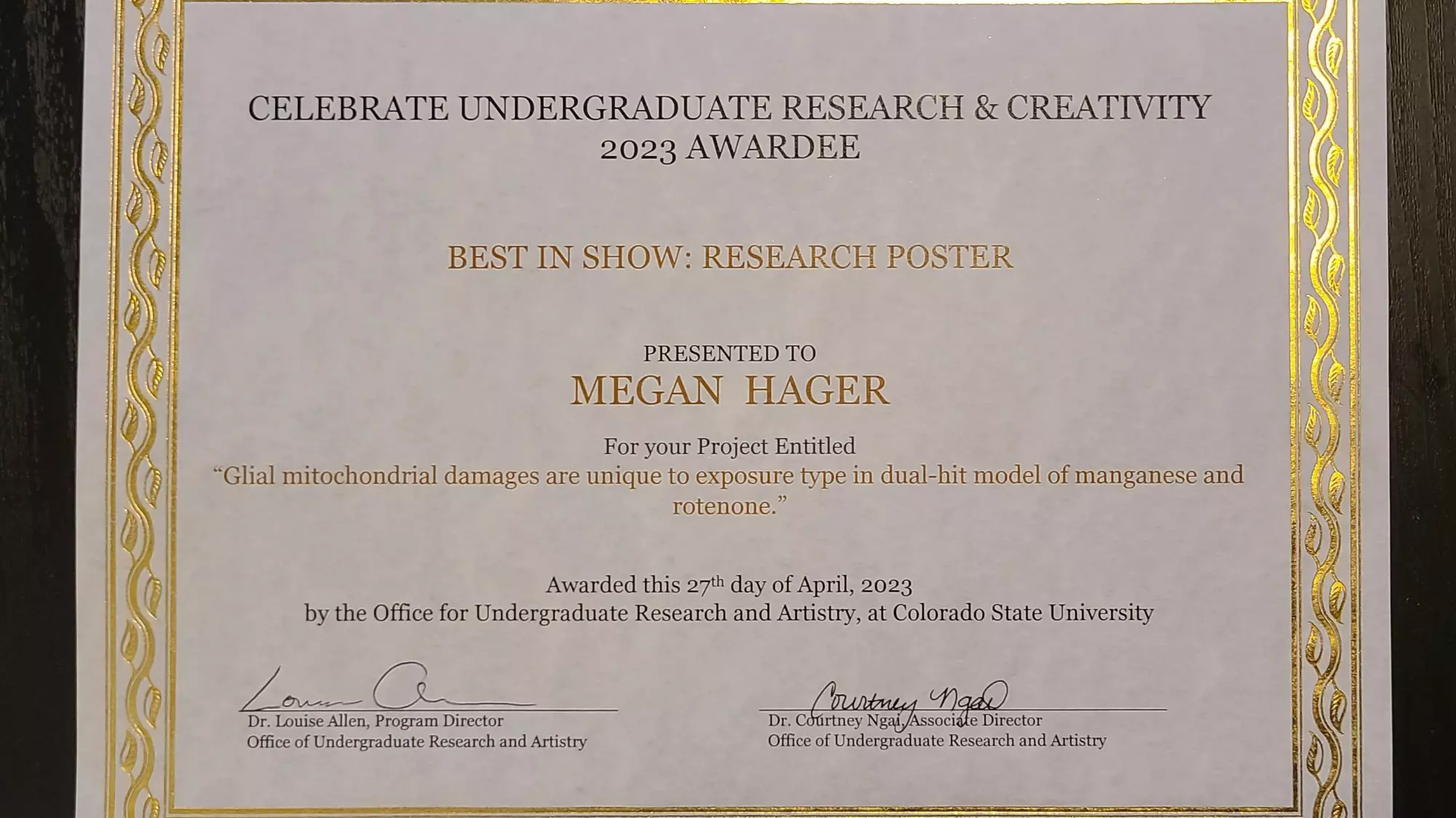
As it turned out, opening the email was a stroke of genius, leading her to become part of a research project being done by Dr. Savannah Rocha, a post-doctoral student at the Tjalkens Lab on campus. In April, Hager presented her part of the research – Glial mitochondrial damages are unique to exposure type in dual-hit model of manganese and rotenone – at Celebrate Undergraduate Research and Creativity.
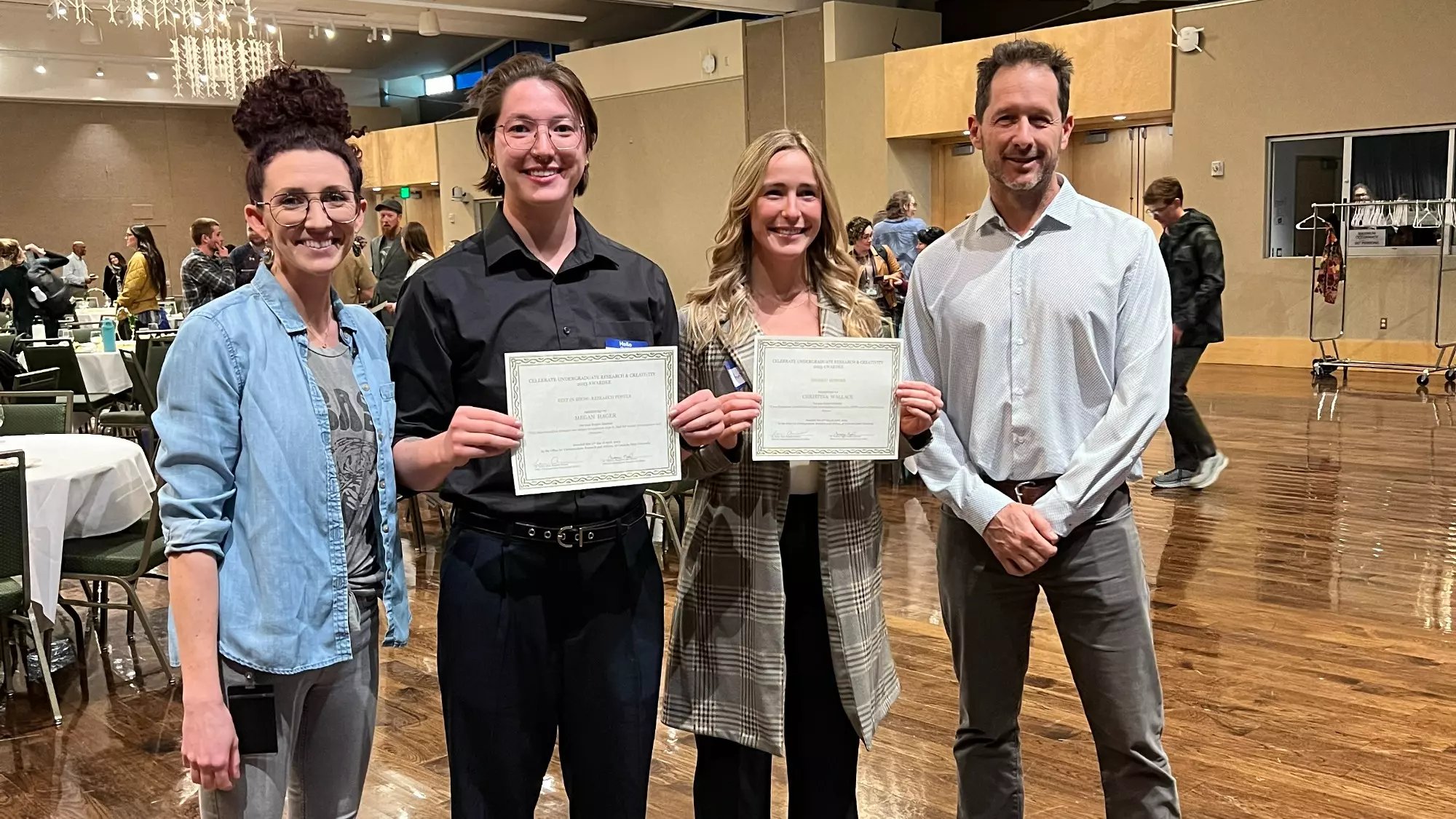
Out of nearly 250 posters presented at the campus-wide competition, Hager – a 2023 College Sports Communicators Academic All-District honoree -- was named Best of Show, falling one point shy of a perfect score.
The email the junior swimmer opened was a newsletter from her college of study. Attached was an ad to apply to help with a research project on campus. It sounded interesting.
Of course it did. Not because her career path at the time involved doing research. She had started paving out a path toward medical school to lead her eventually to opening a psychology practice. Nothing in her blueprint included research.
The interest came from the pursuit of knowledge. In middle school, while her classmates were diving into the Twilight series, she had found her own genre.
“I’ve always loved the brain,” Hager said. “That was my niche hobby in middle school, reading neuroscience books for whatever reason.
“I love learning. I’m one of those kids who likes school. I thought, this is really neat.”
An aspect of Hager which Rocha picked up on early, making her an ideal undergrad to add to her team. Rocha is rather particular in who she chooses for good reason. She looks for students who not only excel academically but can manage multiple activities at one time.
As the Tjalkens Lab, Rocha explained there are around four “slivers” of connected research all being done in conjunction with each other, and as time progressed, Hager proved capable of being able to bounce to each and every one and lend aid.
“What initially struck me about her is she’s super organized. People always say if you want something done right, choose the person who’s busiest – they’re obviously busy for a reason, because they’re good at what they do and they can take on many things because of their organizational skills,” Rocha said. “The other aspect which really stood out to me that puts her far apart from other undergrads I’ve worked with is her ability to comprehend scientific literature. As a mentor, I typically assign readings for my students, so they understand the field, whereas with Megan, she came in and said I read this paper and that paper and formulated this idea, what do you think? It’s her ability to critically think which really stood out to me and why I wanted to keep her in the lab.
“When we finally started to do experimentation, her technical skills are impeccable. I’m a very picky person when it comes to retaining undergrads for my specific projects in the laboratory. We have other students and grad students in the lab, and I told my boss – and this is a big deal for me – is trusting samples which can’t be recovered to an undergrad is a big deal. I fully trust her because of her technical ability and proficiency, and her care that goes into the work. She understands the importance to the work we’re doing and holds it to such respect.”
The more Hager worked on the project, the more fascinated she became – in the work, what the research was showing and how the findings could impact what the world knows about Parkinson’s Disease.
During the fall semester, she didn’t have swim practice on Wednesday nights, so she would go back to her dark room taking images with a microscope. She would collect the data and send it to Rocha, figuring she put in at least 100 hours into the research.
“We took a sub-acute – non-harmful levels – of this pesticide and combined it with a sub-acute level of a heavy metal, that this will still ruin your cells,” Hager explained, noting the two are not introduced simultaneously. “It’s moving toward agriculture workers who are exposed to a bunch of pesticides and all the different combinations of all these little insults that build up. That’s the crux of this paper – everything builds up. It can, even if alone it is doing nothing to you, it can still hurt you.
“Parkinson’s is the fastest growing neurodegenerative disease; it’s increasing a rate higher than Alzheimer’s. That’s really concerning.”
Hager entered her portion of the research in CURC, a longstanding competition for undergraduates which Louise Allen, the Director of Student Engagement, traces back to 1990. It is the largest and only all-campus contest where any undergrad can present.
Judges of the poster were people purposefully not involved in the field. The goal was to have students present their findings in a manner all could understand the full impact.
“This year, what we did was we focused on the content of the research and the student’s presentation of the material, specifically geared toward talking to anyone, not just a scientist about research,” said Allen, who additionally is the program director for the office of undergraduate research and artistry. “There was a heavy emphasis on that this year.
“I would be very pleased if I were Megan. It’s really remarkable. There were a lot of good posters, but hers was really good.”

I’m glad my judges were able to understand my science and that I could effectively communicate it. It was a big confidence boost as I move forward in my career.Megan Hager
During spring break, Hager had a trial run at presenting, attending the national conference held by the society of toxicology in Nashville, Tenn. Hager’s poster session there was a very different, as the people who were asking her questions were experts in the field. As she remembers, “they grilled me.”
They were also impressed, as many asked her what year she was in her PhD, only to find out she’s still a junior. That added to her confidence, but so did her background as an athlete.
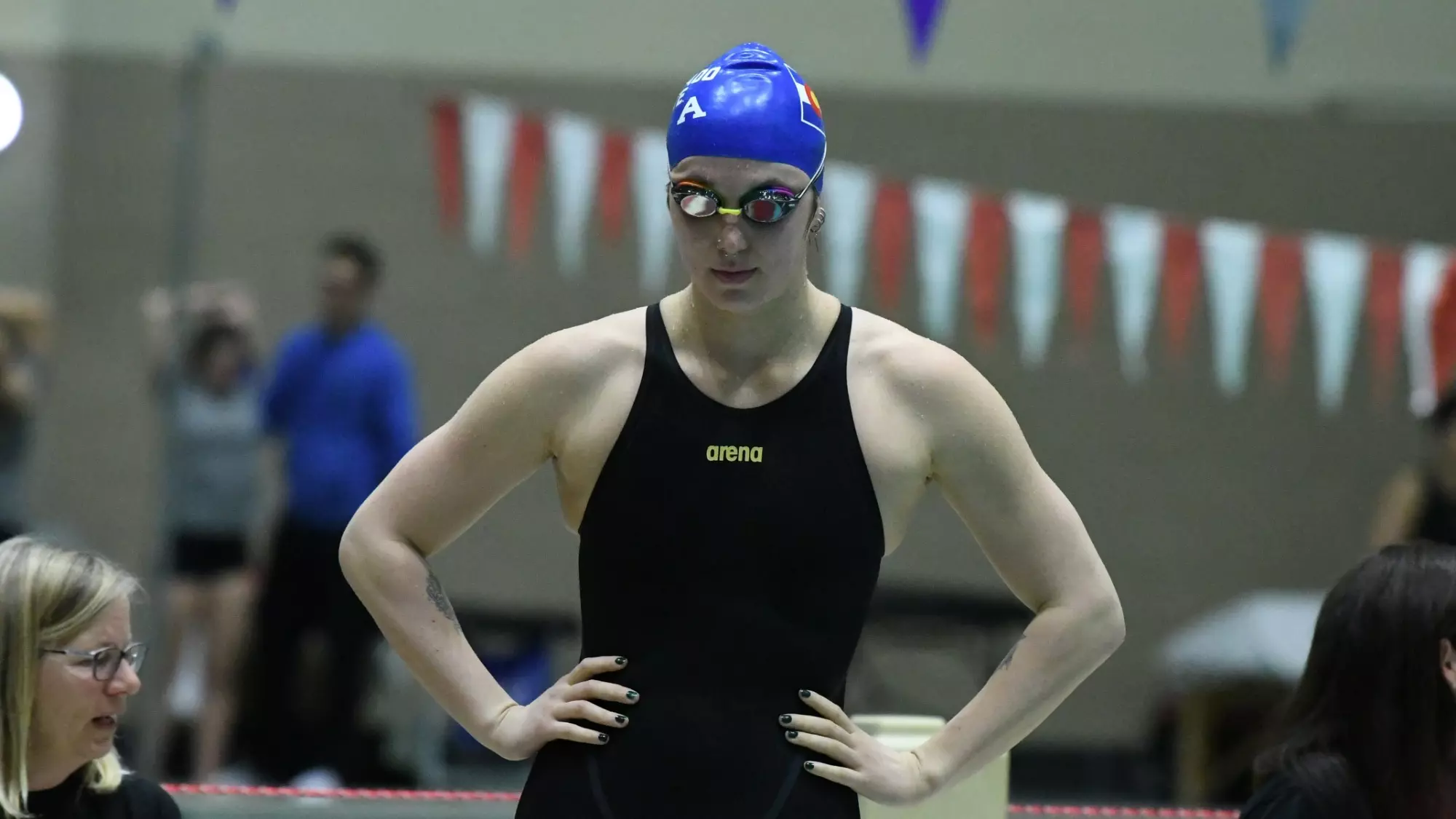
The product of Sweet Home, Ore., is an eight-time Mountain West placer who holds one of the top-10 times in program history in the 200-yard freestyle and is part of the school record 800 freestyle relay team. As with her presentation, she said a competitor never really knows what’s going to happen in a race, but over time, she learned how to cope with pressure and learn how to deliver in the moment.
“After walking out of this presentation, I felt really good. For CURC, it was local and you’re judges cannot be directly affiliated with your department because of bias,” Hager said. “I had judges with different disciplines, so it was a real challenge to adapt my presentation to their level of expertise and explain things in a way that made sense to them. I feel like I did pretty well. I think I did a good job of adapting to the person I was presenting to, which probably was the biggest challenge.”
Hager also took the time to walk around the competition and listen to others present and look at their projects. She said it hit her just how big the campus is and the level of research being done at Colorado State, much of it by undergraduates.
Then she received another email, one informing her she had won an award for her presentation, just not which one.
Rocha, who had won a departmental award in the same contest during her time as an undergrad, was not just excited for Hager but proud. She felt one of Hager’s best attributes was the ability to relay information in a way anybody could understand. That, as well as her work in the lab, led to her hiring Hager as a student assistant.
She said if she could, she’d keep Hager forever, but at the very least she knows Hager will work with her for the next 14 months.
Allen said the committee does not inform the student what award they’ve won, just that they have earned one, to help build the drama at the presentation. She hit the target with Hager.
“As I was sitting during the award ceremony, they called all the names. It started at college honors then moved to highest honors, then related honors and the final category was best in show,” Hager said. “I was getting so anxious they made a mistake when thy emailed me. My heart rate, my watch clocked me at 140.
“It was so scary, and then it was the final name, because in the best of show category, they had five. I was convinced they messed up, then I heard my name get called for first and I was in shock. I was so happy about it. I’m glad my judges were able to understand my science and that I could effectively communicate it. It was a big confidence boost as I move forward in my career.”
One which Rocha feels is more than bright for Hager.
As she waited to hear Hager’s name called, she was also nervous, just not for the same reason. She understood the longer it took the higher honor it meant for Hager, so her emotions ran toward the reaction.
“I almost started crying when she won, and I looked at my boss, Ron Tjalkens. I was so proud,” Rocha said. “I asked him after the ceremony, is this what having kids feels like? I was so incredibly proud and happy for her. It’s something so much bigger than what you may anticipate, and as a mentor, this is why I do it, other than helping patients hopefully in the Parkinson’s field, is to see these students grow and experience the joys that can come with quality research.”
Rocha has already planted the seed of Hager remaining in Fort Collins for her post-grad work, realizing her student will have a host of options awaiting her.
Hager said the entire experience has opened her eyes to a world of possibilities. The idea she could remain involved with impactful research while working in the psychiatry field. She learned how to network, meeting admissions people from Indiana and Vanderbilt, even setting up preliminary interviews with them.
“I’ve always loved the brain. This type of research directly affects people,” Hager said. “Coming at it from the psychiatry side, that’s the field I want to go into and work with patients and their families, but also knowing being involved in this type of research can make a long term difference on a more systemic level.”