
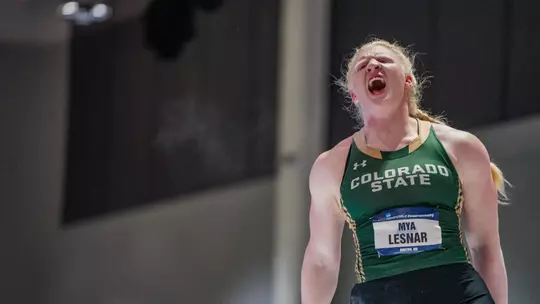
Learning the Mettle to Medal
Lesnar relishes the trophy and the trip
Mike Brohard
Everything was good. It took awhile, but she had finally found comfort in competition.
Forego the outside expectations. Stop looking around and stay within herself. Be her best that day. Have some fun.
Then, let it all fly.
It was all good except the literal flying part for Mya Lesnar. She’s not a fan of getting on an airplane. That was the worst part about the great thing in qualifying for the NCAA Indoor Track and Field National Championships. Getting in an airplane and flying across the country to Boston.
“I don’t like flying. (Colorado State track and field coach Brian) Bedard doesn’t like flying either,” Lesnar said. “We have something in common.”
A couple of things, actually. Yes, there’s the anxiety created by turbulence. More to the point, Lesnar is now the fourth national champion Bedard has coached, the group winning five national championships. Lesnar’s came March 9 in Boston when she bettered a 16-woman shot put field which included teammate Gabi Morris.
Lesnar is the first female at CSU to win an indoor national championship. Bedard guided Casey Malone (discus, 1998) and Loree Smith (hammer, 2005) as the head throws coach; Mostafa Hassan won the indoor shot put in back-to-back years, 2017-18, with Bedard guiding the program.
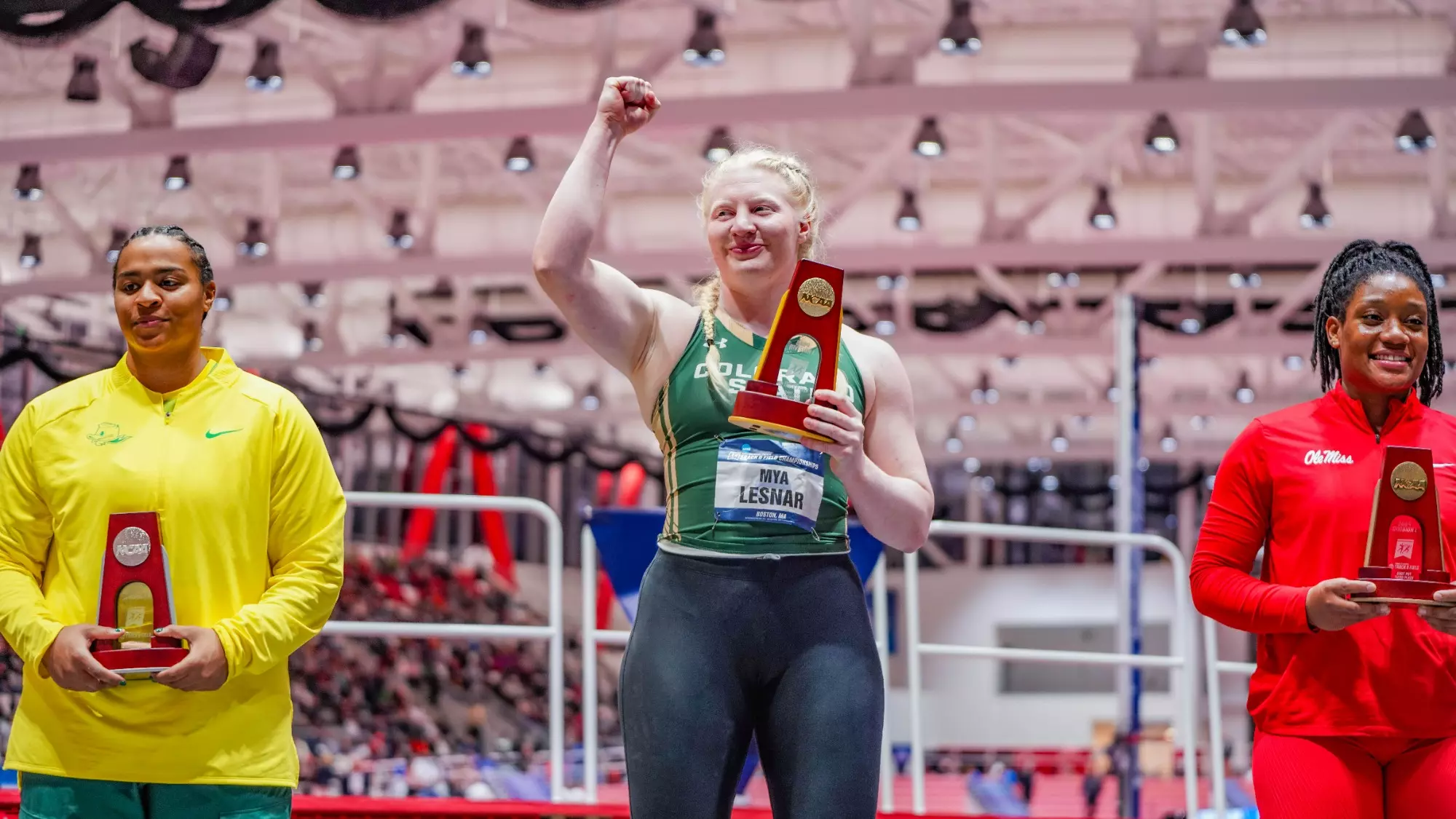
The trophy she won can be found sitting right below her television, putting it in prime view to catch her attention daily. Of course, she’s a bit enamored with it, and the win it represents. But the view takes her much deeper.
Not just that weekend, or even the indoor season as a whole when week after week she was consistently bettering herself. Seeing it takes her back to the year prior when she probably wouldn’t have been in position to become a national champion.
The work that was required actually caught Bedard a bit off guard.
“I go back in December of 2022, we went to the Air Force Holiday Open, a very low-key meet for her to get started in a CSU uniform, and I saw one of the most stressed out athletes I have ever worked with,” he said. “I was surprised and shocked by how stressed and nervous she was, looking up in the stands and not being able to control her emotions. She had an awful meet.
“That was a realization for me that Mya and I had to do a lot of work in practice and competition, working on controlling excitement levels, dealing with stress levels, the negative self-talk stuff, controlling her eyes so she doesn’t get distracted, really staying on technical ques and managing relaxation levels.”
They had to build a bond. They’re both naturally sarcastic, a great starting point. Even more so, Lesnar had to develop a bond with her new team, the program and even herself to a degree.
The buildup made the payoff feel so much greater.
“I actually think this was best-case scenario. Last year I struggled,” she said. “I wasn’t seeing the results I wanted to see. I was getting used to my new teammates, a new coach, a new degree, a new school and a new environment. It definitely made winning this title more meaningful. I think it needed to happen before I did win a national championships just to tell people I’ve been at the bottom, and I’ve been at the top.”
Pressure always played a role. The kind she put on herself as a transfer. She felt she had something to prove. The kind which comes from outside people. The nastiest kind, stemming from an internal voice telling her things she didn’t need to hear. Or even take into consideration.
Being able to quell all that was the key to what she did in Boston. Entering the meet, she was the only woman in the country to have thrown 19 meters during the season, and she did it twice. She was the one to beat for the field. The target.
The one with all the pressure to succeed.
I feel that’s where a lot of things turned for me. I have a connection with Bedard like I’ve never had before with any other coach.Mya Lesnar
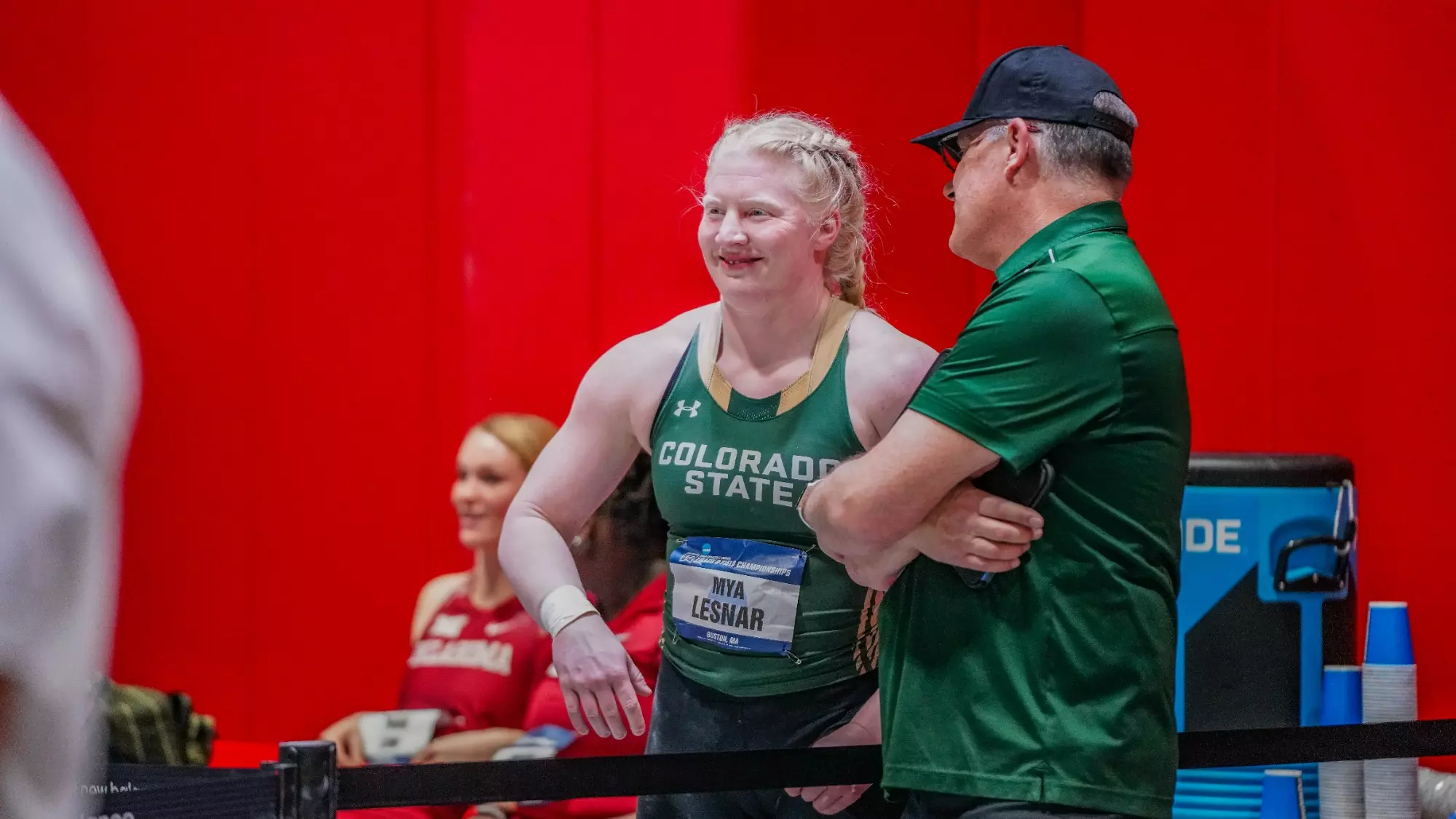
“I just decided I’m going to let go of what everyone thinks about me. I’m going to trust I put in the hours, I know my technique and I know my body,” Lesnar said of her personal revelation prior to this season. “I’m going to trust everything I’ve done is going to make this thing happen. Also, Bedard having trust in me and me having trust in him, knowing we’re going to do this together. I feel that’s where a lot of things turned for me. I have a connection with Bedard like I’ve never had before with any other coach.
“We like to joke and have fun, that’s our personality. We also know how to get down to business, and that’s why we work well together because if it wasn’t fun, I wouldn’t be doing what I do, and he makes it fun.”
A good feeling hit Bedard a week before the meet. During practice, Lesnar was in a good place. She had a smile on her face when she arrived at the Glenn Morris Fieldhouse and when she left. She joked with Morris and Bedard constantly. She listened. She provided feedback.
She was loose. She was poised.
“What I liked from the moment we left campus, that whole week leading into it, she seemed really happy. I didn’t see someone who was stressed out,” he said. “She was just very happy and excited it was NCAA week. I’m not sure we would have seen that last year. I think she would have been a stress monster. This year, with her maturity and the changes she made, I saw someone who was enjoying the whole experience.”
Morris saw the same thing. If anybody knows the signs, it’s her. She’s also had to tell her personal demons to pipe down in her career, a step which has made her an All-American multiple times. The initial talk doesn’t come easy, and the conversation has to creep up every now and again.
Over the course of 12 months, Morris had a front row seat to watch and help Lesnar through the process.
“She’s grown tons. I have been saying it for over a year, even while competing against her,” Morris said. “She has always been so explosive, and I knew she would throw 19 meters if she just lined all that up.”
Which she had to do on one specific day. Her 19-meter throws during the year no longer counted. If she was going to win the title, she had to do it that day.
Pressure, meet mindset.
She felt it, no doubt. She was at her peak in countering it, which started in warmups.
“There were times I was a little more nervous. I was kind of on a bit of a rollercoaster,” Lesnar said of the competition. “My warmup throws were very good, and I didn’t take that many. There was one that would have probably won the meet by 3 feet. That one was really big. My parents – we had a conversation after – they said it was really big because they could see it up above in the stands. If I’d have done that first throw, looking back, I would have only had to take one throw.
“I told Bedard, I took two throws and I feel good. I didn’t start out the way I wanted. I started out very low. Going into finals I was in seventh. I didn’t start out well, and I was a little nervous, but I told Bedard we made it to finals, I get three more throws. After I made it to finals, I was good to go. All the nerves and stress went away. Even though I was in seventh, I just needed to know I made it.”
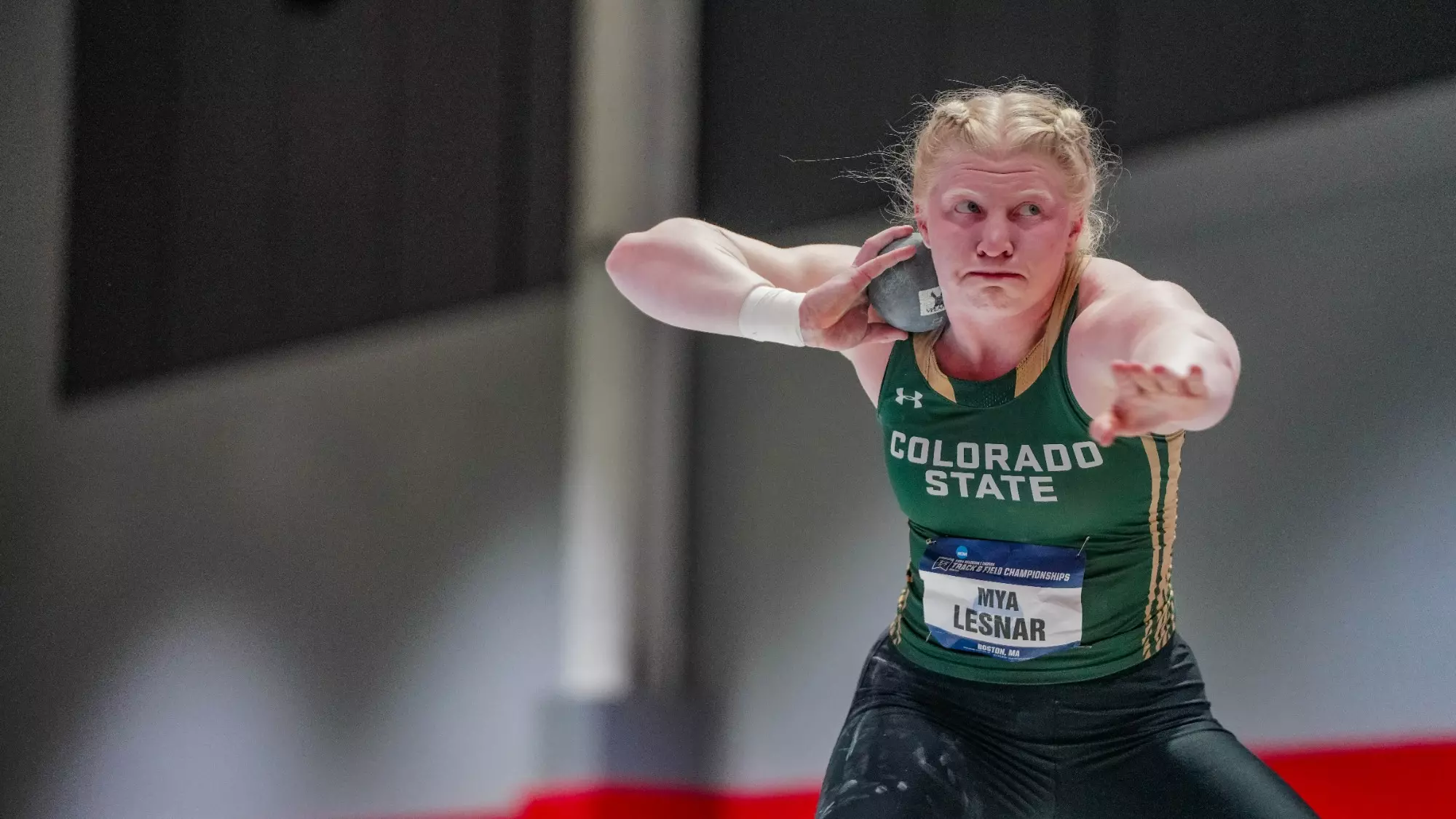
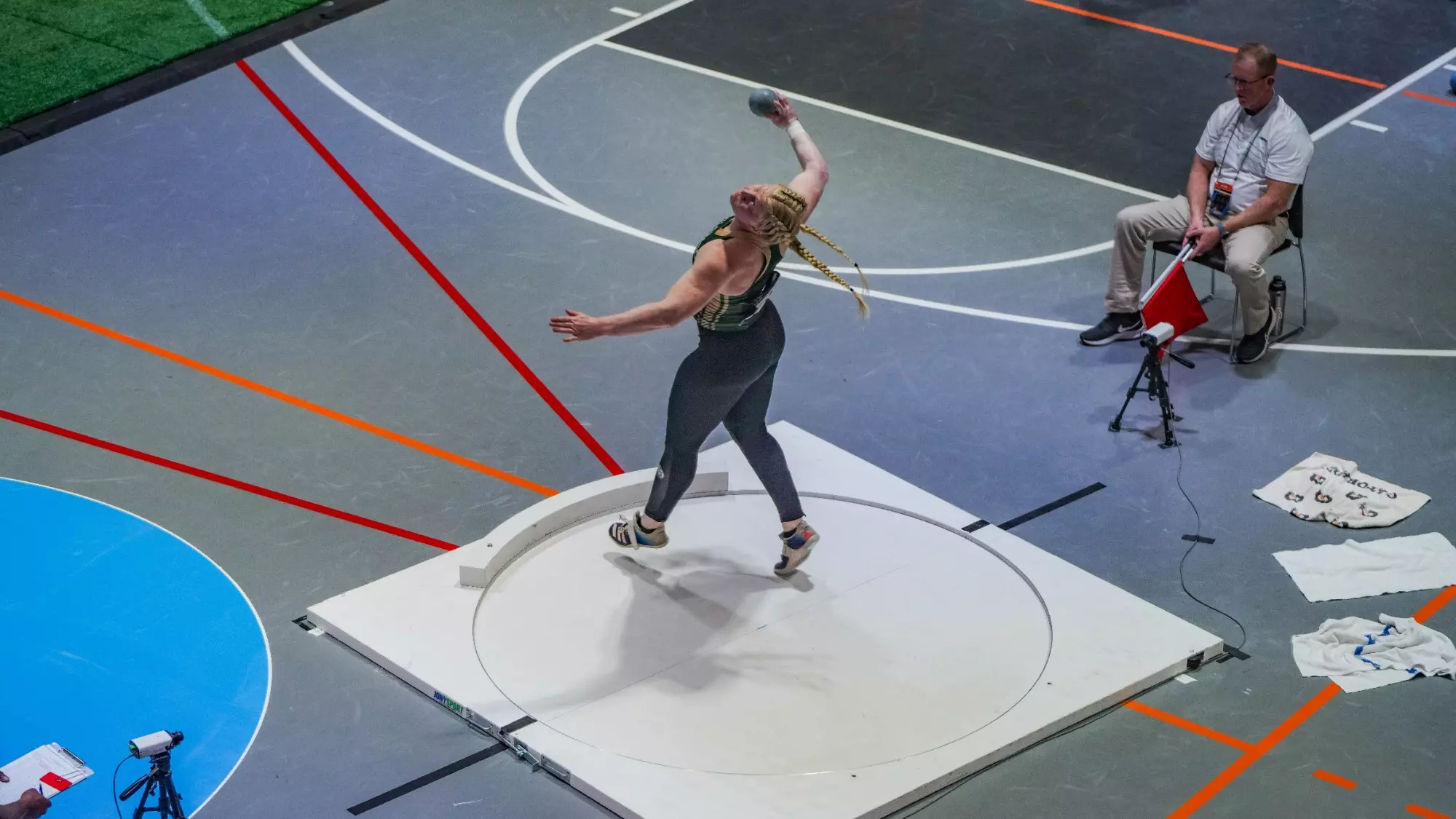
In finals, she threw two of the best three throws of the entire competition. The one which secured the title came in the opening round of finals, a toss of 18.53 meters. That was the second throw of the round, and the last attempt came from Oregon’s Jaida Ross. She hit 18.47. In the fifth round, Lesnar came back with an 18.42. On her sixth and final attempt, she scratched. Bedard felt it was his fault, getting her too hyped up. Lesnar shrugs off the suggestion of her coach, saying in the final round, everybody has the notion of go big and go for broke.
Nothing to lose.
But as she watched the final throws from the remaining six finalists, she had a title on the line.
“It was really hard. I went up to Bedard and said, ‘what do we do now?’ And I knew what we did now – nothing,” she said. “I still went up and said it, and he said well, we sit back and watch. He watched. I didn’t. I went back and I actually turned my back and just watched the scoreboard. It was six, then five and then four and then down to Jaida. That one, I don’t know if I was praying or what, but I think I told myself you’re either first or second. At that point, given all the circumstances, the tension, the pressure, I had done everything I could in that competition.
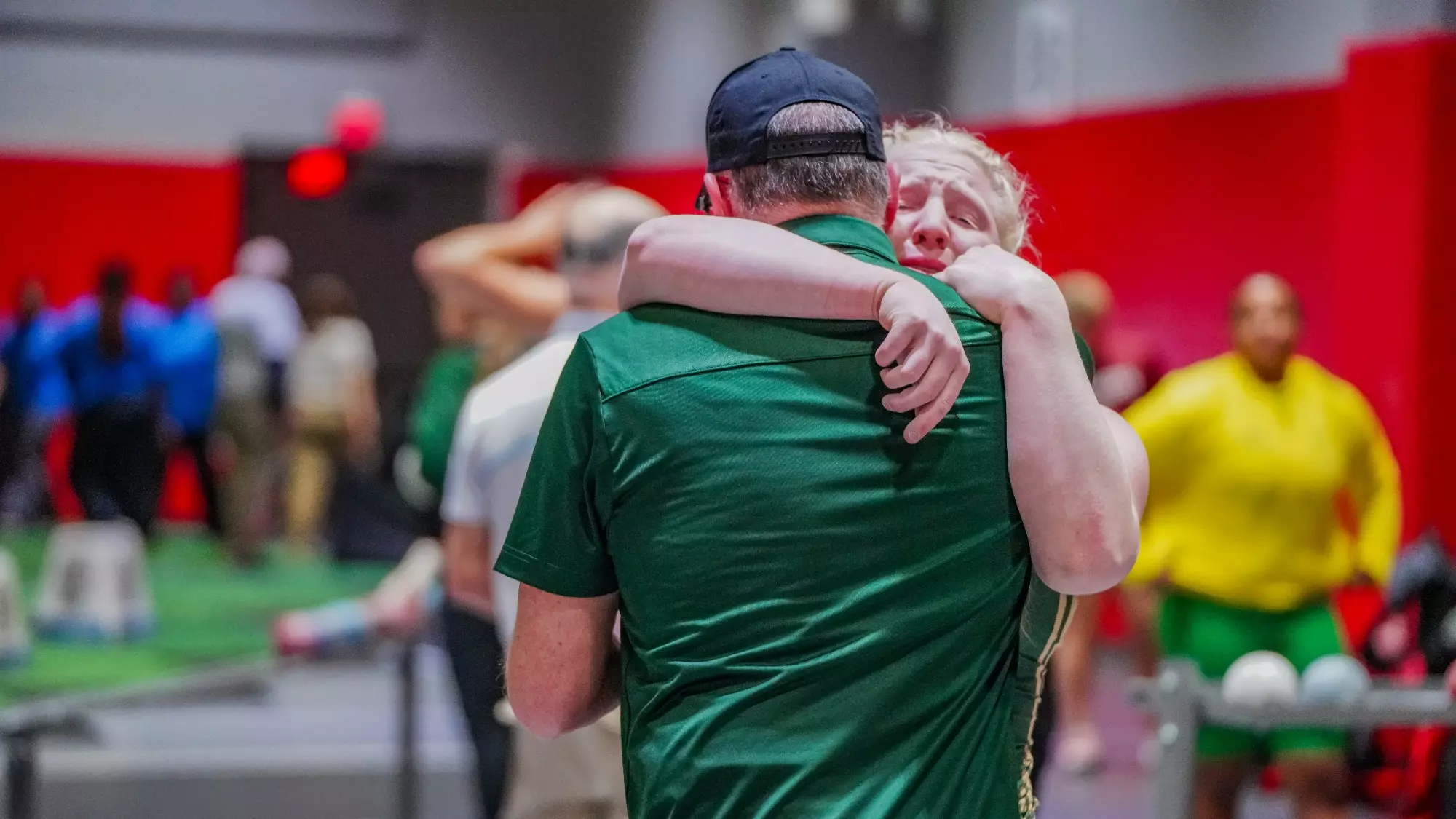
“Jaida threw, I saw it out of the corner of my eye, and I knew it wasn’t as far as mine. I ran to Bedard and said, did we do it? He said, ‘we did,’ and I started crying. In that moment, I think I looked at Jaida and I really like Jaida, I like competing with her. We’re good friends, and I kind of saw her go to her coach and she was sad, but I thought in the moment, you know what, I deserved this after everything I’ve bene through, I deserved this. I think Bedard and I both shed a tear, and that was one of the happiest nights of my life.”
Morris, who placed 13th, was not far behind the duo. Like Bedard, she watched. Like all of them, she knew.
“I got to be the one to tell her she won and give her her first hug before she ran off to hug Bedard,” Morris said.
It will always be a great memory, one which isn’t hard to retrieve in her mind. The day itself was dreamlike, but what it took to get there often held a nightmare theme.
Sort of like a plane ride. Winning left Lesnar exhausted, emotionally and physically. She almost slept a bit on the plane, which helped. Morris was in the seat next to her, giving her someone to talk with to take her mind off of the travel.
Right now, nothing beats the view in her living room. There, just below the television is the greatest reminder every single part of the journey was necessary and worthwhile.
“It's really cool honestly. I think it makes a person who they are, and it makes me want to work harder,” Lesnar said. “If it came easy, everybody would do it.”