
Colorado State University Athletics

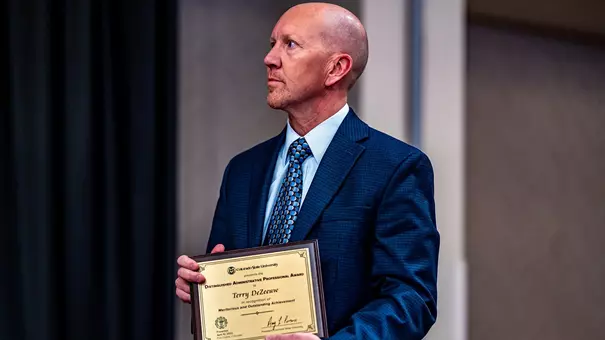
Photo by: Tomas Redondo
Parker Meets with Faculty Council to Discuss Athletics
3/6/2021 10:00:00 AM | RamWire
Director of Athletics looks forward to future meetings
Joe Parker is hoping the first-time meeting will become an annual event.
That was the invitation given to Colorado State's Director of Athletics when he met with the university's faculty council virtually on Tuesday, and it's one he intends to make good on in the years to come.
"The importance of engaging the faculty is to one, provide transparency in our reporting and help to some extent demystify the numbers for them to enter into a conversation where they can ask questions for clarity," Parker said. "It also gives us that chance to highlight the things we believe are important as it relates to how we support the overall mission of the institution.
"Anytime you're able to provide information and expand someone's view of the world, there's going to be some kind of benefit from that. I think this year, particularly with the good academic performance, it shows our students belong in the competitive classrooms here at CSU. Our students are diverse, our rosters are inclusive and they are important to our campus community."
Parker made a presentation highlighting the academic success of Colorado State's nearly 400 student-athletes, as well as the diversity they bring to campus. In addition, he outlined the athletic budget and the positive financial impacts athletics has on the university.
The past two semesters, 15 of CSU's 16 athletic rosters posted GPAs of 3.00 or better. In the spring of 2020 five teams held GPAs of 3.5 or better, a number which rose to six in the fall semester of the same academic year. The one sport which did not reach the 3.00 threshold – football – saw academic gains with the two best GPAs in recorded history, reaching 2.846 in the spring and 2.882 in the fall.
"That should be the faculty's first concern – are our students having success? I think we have been able to demonstrate our student-athletes are having success," Parker said.
As with all athletic departments at universities nationwide, dollars always become a hot topic, and Parker knows there are many in the academic realm of the university who never really come to grips with the expenditure or what it provides to the campus experience as a whole for all students and alumni.
He pointed out that 53 percent of direct university support to the athletic department is paid back in the form of revenue for other campus departments. He also understood some would look at those numbers in a different lens.
"That was probably the thing that drove more questions than anything else, as far as what we shared in data," Parker said. "It could be argued, is that number accurate or is it smaller? I think to define our direct institutional support after cash flows to other areas of campus is $10.4 million, and when you push that into the overall budget, it reflects a relatively modest overall investment in athletics.
"There's so many ways to slice it up from an economic perspective. A common part of economics is the multiplier effect, so the idea that you have a student on campus has a positive residual ripple effect for the broader economic community."
The $10.4 million in support Parker noted is 2 percent of all university education and general spending. Total university education and general expenses reached $510,354,256 in the fiscal year 2020.
Colorado State's student-athlete population represents 1.3 percent of all student enrolled, yet the group accounts for 2.0 of the total minoritized population at the university. The department of athletics employed 140 students in 2019, where they made $310.000. When it comes to game-day operations, vendor and security partners add more than $825,000 in employee earnings.
To him, the real goal is the education provided, and he could point to 101 total term GPAs of 4.0 in 2020 – 44 in the spring, 57 in the fall -- well above a 13-year average of 22 per term (from Spring of 2007-Fall of 2020).
Entering the meeting, Parker understood he would face detractors, but he also hoped – and feels – he was able to shed some newfound perspective and answer pressing questions many in the meeting held. For that reason, as well as promoting the academic achievements of the student-athletes, Parker is more than happy to meet with the group every year.
"That's the one thing I've always felt good about our mission is providing access to education. That directly supports the land-grant mission of the university," Parker said. "There are several students on our rosters that if they didn't have access to financial aid through a scholarship, they wouldn't know how to envision this experience. They wouldn't have a way to practically access it. By playing sports and being part of our department, they get the advantages of being a CSU student.
"Those are dollars well spent that change lives, and I think that falls perfectly in line with the overall mission of the university."
That was the invitation given to Colorado State's Director of Athletics when he met with the university's faculty council virtually on Tuesday, and it's one he intends to make good on in the years to come.
"The importance of engaging the faculty is to one, provide transparency in our reporting and help to some extent demystify the numbers for them to enter into a conversation where they can ask questions for clarity," Parker said. "It also gives us that chance to highlight the things we believe are important as it relates to how we support the overall mission of the institution.
"Anytime you're able to provide information and expand someone's view of the world, there's going to be some kind of benefit from that. I think this year, particularly with the good academic performance, it shows our students belong in the competitive classrooms here at CSU. Our students are diverse, our rosters are inclusive and they are important to our campus community."
Parker made a presentation highlighting the academic success of Colorado State's nearly 400 student-athletes, as well as the diversity they bring to campus. In addition, he outlined the athletic budget and the positive financial impacts athletics has on the university.
The past two semesters, 15 of CSU's 16 athletic rosters posted GPAs of 3.00 or better. In the spring of 2020 five teams held GPAs of 3.5 or better, a number which rose to six in the fall semester of the same academic year. The one sport which did not reach the 3.00 threshold – football – saw academic gains with the two best GPAs in recorded history, reaching 2.846 in the spring and 2.882 in the fall.
"That should be the faculty's first concern – are our students having success? I think we have been able to demonstrate our student-athletes are having success," Parker said.
As with all athletic departments at universities nationwide, dollars always become a hot topic, and Parker knows there are many in the academic realm of the university who never really come to grips with the expenditure or what it provides to the campus experience as a whole for all students and alumni.
He pointed out that 53 percent of direct university support to the athletic department is paid back in the form of revenue for other campus departments. He also understood some would look at those numbers in a different lens.
"That was probably the thing that drove more questions than anything else, as far as what we shared in data," Parker said. "It could be argued, is that number accurate or is it smaller? I think to define our direct institutional support after cash flows to other areas of campus is $10.4 million, and when you push that into the overall budget, it reflects a relatively modest overall investment in athletics.
"There's so many ways to slice it up from an economic perspective. A common part of economics is the multiplier effect, so the idea that you have a student on campus has a positive residual ripple effect for the broader economic community."
The $10.4 million in support Parker noted is 2 percent of all university education and general spending. Total university education and general expenses reached $510,354,256 in the fiscal year 2020.
Colorado State's student-athlete population represents 1.3 percent of all student enrolled, yet the group accounts for 2.0 of the total minoritized population at the university. The department of athletics employed 140 students in 2019, where they made $310.000. When it comes to game-day operations, vendor and security partners add more than $825,000 in employee earnings.
To him, the real goal is the education provided, and he could point to 101 total term GPAs of 4.0 in 2020 – 44 in the spring, 57 in the fall -- well above a 13-year average of 22 per term (from Spring of 2007-Fall of 2020).
Entering the meeting, Parker understood he would face detractors, but he also hoped – and feels – he was able to shed some newfound perspective and answer pressing questions many in the meeting held. For that reason, as well as promoting the academic achievements of the student-athletes, Parker is more than happy to meet with the group every year.
"That's the one thing I've always felt good about our mission is providing access to education. That directly supports the land-grant mission of the university," Parker said. "There are several students on our rosters that if they didn't have access to financial aid through a scholarship, they wouldn't know how to envision this experience. They wouldn't have a way to practically access it. By playing sports and being part of our department, they get the advantages of being a CSU student.
"Those are dollars well spent that change lives, and I think that falls perfectly in line with the overall mission of the university."


Tuesday, May 13
Wednesday, April 17
Thursday, April 20
Thursday, December 15