
Colorado State University Athletics
5/28/2026 10:01:00 AM | General
Former AD pushed CSU forward in brief stint
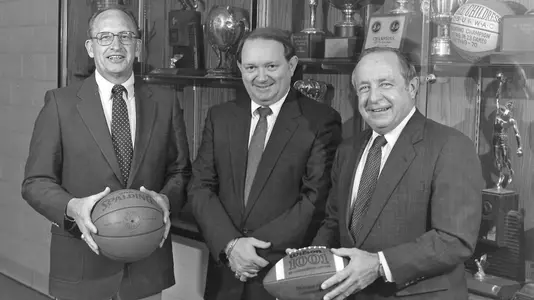
On Sunday, May 24, 2026, former CSU athletic director Oval Jaynes passed away at the age of 85 at his home in Morganton, N.C. He was born in Morganton on July 25, 1940; his full obituary is available here.
In 1986, Jaynes came to CSU to replace the legendary Fum McGraw as the school's athletic director, and upon his arrival in Fort Collins, he told student-athletes and coaches that CSU could and would get better to compete at a higher level in the NCAA. He made an immediate impact on the school when he hired former Colorado A&M basketball star turned CSU assistant coach, Boyd "Tiny" Grant, in 1987 as the head men's basketball coach.
Grant had made a name for himself after leaving CSU to be an assistant coach at Kentucky and later a head coach at the College of Southern Idaho where he won the junior college national championship in 1976. Grant then moved on to be the head coach at Fresno State, where he won three Pacific Coast Athletic Association (now known as the Big West) championships. Grant resigned from his position at Fresno State after the 1985-86 season and had been out of basketball for a year when Jaynes hired him.
In his first season, Grant did what his boss said would happen -- he took them to a higher level than Rams basketball had been in almost two decades. Grant led the Rams to the final four of the NIT in New York City, where CSU finished third, the highest finish any CSU men's basketball team has had in a postseason tournament.
Grant continued to lead his basketball teams in 1988-89 and 1989-90, winning back-to-back WAC championships and creating a new level of Moby Madness which had not been seen prior. The fire department even had to clear the aisles due to overcrowding at Moby in the late 1980s.
Jaynes did more than hire a new basketball coach when he arrived; he wanted the level of how CSU athletics was perceived to be taken up several notches as well. When Jaynes heard the name of the building where the Rams basketball and volleyball teams played was named Moby Gym, he said, "No big school plays in a building called a gym." Moby, built in 1966 and originally named Auditorium/Gymnasium, had morphed into the name Moby Gym, named by two students who thought it looked like a beached whale while it was under construction.
Jaynes did not mind the name Moby, but he would not have his athletic teams play in a gymnasium. Jaynes then had the name of the building changed to Moby Arena. If the Denver Nuggets could play at McNichols Arena, then the CSU Rams could play at a building called an arena, too. The name has stayed the same for nearly 40 years.
Jaynes made another contribution to CSU athletics, which is still felt today when he charged former athletes to create a Hall of Fame and banquet to honor the greatest of Aggies and Rams athletes. Former CSU football player Jim Smith, along with Alan Ashbaugh, gathered former players together and inducted the first CSU Sports Hall of Fame class in 1988. Since then and continuing today, CSU has inducted nearly 200 former athletes into its hall of fame, and their legacy lives on in Moby Arena's Hall of Fame on the south concourse.
Jaynes' most notable contribution to CSU athletics came in 1989 when he hired former Ohio State coach Earle Bruce to take over as the Rams' football coach. Bruce had made his name on the national stage as the assistant coach of Woody Hayes and went on to be a well-known head coach in his own right. CSU football had reached its lowest point since the 1960s, going 1-11 and 1-10 in 1987 and 1988. Bruce came in and immediately transformed the same players into a team that would believe in themselves.
In 1989, Bruce led the Rams to a 5-5-1 record, the second-best turnaround in college football that season. In 1990, Bruce lived up to Jaynes' promise to make CSU compete at a higher level. The Rams did not lose a game at home that season and finished the season with a 9-4 record, capped by becoming Freedom Bowl champions over Oregon and the first bowl win in school history.
The 1990 football season, combined with Grant's second WAC championship earlier that year, took CSU athletics to heights it had not seen since 1954-1955. Rarely in school history had both men's basketball and football had such successful seasons and it was all thanks to the hard work, determination and promises kept by Jaynes.
Jaynes left CSU in 1991, but his impact is felt not only in the hall of fame or in Moby Arena's name, but also in bringing in a national coach like Bruce, which allowed Sonny Lubick to take the reins with talented athletes and coaches to usher in the greatest era of football in school history.
Fans may have forgotten Jaynes or never even knew about him at CSU, but looking back on those five years he spent guiding Rams athletics, it is impossible not to see how impactful he was to CSU athletics.
In 1986, Jaynes came to CSU to replace the legendary Fum McGraw as the school's athletic director, and upon his arrival in Fort Collins, he told student-athletes and coaches that CSU could and would get better to compete at a higher level in the NCAA. He made an immediate impact on the school when he hired former Colorado A&M basketball star turned CSU assistant coach, Boyd "Tiny" Grant, in 1987 as the head men's basketball coach.
Grant had made a name for himself after leaving CSU to be an assistant coach at Kentucky and later a head coach at the College of Southern Idaho where he won the junior college national championship in 1976. Grant then moved on to be the head coach at Fresno State, where he won three Pacific Coast Athletic Association (now known as the Big West) championships. Grant resigned from his position at Fresno State after the 1985-86 season and had been out of basketball for a year when Jaynes hired him.
In his first season, Grant did what his boss said would happen -- he took them to a higher level than Rams basketball had been in almost two decades. Grant led the Rams to the final four of the NIT in New York City, where CSU finished third, the highest finish any CSU men's basketball team has had in a postseason tournament.
Grant continued to lead his basketball teams in 1988-89 and 1989-90, winning back-to-back WAC championships and creating a new level of Moby Madness which had not been seen prior. The fire department even had to clear the aisles due to overcrowding at Moby in the late 1980s.
Jaynes did more than hire a new basketball coach when he arrived; he wanted the level of how CSU athletics was perceived to be taken up several notches as well. When Jaynes heard the name of the building where the Rams basketball and volleyball teams played was named Moby Gym, he said, "No big school plays in a building called a gym." Moby, built in 1966 and originally named Auditorium/Gymnasium, had morphed into the name Moby Gym, named by two students who thought it looked like a beached whale while it was under construction.
Jaynes did not mind the name Moby, but he would not have his athletic teams play in a gymnasium. Jaynes then had the name of the building changed to Moby Arena. If the Denver Nuggets could play at McNichols Arena, then the CSU Rams could play at a building called an arena, too. The name has stayed the same for nearly 40 years.
Jaynes made another contribution to CSU athletics, which is still felt today when he charged former athletes to create a Hall of Fame and banquet to honor the greatest of Aggies and Rams athletes. Former CSU football player Jim Smith, along with Alan Ashbaugh, gathered former players together and inducted the first CSU Sports Hall of Fame class in 1988. Since then and continuing today, CSU has inducted nearly 200 former athletes into its hall of fame, and their legacy lives on in Moby Arena's Hall of Fame on the south concourse.
Jaynes' most notable contribution to CSU athletics came in 1989 when he hired former Ohio State coach Earle Bruce to take over as the Rams' football coach. Bruce had made his name on the national stage as the assistant coach of Woody Hayes and went on to be a well-known head coach in his own right. CSU football had reached its lowest point since the 1960s, going 1-11 and 1-10 in 1987 and 1988. Bruce came in and immediately transformed the same players into a team that would believe in themselves.
In 1989, Bruce led the Rams to a 5-5-1 record, the second-best turnaround in college football that season. In 1990, Bruce lived up to Jaynes' promise to make CSU compete at a higher level. The Rams did not lose a game at home that season and finished the season with a 9-4 record, capped by becoming Freedom Bowl champions over Oregon and the first bowl win in school history.
The 1990 football season, combined with Grant's second WAC championship earlier that year, took CSU athletics to heights it had not seen since 1954-1955. Rarely in school history had both men's basketball and football had such successful seasons and it was all thanks to the hard work, determination and promises kept by Jaynes.
Jaynes left CSU in 1991, but his impact is felt not only in the hall of fame or in Moby Arena's name, but also in bringing in a national coach like Bruce, which allowed Sonny Lubick to take the reins with talented athletes and coaches to usher in the greatest era of football in school history.
Fans may have forgotten Jaynes or never even knew about him at CSU, but looking back on those five years he spent guiding Rams athletics, it is impossible not to see how impactful he was to CSU athletics.



Thursday, July 02
Wednesday, July 01
Tuesday, June 30
Wednesday, June 17