
Colorado State University Athletics
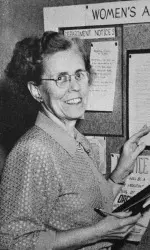
Elizabeth Forbes - Pioneer of Women's Athletics at Colorado State
9/30/2014 12:00:00 AM | General
Sept. 30, 2014
By John Hirn
It is hard to imagine what women’s athletics at CSU was like before 1976. Today, we don’t think twice about Rams volleyball, softball, golf, tennis, swimming and basketball teams being part of the entire department of athletics.
With the exception of basketball from 1899 to 1907, women at CSU did not compete in intercollegiate athletics until the late 1950s. They did not consistently compete against other colleges until the late 1960s and early 1970s before Title IX and the full creation of a women’s athletics department in 1976.
During the Aggie days, women had their own segregated athletic association, which was directed by Elizabeth Forbes from 1920 to 1959. Forbes was born in Springfield, Mass., on Sept. 9, 1894 and graduated from the Sargent College of Physical Education at Boston University in 1916. She later taught physical education in Toronto and Schenectady, N.Y., before making the trip out to Colorado in the fall of 1920.
Forbes helped change women’s athletics at Colorado State and in 1922 she formed the Women’s Athletic Association, or WAA so that the school could, “Create and promote interest in athletic activities among Aggie girls.”
This association was run similar to how the athletic association for men was run with faculty members and students on a board that organized the various sports women played among themselves. Women did not compete against other colleges and universities; their sporting involvement was within the college.
Sports like volleyball, swimming, baseball, basketball, archery, tennis, field hockey, hiking, soccer and more were played by up to 30 percent of the women in the college. These women could earn letters through a point system. With a minimum of 100 points and a “C” average they could compete in various sports earning 100 points per sport.
Once they achieved 300 points they could get a WAA pin, 800 points earned them a green letter “A”. (Men won gold letter “A”s) Then at 1,000 points women would earn a gold sweater to sew their green “A” onto and finally with 1,600 points a woman would earn a silver loving cup.
Ammons Hall, built in 1922, served as the home of Women’s Athletics and is where Elizabeth Forbes taught physical education to all women of the campus. This building, located in the northwest corner of the Oval, housed a gymnasium, classrooms, offices and the first on-campus swimming pool. Many Silver Spruce yearbooks show Forbes and her WAA athletes participating in these various sports either inside of Ammons Hall or on the lawn surrounding the building.
Throughout the 1920s and 1930s, Elizabeth Forbes continued to guide and direct the women in these sports, gaining respect and admiration from her students and peers. Forbes continued her education graduating with her bachelor’s degree in education from the University of California in 1928 and a master’s degree from New York University in 1940. She then guided women’s athletics throughout the duration of WWII.
In 1931, Forbes published a 16-page book titled “Home Play, 50 Answers to the Question: What can we play?” The booklet was a guide to families for games they could play with their children at home.
Besides the sports she guided, Forbes also trained women in dance under the college name of “Orchesis.” Her dance classes later became very popular among the Aggie women.
By the early 1950s, Forbes had found a new assistant director of women’s athletics named Virginia Frank. Frank began to instill new reforms at Colorado A&M that changed how the WAA had operated under Forbes for more than 30 years.
By 1956, women of the WAA were able to compete against other colleges for the first time since the early 1900s. Although nothing like today’s intercollegiate sports, the new system pitted the best women at Colorado A&M against the best women of the other colleges and universities in the Rocky Mountain region. These were not organized teams that played in a conference; it was not competitive like modern women’s athletics are today.
This new ability to allow women to compete against other schools led to more modern changes in women’s athletics. Track and field along with swimming became the first two sports to develop into competitive intercollegiate athletics, but not until the 1970s did it become more organized.
The Silver Spruce yearbooks of the late 1950s describe Elizabeth Forbes as a “friend to all” and the “Little lady with the great big smile”. She was beloved by her athletes and had guided the women for 39 years until her retirement in 1959.
She belonged to the American Association of University Women, the American Association for Health, Physical Education and Recreation and was a member of Delta Kappa Gamma.
Following her retirement in 1959, Forbes wrote a book in 1962 titled “Ammons Hall: 40 years of service 1922-1962.” The book outlined the history of the building where she spent her career training women in athletics and dance.
Elizabeth Forbes remained in Fort Collins after retirement and occasionally guest lectured at CSU. She did not appear to be a frequent face in the athletic department during her retirement and although she spent so many years at CSU as an associate professor and director of women’s athletics, few people today remember her after retirement.
Elizabeth Forbes died on January 16, 1992 at the Good Samaritan Nursing Home on Trilby Road in Fort Collins at the age of 97. She laid the groundwork for women’s athletics at a time when her resources were limited and helped pave the way to the modernization of women’s athletics in the 1960s and 1970s.


Wednesday, May 20
Friday, May 15
Thursday, April 30
Tuesday, April 28