

Colorado State University Athletics
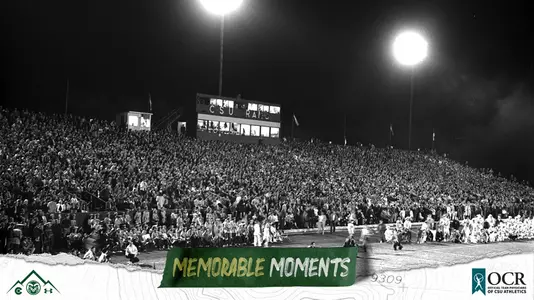
Memorable Moments: Night Games Have Been Special for CSU
10/28/2021 3:00:00 PM | Football
First one was played in 1948
As a kid in the mid-1980s, 1993 Colorado State graduate Jim Starling proudly wore his T-shirt that read, "No Lights at Wrigley Field!" It was a battle cry of Cubs fans for many years, and while it may be difficult for some to believe the Chicago Cubs didn't play a night game at home until August 8, 1988, today it is very common to see sports under the lights.
In 2021, the Rams will play five of their six home games under the lights of Canvas Stadium. While we may look at night football as something more common today, it was not until the 1930s that the first night games were played in Colorado, and 1948 was the first on the CSU campus.
The first night game under artificial lighting ever played by a CSU team occurred on September 27, 1930, at DU Stadium in Denver. The week before the Aggies took on Regis College, the University of Denver had taken on Regis at DU Stadium in the first ever night football game in Colorado history. In the Aggies first night game, it was a disaster when they lost 14-7 to the tiny college which later dropped football. A white football to help players and fans see better couldn't help the Aggies under the unfamiliar artificial lighting.
While the Aggies played occasional night games in Denver and at other schools after 1930, it was not until after WWII that Colorado A&M decided it would try playing a night game in Fort Collins. The only problem, Colorado Field was not equipped with lights and the administration was unsure if it would pay off to install them. Luckily, Fort Collins High School had installed lighting and the opening game of the 1947 season was played at the high school field as an experiment for night football in Fort Collins.
In the only CSU home football game in the 20th Century played on a field not owned by the school, the Aggies beat the Colorado School of Mines handedly. It was the first game of new head coach Bob Davis and the first for the legendary Eddie Hanna, who ran roughshod over the Miners. The Aggies played two more road night games that year, so Davis also instituted another first for the football program, different color jerseys.
Davis was the first head coach to implement a white football jersey, not for road games, but rather for day football games. He then reserved his green jerseys for night games to make it more difficult for opposing players to see the Aggies. While this rule was never followed very well, it was not until 1956 that CSU football switched to white jerseys for road games and green jerseys for home games. This is why so many historic photos from 1947-1956 show Aggie players in white jerseys.
In 1948, with six new 100-foot wooden light poles installed at Colorado Field, the first on-campus night game occurred against Colorado College in an 8 p.m. start time. At least one and sometimes two, night games would be played at Colorado Field until its ultimate demise after the 1967 season. Nearly all those games started at 8 p.m. and were usually played early in the season.
When Hughes Stadium opened in 1968, the school chose not to install lighting to save costs and showcase their new concrete giant in the daylight. Television had never been the reason for night football at Colorado Field and in 1968, CSU did not see the future of what games played at night could bring. Over the years many games could have used lighting as the weather or shorter days created a darkened condition but there was no discussion to install lighting.
It was the success of the 1990 Rams and Earle Bruce which brought ESPN to Hughes Stadium on October 31, 1991, for a game against BYU. The cable network chose to air the nationally televised game at night, the only issue was that Hughes Stadium still had no lights. That was corrected by bringing in four large trucks with lights that extended over the stands at Hughes Stadium and instantly created a night game for the fans and people watching from coast-to-coast. They even turned the lights toward the parking lot after the game so fans could find their cars.
Throughout the 1990s these trucked-in lights brought football from Hughes Stadium to all corners of the country and helped Sonny Lubick's teams gain recruits from all over the map. It was not until 2000, 33 years after Hughes Stadium was built, that permanent lights were installed for more of these night games to occur. With six sets of light poles, (later more after the 2004 expansion) the brightness on the Hughes Stadium turf was improved.
On December 31, 2011, just 28 days after a windy game against Wyoming, another blustery day in Fort Collins brought the center light pole attached to the press box down and into the outdoor seating below the Rams Horn indoor club. Had the pole fallen during the windy December 3 Wyoming game, several Rams fans would have been seriously injured or killed -- including this author whose seats were obliterated by the heavy steel pole.
Canvas Stadium is the first football stadium at CSU to be built with lights and those lights are state-of-the-art. With LED and flashing capabilities, they are a far cry from the six wooden poles at Colorado Field.
Football at night is here to stay, just like Wrigley Field will continue to have lights despite the protest's fans made in the 1980s.
In 2021, the Rams will play five of their six home games under the lights of Canvas Stadium. While we may look at night football as something more common today, it was not until the 1930s that the first night games were played in Colorado, and 1948 was the first on the CSU campus.
The first night game under artificial lighting ever played by a CSU team occurred on September 27, 1930, at DU Stadium in Denver. The week before the Aggies took on Regis College, the University of Denver had taken on Regis at DU Stadium in the first ever night football game in Colorado history. In the Aggies first night game, it was a disaster when they lost 14-7 to the tiny college which later dropped football. A white football to help players and fans see better couldn't help the Aggies under the unfamiliar artificial lighting.
While the Aggies played occasional night games in Denver and at other schools after 1930, it was not until after WWII that Colorado A&M decided it would try playing a night game in Fort Collins. The only problem, Colorado Field was not equipped with lights and the administration was unsure if it would pay off to install them. Luckily, Fort Collins High School had installed lighting and the opening game of the 1947 season was played at the high school field as an experiment for night football in Fort Collins.
In the only CSU home football game in the 20th Century played on a field not owned by the school, the Aggies beat the Colorado School of Mines handedly. It was the first game of new head coach Bob Davis and the first for the legendary Eddie Hanna, who ran roughshod over the Miners. The Aggies played two more road night games that year, so Davis also instituted another first for the football program, different color jerseys.
Davis was the first head coach to implement a white football jersey, not for road games, but rather for day football games. He then reserved his green jerseys for night games to make it more difficult for opposing players to see the Aggies. While this rule was never followed very well, it was not until 1956 that CSU football switched to white jerseys for road games and green jerseys for home games. This is why so many historic photos from 1947-1956 show Aggie players in white jerseys.
In 1948, with six new 100-foot wooden light poles installed at Colorado Field, the first on-campus night game occurred against Colorado College in an 8 p.m. start time. At least one and sometimes two, night games would be played at Colorado Field until its ultimate demise after the 1967 season. Nearly all those games started at 8 p.m. and were usually played early in the season.
When Hughes Stadium opened in 1968, the school chose not to install lighting to save costs and showcase their new concrete giant in the daylight. Television had never been the reason for night football at Colorado Field and in 1968, CSU did not see the future of what games played at night could bring. Over the years many games could have used lighting as the weather or shorter days created a darkened condition but there was no discussion to install lighting.
It was the success of the 1990 Rams and Earle Bruce which brought ESPN to Hughes Stadium on October 31, 1991, for a game against BYU. The cable network chose to air the nationally televised game at night, the only issue was that Hughes Stadium still had no lights. That was corrected by bringing in four large trucks with lights that extended over the stands at Hughes Stadium and instantly created a night game for the fans and people watching from coast-to-coast. They even turned the lights toward the parking lot after the game so fans could find their cars.
Throughout the 1990s these trucked-in lights brought football from Hughes Stadium to all corners of the country and helped Sonny Lubick's teams gain recruits from all over the map. It was not until 2000, 33 years after Hughes Stadium was built, that permanent lights were installed for more of these night games to occur. With six sets of light poles, (later more after the 2004 expansion) the brightness on the Hughes Stadium turf was improved.
On December 31, 2011, just 28 days after a windy game against Wyoming, another blustery day in Fort Collins brought the center light pole attached to the press box down and into the outdoor seating below the Rams Horn indoor club. Had the pole fallen during the windy December 3 Wyoming game, several Rams fans would have been seriously injured or killed -- including this author whose seats were obliterated by the heavy steel pole.
Canvas Stadium is the first football stadium at CSU to be built with lights and those lights are state-of-the-art. With LED and flashing capabilities, they are a far cry from the six wooden poles at Colorado Field.
Football at night is here to stay, just like Wrigley Field will continue to have lights despite the protest's fans made in the 1980s.
Tuesday, July 07
Thursday, May 14
Monday, May 11
Friday, May 08