





Colorado State University Athletics
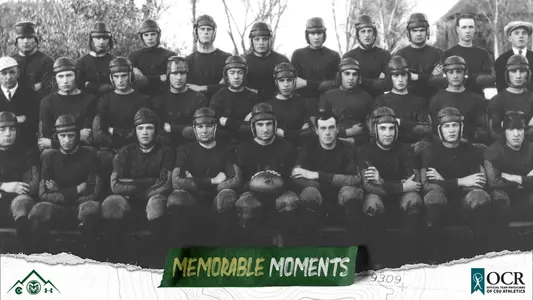
Memorable Moments: Going Up Against Stagg
9/23/2021 3:00:00 PM | Football
Rams took on Big Ten beast Chicago back in 1923
All early season "dope" in September of 1923 focused on the announcement about the game the Aggies would play against legendary football coach Amos Alonzo Stagg and his University of Chicago Big 10 defending conference champions. To that date, no non-conference game in the school's history had ever received as much press as the game against Stagg's dominating team. With several returning players from the 1922 season, the Aggies seemed to have an extremely strong squad in 1923. After an embarrassing 35-0 drubbing the Maroons had unleashed on the University of Colorado in 1921, the school hoped Hughes would not embarrass the Aggies in the same way.
Stagg's name remains a legend in collegiate football history, and in 1923 he was equally a legend, too. At 61 years of age, Stagg had coached the University of Chicago football team since 1892, won six Big 10 Conference championships and in 1905 coached the undisputed national championship Maroon team. Over his 31 seasons he had been credited with the invention of the lateral, tackling dummy, man-in-motion play and the placement of numbers on the uniforms to tell players apart.
Stagg's team had won the co-championship of the Big 10 in 1922, and the press reported the odds in his favor to win it again with one of his strongest teams ever. Each week which led up to the season opener against Wyoming, the Fort Collins Express Courier printed article after article about Stagg and Chicago.
After the Wyoming game, Hughes' focus turned to the Maroons for the October 6th battle. Since the team was set to leave for Chicago on Wednesday afternoon October 3rd, this gave Hughes only two full practices before his team would have to travel 1,000 miles to the Windy City.
In a rare Sunday evening practice, one day after the Wyoming game, Hughes did not just practice his team hard, he put them through an 80-minute scrimmage against the freshman team. He brought in floodlights rather than auto headlights to continue their practice after dark, and Hughes ordered Jack Houser to punt over and over again since he knew the strength of the Maroon defense.
Hughes also had an ace up his sleeve in the form of Charles Shepardson, the former star of the 1915 and 1916 teams who had been the freshman coach for the past three seasons. Shep took a sabbatical in Iowa to complete his doctoral studies, and always the consummate Aggie, he witnessed the Chicago game against Michigan State the previous week on a scouting mission.
On Wednesday, October 3rd at 3:45 p.m., the Aggies' train pulled out of the Fort Collins Union Pacific train station at Jefferson Street and Pine Street and headed to Chicago on what became the longest road trip in school history to that point. A massive crowd of fans and students gathered at 3:30 to say goodbye and wish their team well. College President Charles Lory not only accompanied his team on the trip, but he also allowed for classes to be dismissed early so the entire student body and band could see the team leave.
On Thursday at noon, the team arrived in Ames, Iowa to go through a light practice and spend time with "Chuck" Shepardson to get a scouting report on the Chicago team. The short workout ended in time for the team to jump back on the train at 6 p.m. for an overnight trip into the city of Chicago.
Before a crowd estimated at 15,000, the Colorado Agricultural College Aggies took the field against the University of Chicago Maroons on Stagg Field. Harry Hughes, 36-years- old and known as an upcoming coach from the west, faced off against 61-year-old Amos Alonzo Stagg, about whom Knute Rockne once said, "All football comes from Stagg."
On a gray and cloudy day, the game opened as a defensive struggle against the two teams. Stagg expected to replace his starters during the second half in anticipation of his next game against Northwestern, but the Aggies game never got to a point where Stagg could afford to play anybody besides his first team. The Maroons struck first when Houser punted in the closing minutes of the first quarter deep in his own territory. Chicago's Henderson blocked the punt at the 5-yard line and Rohrke covered the ball in the Aggie end zone for a touchdown.
As the game continued to be a close battle, Rohrke put three more points on the board with a 30-yard drop kick in the second quarter. Nearly 20 punts between both schools along with a few missed drop kicks kept the Aggies and Maroons to a 10-0 final score in Chicago's favor. The efforts of Shep's scouting had paid off. Houser's punting, along with a strong defensive effort, helped keep the Maroons from an offensive touchdown. Twice the Maroons ended up on the 5-yard line and both times the Aggie defense held them.
Chicago only completed 3 of 13 passes, which showed how effective the Aggie defense was against the bigger and faster Maroon offense. Although they lost and were shut out, the Aggies held the Maroons to the fewest points scored in a winning game during Chicago's 1923 season. According to news reports, "The Colorado Aggies did much to raise the regard of Western football in the eyes of Eastern conferences."
The low score in the Chicago game prevented the embarrassment CU received in 1921 and opened the eyes of the nation when the Aggies held the Big 10 team to just 10 points.
Lory said of the trip, "A world of favorable advertising comes to the Aggies."
Stagg's name remains a legend in collegiate football history, and in 1923 he was equally a legend, too. At 61 years of age, Stagg had coached the University of Chicago football team since 1892, won six Big 10 Conference championships and in 1905 coached the undisputed national championship Maroon team. Over his 31 seasons he had been credited with the invention of the lateral, tackling dummy, man-in-motion play and the placement of numbers on the uniforms to tell players apart.
Stagg's team had won the co-championship of the Big 10 in 1922, and the press reported the odds in his favor to win it again with one of his strongest teams ever. Each week which led up to the season opener against Wyoming, the Fort Collins Express Courier printed article after article about Stagg and Chicago.
After the Wyoming game, Hughes' focus turned to the Maroons for the October 6th battle. Since the team was set to leave for Chicago on Wednesday afternoon October 3rd, this gave Hughes only two full practices before his team would have to travel 1,000 miles to the Windy City.
In a rare Sunday evening practice, one day after the Wyoming game, Hughes did not just practice his team hard, he put them through an 80-minute scrimmage against the freshman team. He brought in floodlights rather than auto headlights to continue their practice after dark, and Hughes ordered Jack Houser to punt over and over again since he knew the strength of the Maroon defense.
Hughes also had an ace up his sleeve in the form of Charles Shepardson, the former star of the 1915 and 1916 teams who had been the freshman coach for the past three seasons. Shep took a sabbatical in Iowa to complete his doctoral studies, and always the consummate Aggie, he witnessed the Chicago game against Michigan State the previous week on a scouting mission.
On Wednesday, October 3rd at 3:45 p.m., the Aggies' train pulled out of the Fort Collins Union Pacific train station at Jefferson Street and Pine Street and headed to Chicago on what became the longest road trip in school history to that point. A massive crowd of fans and students gathered at 3:30 to say goodbye and wish their team well. College President Charles Lory not only accompanied his team on the trip, but he also allowed for classes to be dismissed early so the entire student body and band could see the team leave.
On Thursday at noon, the team arrived in Ames, Iowa to go through a light practice and spend time with "Chuck" Shepardson to get a scouting report on the Chicago team. The short workout ended in time for the team to jump back on the train at 6 p.m. for an overnight trip into the city of Chicago.
Before a crowd estimated at 15,000, the Colorado Agricultural College Aggies took the field against the University of Chicago Maroons on Stagg Field. Harry Hughes, 36-years- old and known as an upcoming coach from the west, faced off against 61-year-old Amos Alonzo Stagg, about whom Knute Rockne once said, "All football comes from Stagg."
On a gray and cloudy day, the game opened as a defensive struggle against the two teams. Stagg expected to replace his starters during the second half in anticipation of his next game against Northwestern, but the Aggies game never got to a point where Stagg could afford to play anybody besides his first team. The Maroons struck first when Houser punted in the closing minutes of the first quarter deep in his own territory. Chicago's Henderson blocked the punt at the 5-yard line and Rohrke covered the ball in the Aggie end zone for a touchdown.
As the game continued to be a close battle, Rohrke put three more points on the board with a 30-yard drop kick in the second quarter. Nearly 20 punts between both schools along with a few missed drop kicks kept the Aggies and Maroons to a 10-0 final score in Chicago's favor. The efforts of Shep's scouting had paid off. Houser's punting, along with a strong defensive effort, helped keep the Maroons from an offensive touchdown. Twice the Maroons ended up on the 5-yard line and both times the Aggie defense held them.
Chicago only completed 3 of 13 passes, which showed how effective the Aggie defense was against the bigger and faster Maroon offense. Although they lost and were shut out, the Aggies held the Maroons to the fewest points scored in a winning game during Chicago's 1923 season. According to news reports, "The Colorado Aggies did much to raise the regard of Western football in the eyes of Eastern conferences."
The low score in the Chicago game prevented the embarrassment CU received in 1921 and opened the eyes of the nation when the Aggies held the Big 10 team to just 10 points.
Lory said of the trip, "A world of favorable advertising comes to the Aggies."


Inside the Wide Receiver Room | Colorado State Football | Rams Live
Sunday, April 19
Colorado State Football: Jim Mora Final Spring Practice Presser
Friday, April 17
Inside the Linebacker Room | Colorado State Football | Rams Live
Tuesday, April 14
Inside the Running Back Room | Colorado State Football | Rams Live
Monday, April 06