









Colorado State University Athletics
Memorable Moments: Ag Day a Longstanding Tradition
9/9/2021 2:00:00 PM | Football
Orange returned to uniforms back in 2010
FORT COLLINS, Colo. -- The Rams revert to their roots this week and once again will don the Aggie orange uniforms, this time with a 1966 throwback Ram logo on their helmets. The celebration of Ag Day goes back more than 40 years as Colorado State honors its heritage when the team went by the name Colorado Aggies from 1890-1945.
Since 2010, CSU has emphasized the orange of the Aggie era with Orange Outs and orange jerseys, one of the original colors of the school when the first football team chose green and orange as the school colors in 1893. The official school colors have been green and gold since 1909, when then college president Charles Lory made the change. The orange in the school's colors, a secondary color with green as the dominant color, was meant to represent pumpkin. Later, the gold was meant to represent the golden corn grown in Colorado by farmers attending the school, it had nothing to do with the mineral mined in the mountains of the great state.
Between 1909 and roughly 1957, that "gold" often appeared as an orange color on uniforms and other college material. These were the days when there were no guidelines to color, the green changed from dark green to light green and back to an exceptionally dark green that was nearly black. Yellow often represented gold as well, but frequently orange was used during the so-called Aggie era.
The Aggie era can be defined as 1899 to 1959. The Aggies represented the agricultural education that CSU was founded upon, farmers were needed to learn about how to grow and engineer food for an ever-expanding nation. Students came from the farms of Colorado and the surrounding states to learn about everything from growing wheat to raising cattle -- something still very necessary in this country today and why we honor this era in our history.
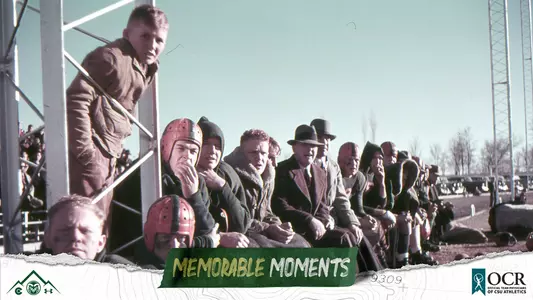
In August 2021, color slides of 1938 Aggies football season surfaced on eBay and have been returned to the school to preserve in the athletic archives. These photos show what the orange of the Aggie era really looked like in the infancy of color photography. These earliest known color photos of CSU football were taken by William Madsen, a senior and editor of the yearbook who aspired to be a journalist. Color photography by the Kodak Corporation became available for still pictures in 1936, just two years before these amazing shots were taken by Madsen.
Madsen captured the close-up look of football from the sidelines and his color images allow us to see for the first time those uniforms and orange helmets brightly shining on a sunny Thanksgiving Day in Albuquerque. Although the Aggies went 1-5-2 in 1938, we can see the legendary Harry Hughes with his trusty assistant coach Hans Wagner sitting on the bench, a young unidentified boy lurking over the team on the light tower. The photo seemingly has a Norman Rockwell feel and might appear as if it came from the cover of The Saturday Evening Post. It shows an era of football none of us have ever known, and by having it in brilliant color, the photos bring the game to life.
The Aggies always used green as their primary color, but in 1940, Hughes ordered the first orange jerseys to go along with new orange pants. The "Orange-clad Aggies" of 1940 brightly lit up the football field and were mocked at a time prior to the modern era when both pants and jerseys were never the same color. It was not until 2010 that CSU football ever wore an orange jersey again.
As we look back on the Aggie era, it is important to remember why we honor our agricultural roots, not just in sports but in American history. A wise old man once said, "Never make fun of a farmer when you have food on the table." We can thank our agricultural community today for keeping that food on our tables through the research and extension services still possible at Colorado State University.
Since 2010, CSU has emphasized the orange of the Aggie era with Orange Outs and orange jerseys, one of the original colors of the school when the first football team chose green and orange as the school colors in 1893. The official school colors have been green and gold since 1909, when then college president Charles Lory made the change. The orange in the school's colors, a secondary color with green as the dominant color, was meant to represent pumpkin. Later, the gold was meant to represent the golden corn grown in Colorado by farmers attending the school, it had nothing to do with the mineral mined in the mountains of the great state.
Between 1909 and roughly 1957, that "gold" often appeared as an orange color on uniforms and other college material. These were the days when there were no guidelines to color, the green changed from dark green to light green and back to an exceptionally dark green that was nearly black. Yellow often represented gold as well, but frequently orange was used during the so-called Aggie era.
The Aggie era can be defined as 1899 to 1959. The Aggies represented the agricultural education that CSU was founded upon, farmers were needed to learn about how to grow and engineer food for an ever-expanding nation. Students came from the farms of Colorado and the surrounding states to learn about everything from growing wheat to raising cattle -- something still very necessary in this country today and why we honor this era in our history.
In August 2021, color slides of 1938 Aggies football season surfaced on eBay and have been returned to the school to preserve in the athletic archives. These photos show what the orange of the Aggie era really looked like in the infancy of color photography. These earliest known color photos of CSU football were taken by William Madsen, a senior and editor of the yearbook who aspired to be a journalist. Color photography by the Kodak Corporation became available for still pictures in 1936, just two years before these amazing shots were taken by Madsen.
Madsen captured the close-up look of football from the sidelines and his color images allow us to see for the first time those uniforms and orange helmets brightly shining on a sunny Thanksgiving Day in Albuquerque. Although the Aggies went 1-5-2 in 1938, we can see the legendary Harry Hughes with his trusty assistant coach Hans Wagner sitting on the bench, a young unidentified boy lurking over the team on the light tower. The photo seemingly has a Norman Rockwell feel and might appear as if it came from the cover of The Saturday Evening Post. It shows an era of football none of us have ever known, and by having it in brilliant color, the photos bring the game to life.
The Aggies always used green as their primary color, but in 1940, Hughes ordered the first orange jerseys to go along with new orange pants. The "Orange-clad Aggies" of 1940 brightly lit up the football field and were mocked at a time prior to the modern era when both pants and jerseys were never the same color. It was not until 2010 that CSU football ever wore an orange jersey again.
As we look back on the Aggie era, it is important to remember why we honor our agricultural roots, not just in sports but in American history. A wise old man once said, "Never make fun of a farmer when you have food on the table." We can thank our agricultural community today for keeping that food on our tables through the research and extension services still possible at Colorado State University.


Thursday, May 14
Monday, May 11
Friday, May 08
Tuesday, April 28