








Colorado State University Athletics
Setting the Stage: Air Force
10/27/2023 2:00:00 PM | Football
Offensive front always looking out for their QB
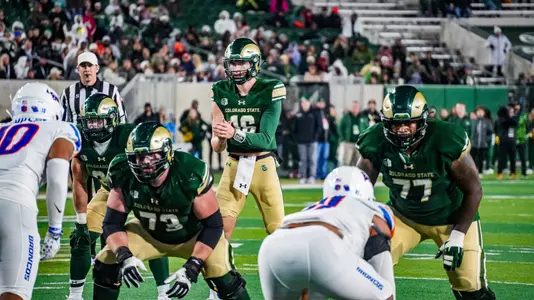
Colorado State has started the same offensive line every game this season, a stark contrast to a year ago when the Rams had already used five different combinations at the same point. The current group has been protecting Brayden Fowler-Nicolosi all year – and not just on game day.
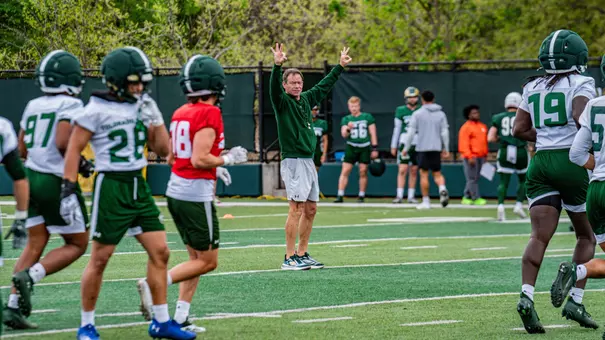
"I'm so proud of those five guys. That was our whole goal this year was to get five guys who were prideful, dependable, tough guys who were just going to protect the quarterback," CSU coach Jay Norvell said. "I'll give you the greatest example. We have jumping jacks every day and whoever gets called out goes to the middle and a bunch of the defensive guys push them around and hit them. Well, we called Brayden out and Brayden started doing jumping jacks, and the five O-linemen went out there and protected him, didn't let those guys push him.
"That's the mentality you've got to have -- the old blind side -- you're going to protect that guy no matter what. That's what we needed, old-school football. Those five guys have played almost every snap and they're playing with continuity. They're really giving us the maturity and the pride that we need."
A year after allowing the most sacks in the nation – 59 -- Colorado State has yielded only 10 on the season through seven games. The rebuild started in the spring around returner Jacob Gardner (who moved back to center), with transfers Saveyon Henderson, Oliver Jervis and Drew Moss gaining some cohesiveness. In the fall, Andrew Cannon was added to the mix.
Keeping the group together has been a boon for the offense as a whole, but it's also an extra layer of comfort for a young quarterback in his first year as a starter. Anything which can be taken off his plate – including a measure of worry – is a positive step.
"It's so important that Brayden knows he's protected. Even last week, we had one sack, it really wasn't the line's fault," Norvell said. "They've been excellent, and they've been consistent. They're the watchdogs. They have to protect the quarterback and give him a chance to do his job."
Every play, All the Time
When games are close, the plays at the end become magnified. Norvell spent the early part of the week explaining to his team they need to apply the same scrutiny to downs throughout a contest.
"The biggest thing that our kids have to understand about that is it's not always the last play that determines winning and losing," he said. "There's a whole lot of plays from the first quarter on that make a difference. Just little adjustments, little understandings of the execution can make a big difference. We had a handful of plays like that throughout the game that really affected the outcome at the end."
Getting the message across is part of building up a culture with a program which has undergone a host of change since he was hired. More than half the team is different from the group which lined up last year, and a lot of young and inexperienced players are part of the roster.
Mukendi Wa-Kalonji gained valuable experience a season ago, gaining even more this season. He admitted gaining an understanding of the concept Norvell shared requires some maturity to understand.
"I feel like it's really hard to grasp it, understand it all, how this play might affect how the game turns out in the end," he said. "As I start to become one of the older guys and understand the offense, I see that every down counts. Every snap from me counts."
When the Rams rallied to beat Boise State two weeks back, Norvell said there were about two dozen plays – of which had to be made – for the win to occur. Last week, the number of plays didn't deviate, noting there were occurrences where execution was off, something was misread, or a one-on-one battle didn't favor the Rams.
It all added up in a narrow defeat on the road to UNLV.
In football, it's not so much about time and place, it's every time, every part of the game.
"Every play. We probably had a half-a-dozen plays that were just a bit off in execution, and had we executed them a little differently, it might have been a difference in the game," Norvell said.
Behind the Chains
Air Force has only allowed 18 tackles for loss this season, four of those plays sacks. That's an average of 2.5 plays per game where teams have put the Falcons behind the chains. Take away the sacks, only 14 rushes in 405 attempts have been stopped behind the line of scrimmage, or 3.5 percent of their running attempts.
That's not a lot of chances to make their offense uncomfortable. However, it's an area where the Rams have excelled, their 7.6 tackles for loss per game ranking 11th in the country and leading the Mountain West.
Air Force has also been sharp in limiting mistakes, just five turnovers on the year, all of them fumbles. Another clash presented, as the Rams rank fourth in the country in takeaways with 16, 10 produced via recovered fumbles.
"I'm so proud of those five guys. That was our whole goal this year was to get five guys who were prideful, dependable, tough guys who were just going to protect the quarterback," CSU coach Jay Norvell said. "I'll give you the greatest example. We have jumping jacks every day and whoever gets called out goes to the middle and a bunch of the defensive guys push them around and hit them. Well, we called Brayden out and Brayden started doing jumping jacks, and the five O-linemen went out there and protected him, didn't let those guys push him.
"That's the mentality you've got to have -- the old blind side -- you're going to protect that guy no matter what. That's what we needed, old-school football. Those five guys have played almost every snap and they're playing with continuity. They're really giving us the maturity and the pride that we need."
A year after allowing the most sacks in the nation – 59 -- Colorado State has yielded only 10 on the season through seven games. The rebuild started in the spring around returner Jacob Gardner (who moved back to center), with transfers Saveyon Henderson, Oliver Jervis and Drew Moss gaining some cohesiveness. In the fall, Andrew Cannon was added to the mix.
Keeping the group together has been a boon for the offense as a whole, but it's also an extra layer of comfort for a young quarterback in his first year as a starter. Anything which can be taken off his plate – including a measure of worry – is a positive step.
"It's so important that Brayden knows he's protected. Even last week, we had one sack, it really wasn't the line's fault," Norvell said. "They've been excellent, and they've been consistent. They're the watchdogs. They have to protect the quarterback and give him a chance to do his job."
Every play, All the Time
When games are close, the plays at the end become magnified. Norvell spent the early part of the week explaining to his team they need to apply the same scrutiny to downs throughout a contest.
"The biggest thing that our kids have to understand about that is it's not always the last play that determines winning and losing," he said. "There's a whole lot of plays from the first quarter on that make a difference. Just little adjustments, little understandings of the execution can make a big difference. We had a handful of plays like that throughout the game that really affected the outcome at the end."
Getting the message across is part of building up a culture with a program which has undergone a host of change since he was hired. More than half the team is different from the group which lined up last year, and a lot of young and inexperienced players are part of the roster.
Mukendi Wa-Kalonji gained valuable experience a season ago, gaining even more this season. He admitted gaining an understanding of the concept Norvell shared requires some maturity to understand.
"I feel like it's really hard to grasp it, understand it all, how this play might affect how the game turns out in the end," he said. "As I start to become one of the older guys and understand the offense, I see that every down counts. Every snap from me counts."
When the Rams rallied to beat Boise State two weeks back, Norvell said there were about two dozen plays – of which had to be made – for the win to occur. Last week, the number of plays didn't deviate, noting there were occurrences where execution was off, something was misread, or a one-on-one battle didn't favor the Rams.
It all added up in a narrow defeat on the road to UNLV.
In football, it's not so much about time and place, it's every time, every part of the game.
"Every play. We probably had a half-a-dozen plays that were just a bit off in execution, and had we executed them a little differently, it might have been a difference in the game," Norvell said.
Behind the Chains
Air Force has only allowed 18 tackles for loss this season, four of those plays sacks. That's an average of 2.5 plays per game where teams have put the Falcons behind the chains. Take away the sacks, only 14 rushes in 405 attempts have been stopped behind the line of scrimmage, or 3.5 percent of their running attempts.
That's not a lot of chances to make their offense uncomfortable. However, it's an area where the Rams have excelled, their 7.6 tackles for loss per game ranking 11th in the country and leading the Mountain West.
Air Force has also been sharp in limiting mistakes, just five turnovers on the year, all of them fumbles. Another clash presented, as the Rams rank fourth in the country in takeaways with 16, 10 produced via recovered fumbles.

Players Mentioned

OL
/ Football
QB
/ Football
OL
/ Football
OL
/ Football
OL
/ Football
OL
/ Football
DL
/ FootballThursday, May 14
Monday, May 11
Friday, May 08
Tuesday, April 28