






Colorado State University Athletics
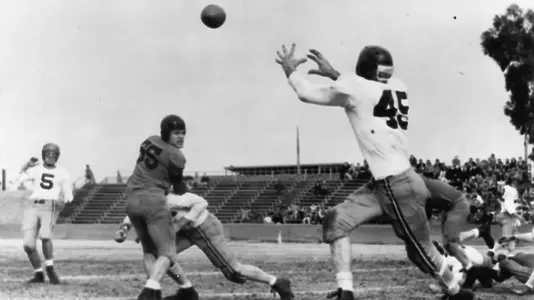
In Memoriam: Bob Hainlen The Last Member of the 1949 Raisin Bowl Team
3/20/2025 10:22:00 AM | Football
Robert Frederick (Bob, Freddy) Hainlen passed away peacefully on December 5, 2024 at the age of 97
News was received late last week from the family of former Colorado A&M quarterback Bob Hainlen (pronounced Hine-len) of his death on Dec. 5, 2024, just 13 days short of his 98th birthday. As a jump-passing quarterback, Hainlen led the 1948 Colorado A&M Aggies to the school's first bowl game, played on Jan. 1, 1949. It has been confirmed through research that Hainlen was the last member of that historic team.
Hainlen came to Colorado A&M in 1945 from Trinidad, Colo., a quarterback with what former teammate Frank Faucett described as a "buggy-whip arm." Hainlen arrived at a pivotal time in CSU's football history when the old wing formation was scrapped in favor of the T-formation, which favored the quarterback. Hainlen won the starting job and played in CSU's first post-World War II football game against Northern Colorado on Sept. 29, 1945. At the age of 17 years and 9 months, Hainlen set the school record as the youngest starting quarterback in school history – a record which still stands.
Hainlen's passing ability allowed coach Hans Wagner to experiment with the new T-formation, throwing the ball more often. By playing in this style, Hainlen became the first modern day quarterback in school history. He kept the job until Harry Hughes took over as head coach midway through the 1946 season and brought back the wing formation. When coach Bob Davis took over in 1947, Hainlen returned to the quarterback position.
Hainlen fit well with the Aggies as a field general, his strong arm connecting with receivers unlike any other player before him. In 1948, the Aggies had their best season since 1934, nearly winning the conference, finishing second. During the final game of the season in Boulder, Hainlen led the Aggies to a 29-25 victory in which Hainlen kicked three field goals making the difference in the game. The win over CU sealed an invitation to the 1949 Raisin Bowl and the legacy of a team not forgotten at CSU.
Colorado State has always held the Raisin Bowl team with high esteem, partly because they mark an exciting period in CSU's football history and partly because of the great players from that team like Eddie Hanna, Jack Christiansen, Tuffy Mullison, Faucett, Dale Dodrill and the late great Fum McGraw, who fans have heard about for more than 75 years. Hainlen might get lost among those greats of CSU, but his accomplishments were outstanding.
Besides his four years as quarterback, Hainlen also lettered as a shortstop on the baseball team for three years and was a jumper for the track and field team for two years, earning a total of nine letters. After graduation, he was drafted by the Washington Redskins and played one season of minor league football with the Wilmington Clippers. He moved to Arizona with his wife, Dee, who was the Colorado A&M 1948 homecoming queen. They were married in 1949, and lived in Arizona the remainder of their lives.
The passing of Bob Hainlen ends an era of CSU football fans have known and heard about for decades. In 2023, four Raisin Bowl alums, Lee Walters, Dasel Hallmark, Joe Folsom and Faucett passed way. They were the last of Hainlen's teammates, Fawcett being the last of any player from that team to attend a CSU football game in November of 2022. Hainlen, the team's on-the-field leader, lived as the lone former player of that legendary team for just more than a year.
Stories of playing football in 1948 are now only caught on audio or video taped interviews. Tuffy Mullison told of being knocked unconscious after the Wyoming game when a Cowboy fan hit him over the head with a beer bottle. Ollie Woods told of the harrowing flights to and from Fresno for the bowl game, the team narrowly crashing in Utah after a fuel stop. Faucett told of how he ran into the back of McGraw on a play and cut his lip, McGraw telling Faucett, "Watch out little halfback."
As Ram fans reflect on Hainlen, a man they may not have known about until now, it allows them to think about the passing years and how to cherish them. The National WWII Museum in New Orleans estimated in 2024 there are less than 67,000 veterans of WWII still living. There are no men who played football at CSU for the legendary Hughes still living and now there are no more members of the school's first bowl team.
We tend to remember the teams which touched us most, such as the 1966 Rams, the 1977 Mean Green, the 1986 Wacky WAC attack and the 1990 Freedom Bowl Champions -- one day they too will be gone. The Aggie era at CSU, which is defined as 1893 to 1957, has very few men and women still around to tell their stories. Before we know it, there will be a day when there are no more alumni who graduated from Colorado A&M College, completely ending a much different time on the CSU campus.
Hainlen came to Colorado A&M in 1945 from Trinidad, Colo., a quarterback with what former teammate Frank Faucett described as a "buggy-whip arm." Hainlen arrived at a pivotal time in CSU's football history when the old wing formation was scrapped in favor of the T-formation, which favored the quarterback. Hainlen won the starting job and played in CSU's first post-World War II football game against Northern Colorado on Sept. 29, 1945. At the age of 17 years and 9 months, Hainlen set the school record as the youngest starting quarterback in school history – a record which still stands.
Hainlen's passing ability allowed coach Hans Wagner to experiment with the new T-formation, throwing the ball more often. By playing in this style, Hainlen became the first modern day quarterback in school history. He kept the job until Harry Hughes took over as head coach midway through the 1946 season and brought back the wing formation. When coach Bob Davis took over in 1947, Hainlen returned to the quarterback position.
Hainlen fit well with the Aggies as a field general, his strong arm connecting with receivers unlike any other player before him. In 1948, the Aggies had their best season since 1934, nearly winning the conference, finishing second. During the final game of the season in Boulder, Hainlen led the Aggies to a 29-25 victory in which Hainlen kicked three field goals making the difference in the game. The win over CU sealed an invitation to the 1949 Raisin Bowl and the legacy of a team not forgotten at CSU.
Colorado State has always held the Raisin Bowl team with high esteem, partly because they mark an exciting period in CSU's football history and partly because of the great players from that team like Eddie Hanna, Jack Christiansen, Tuffy Mullison, Faucett, Dale Dodrill and the late great Fum McGraw, who fans have heard about for more than 75 years. Hainlen might get lost among those greats of CSU, but his accomplishments were outstanding.
Besides his four years as quarterback, Hainlen also lettered as a shortstop on the baseball team for three years and was a jumper for the track and field team for two years, earning a total of nine letters. After graduation, he was drafted by the Washington Redskins and played one season of minor league football with the Wilmington Clippers. He moved to Arizona with his wife, Dee, who was the Colorado A&M 1948 homecoming queen. They were married in 1949, and lived in Arizona the remainder of their lives.
The passing of Bob Hainlen ends an era of CSU football fans have known and heard about for decades. In 2023, four Raisin Bowl alums, Lee Walters, Dasel Hallmark, Joe Folsom and Faucett passed way. They were the last of Hainlen's teammates, Fawcett being the last of any player from that team to attend a CSU football game in November of 2022. Hainlen, the team's on-the-field leader, lived as the lone former player of that legendary team for just more than a year.
Stories of playing football in 1948 are now only caught on audio or video taped interviews. Tuffy Mullison told of being knocked unconscious after the Wyoming game when a Cowboy fan hit him over the head with a beer bottle. Ollie Woods told of the harrowing flights to and from Fresno for the bowl game, the team narrowly crashing in Utah after a fuel stop. Faucett told of how he ran into the back of McGraw on a play and cut his lip, McGraw telling Faucett, "Watch out little halfback."
As Ram fans reflect on Hainlen, a man they may not have known about until now, it allows them to think about the passing years and how to cherish them. The National WWII Museum in New Orleans estimated in 2024 there are less than 67,000 veterans of WWII still living. There are no men who played football at CSU for the legendary Hughes still living and now there are no more members of the school's first bowl team.
We tend to remember the teams which touched us most, such as the 1966 Rams, the 1977 Mean Green, the 1986 Wacky WAC attack and the 1990 Freedom Bowl Champions -- one day they too will be gone. The Aggie era at CSU, which is defined as 1893 to 1957, has very few men and women still around to tell their stories. Before we know it, there will be a day when there are no more alumni who graduated from Colorado A&M College, completely ending a much different time on the CSU campus.


Inside the Offensive Linemen Room | Colorado State Football | Rams Live
Thursday, May 14
Inside The Tight End Room | Colorado State Football | Rams Live
Monday, May 11
Inside the Quarterback Room | Colorado State Football | Rams Live
Friday, May 08
Inside the Nickelback Room | Colorado State Football | Rams Live
Tuesday, April 28