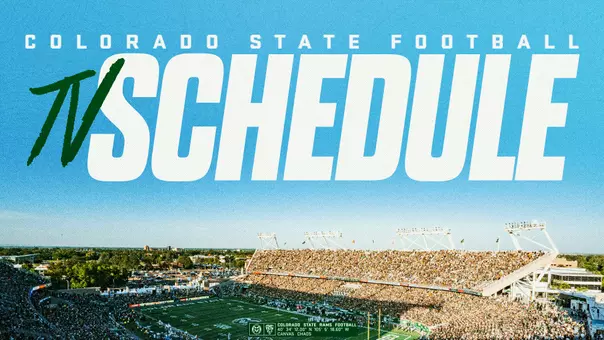
It's official -- the new name of CSU's multipurpose Stadium is Canvas Stadium, with the announcement yesterday confirming the new name. When officials from Canvas Credit Union announced earlier this spring that they would pay $37.7 million for the naming rights to the new CSU Stadium, combined with the $20 million paid to name the field after legendary coach Sonny Lubick by an anonymous donor, the total naming rights package amounts to $57.7 million and is one of the largest in NCAA history.
The concept of paying money to name an athletic venue after someone or something is not new in sports and as it turns out, the Canvas Credit Union deal is not the first in CSU history. The first official athletic field at Colorado State University was built in 1899, but it was not until 1901 that it received its name thanks to a former student that never played any sport on the Agricultural College campus.
Charles Caitlin Durkee was born in Colorado Springs on July 13, 1880 and enrolled at Colorado Agricultural College in the fall of 1898. Durkee studied agriculture and engineering, but at the Thanksgiving break of 1898 he decided not to return to school for the spring semester of 1899.
Over the summer of 1899, the college built its first athletic field on the campus after a new athletic association decided to bring football back to the campus. Both track and baseball also used the new athletic grounds, which were located where the Glenn Morris Field House sits today. The military cadets also used the grounds to do their training as a parade ground.
In the fall of 1899, Charles Durkee, typically known as C.C. Durkee, returned to the CAC campus to resume his studies. He was listed in the Collegian as a Corporal in Company C of the Aggie Battalion and in February of 1900 was promoted to sergeant.
Sometime in 1900, Charles Durkee's father, Charles E. Durkee, a lumber yard and hardware owner in Colorado Springs died at the age of 66. It is believed that young Charles dropped out of school to care for his family and eventually take over his father's business. Durkee's name does not appear in the Collegian during the 1900-1901 school year, leading to the belief he was not in Fort Collins at the time of his father's death. Durkee Field
The September 1901 Collegian is the next time we hear of C.C.Durkee and this is when history is made. The Collegian states, "An old student, C.C. Durkee has donated money and supplies to build a fence on three sides of the athletic field."
Although the Collegian article does not state that Durkee asked to have his name placed on the field, from that moment forward the site is referred to as "Durkee Field." Further research in a book written by local historian Ruth Wattles explains that Durkee donated $650 and the supplies (likely the wood for the fence and tools to build it) to make up the athletic facility known as Durkee Field.
This donation is not only the first to name an athletic facility at CSU, but it is the first recorded donation to CSU Athletics. There were likely others who had helped support the teams with money or equipment prior to 1901, but Durkee's $650 donation (worth approximately $19,500 in 2018 when calculating for inflation) is considered to be the first recorded philanthropic gift to athletics in school history.
Durkee must have remained in the Fort Collins area for some time, but according to school records he did not graduate from Colorado Agricultural College. In 1903 he married Wilma Turk in Fort Collins and later moved to Canon City to be the manager of the Colorado Canning Company. By 1910 Charles and Wilma Durkee moved to Portland, Ore., where he opened his own civil engineering business. It is not clear if he ever received a degree from any institution for engineering.
Charles and Wilma Durkee lived out their lives in Portland. Wilma died in 1959 and Charles Died on September 24, 1965 at the age of 85; they had no children.
Durkee Field served as the home of football, track and baseball until the spring of 1912 when construction began on Colorado Field. The iconic fence that surrounded Durkee Field helping give its name and so prominent in photos of the site was dismantled and some of the wood was used to build the new athletic clubhouse on the northwest corner of the Colorado Field site. That building lasted until the early 1960s.
The Durkee Field site was transformed into tennis courts in 1912 and later a practice area for all athletics until 1926 when the Men's Gym, now known as the Glenn Morris Field House, was built and is still in use today for the CSU Track Teams. The former site of Durkee Field has the distinction of being the longest continuous use for athletics on any part of the CSU campus today.
It would not be until 2003 when private money would be used to name a football facility on the CSU campus. The Bohemian Foundation gave $15.2 million to expand Hughes Stadium and name the field after legendary Coach Sonny Lubick. There are no records of any donations to build or expand Colorado Field using private money and Hughes Stadium was built using bond money with many of Harry Hughes' former players lobbying to have his name on that facility. Only the Hughes Room was built using donations from Harry Hughes' former players.
Although Charles Durkee never played a sport, or even graduated from Colorado State, his original donation to athletics has led to many more gifts among other former athletes, graduates, businesses and non-graduates--proving that any gift can go a long way and last a long time too.