




Colorado State University Athletics
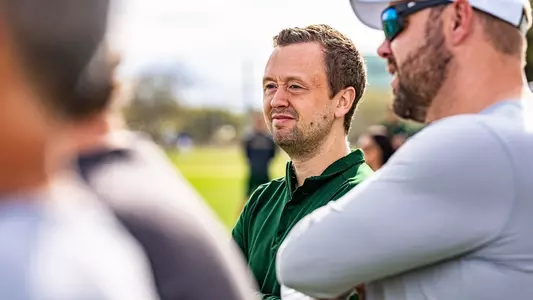
Collins Set to Build a Prosperous Football Program
1/9/2025 10:38:00 AM | Football
Rams’ new GM out to help Rams navigate new frontier
Having been in the NFL, Jay Norvell knows how it works, and there is a dividing line.
Coaches coach. General managers handle the business side. In his more than two decades in college football, the two never had a chance to collide. Now that they have, Norvell knows what he is – a coach. And just a brief foray into the other realm was enough for him.
He wanted no part of it any longer than necessary, thus the addition of Alex Collins to the Colorado State staff as the general manager.
"That's the way we want it to be, and I have to be able to coach these guys and they have to know that I'm trying to help them be the best players they can be, not decide how much money they can get," Norvell said. "Obviously, the coaches evaluate the players and rank them and all that, and we have a lot of influence on what happens, but I don't want to have those conversations with kids.
"Alex understands this, and he's been through it the past couple of years at Ole Miss, and I think it's been very good for our team. I think our guys are focused and they understand there are reasons why we do everything; we have a system that's very well thought out. The whole key is we keep the continuity of our team and get everybody playing hard."
Collins was with Norvell at Nevada in the personnel department, spending the past five years at Ole Miss. It was during his time in Oxford where the landscape of college football started to change. He worked under Austin Thomas (now at LSU) at first, then eventually Billy Glasscock. The two had led Ole Miss into the NIL era and how to navigate it as dedicated general managers, with Collins learning the ropes from them.
He had ties to Norvell at Nevada, but he comes to the program in a different role, armed with a blueprint for success.
"A lot of schools, depending on their NIL structure and resources, tried to determine the need. Now with revenue sharing coming this fall, every school is really seeing the need for that role and that position," Collins said. "Like Jay said, he and I don't talk about it. It's my role that I have a good understanding of what he wants, and at the end of the day, it's my goal to help us build a team that can win football games. Understanding his vision of what he wants it to look like, and understanding all of our assistant coaches and coordinators of what they want their side of the ball to look like and having a unified vision of what we want that to look like helps me do my job.
"I'm not here to be the one to make decisions, but I'll take all the information from the stakeholders and the understanding of how we feel about things and the decision gets made for me at that point."
Collins becomes the bridge to multiple places. From one coach's office to another. To the recruiting personnel. To and from the business ledger. His office becomes the hub for all the information to matriculate so the right decisions can be made.
He also serves the player's needs, especially when it comes to the education piece. With it still in its infancy, and multiple outside people inserting themselves into the equation, Collins is there to educate and help the players make the best decisions for them at whatever point in their career they find themselves. Collins noted the decisions of a freshman or sophomore should vary greatly from that of a senior with one final year of eligibility. Short-term thinking only aids one of those parties.
And as it sits, the players would rather talk to Collins than Norvell when it comes to the financial component.
"I love that. I mean, when I'm meeting with Coach (Billy) Best or Coach Norvell, it should strictly be the football aspect," guard Tanner Morley said. "Am I doing this combo block right? Then I can go meet with Alex and talk financial stuff, career stuff. It's money. It will help you in the future, where you put it, be safe with it. It's good to separate those two so I can focus on one rather than the other."
Collins has met with the players, trying to inform them not just on NIL but what revenue sharing could mean if and when that comes into play. It's a tough field for Collins to navigate as he says many of the scenarios in play are still hypothetical. And he's been working in the arena since its inception.
Imagine the questions the players have. Morely said the addition of Collins is good for all of them, a person with answers and someone who is looking out for them. A college roster 105 players deep isn't separated into equal parts. Like the NFL, certain positions will be assigned more value.
"Alex is an amazing guy. He's been with an SEC program for the past five years. He knows the ins and outs of a great program: Ole Miss has been doing good," Morley said. "It's a whole new generation with NIL. Getting to know how people are getting paid, why they're getting paid and how much players should be getting paid is important, because a lot of guys on many teams are transferring just because of the dollar signs. That's not really what the most important thing is, especially when your value doesn't equate to what it should be. Alex has just done an amazing job of just showing that to us and taking care of us in a way we feel appreciated.
"I understand it really well. He broke it down into a few categories of how valuable a player is, how much would it cost to lose them, what the player did for us the last season, how many snaps he played and how good did he play with those snaps, how are they in the locker room, are they a team guy, a leader, what do they bring to the table in general. When he breaks it down like that, it really helps a student-athlete know what it really means to be in a college program and how they value you. It's important to know how a coach values you in their system."
Norvell himself has reservations about the landscape, as does Collins. There are no real guardrails on the road as of now, though many hope they will be constructed soon. It is a bit of the Wild West, with schools in different states operating under alternate rules of conduct.
He does know those are conversations he does not want to have with his players, and he's not sure the college players are ready for some of the possible actions.
"I am. The system is not … It needs a lot of work," Norvell said. "I've told players, I've been in the National Football League, and they don't want to be employees. There are a lot of things about college football that are better than pro football. Hey, you have a bad year in college, they try to get you better. You have a bad year in pro football, they get rid of you. College players don't want that."
What Collins wants in the end is what Norvell wants: A well-run system which serves the needs of the program, which includes the players involved. He will let everyone do their jobs when it comes to evaluating players, but he will also help close some gaps.
He will do some background checks, talk to the people closest to the players the Rams are looking to add to the program. What he said he won't do is sit at a computer and evaluate.
What's best for the program are the decisions which stem from having the whole in mind, will always win the day.
"I'm never going to sacrifice our culture and expectations from people. It's great when there's a unified opinion," Collins said. "You're trying to bring stability to a chaotic world. Everything is hypothetical. Everything is settlements, which will probably happen, but who knows? Everything is one lawsuit away from changing. Really, for the last couple of years, it's been a lot of operating in a way and understanding it might completely change overnight. I tell a lot of kids and a lot of people, no one know where this is at in five years. In reality, no one ones where it is in one year, four months."
But he knows why he's at Colorado State. He likes the direction of the program, and the unity he's found between the offices of Norvell, Director of Athletics and President Amy Parsons. He said it is rare at a school for all three to share a bonded idea.
He also knows the landscape and how to navigate the waters. He knows what conversations to have, who to have them with and when and why Norvell should or should not be involved. He also knows when he first met Norvell, this wasn't a job description in any college football office.
Times have changed, and Collins has become necessary for Colorado State to grow and prosper.
Coaches coach. General managers handle the business side. In his more than two decades in college football, the two never had a chance to collide. Now that they have, Norvell knows what he is – a coach. And just a brief foray into the other realm was enough for him.
He wanted no part of it any longer than necessary, thus the addition of Alex Collins to the Colorado State staff as the general manager.
"That's the way we want it to be, and I have to be able to coach these guys and they have to know that I'm trying to help them be the best players they can be, not decide how much money they can get," Norvell said. "Obviously, the coaches evaluate the players and rank them and all that, and we have a lot of influence on what happens, but I don't want to have those conversations with kids.
"Alex understands this, and he's been through it the past couple of years at Ole Miss, and I think it's been very good for our team. I think our guys are focused and they understand there are reasons why we do everything; we have a system that's very well thought out. The whole key is we keep the continuity of our team and get everybody playing hard."
Collins was with Norvell at Nevada in the personnel department, spending the past five years at Ole Miss. It was during his time in Oxford where the landscape of college football started to change. He worked under Austin Thomas (now at LSU) at first, then eventually Billy Glasscock. The two had led Ole Miss into the NIL era and how to navigate it as dedicated general managers, with Collins learning the ropes from them.
He had ties to Norvell at Nevada, but he comes to the program in a different role, armed with a blueprint for success.
"A lot of schools, depending on their NIL structure and resources, tried to determine the need. Now with revenue sharing coming this fall, every school is really seeing the need for that role and that position," Collins said. "Like Jay said, he and I don't talk about it. It's my role that I have a good understanding of what he wants, and at the end of the day, it's my goal to help us build a team that can win football games. Understanding his vision of what he wants it to look like, and understanding all of our assistant coaches and coordinators of what they want their side of the ball to look like and having a unified vision of what we want that to look like helps me do my job.
"I'm not here to be the one to make decisions, but I'll take all the information from the stakeholders and the understanding of how we feel about things and the decision gets made for me at that point."
Collins becomes the bridge to multiple places. From one coach's office to another. To the recruiting personnel. To and from the business ledger. His office becomes the hub for all the information to matriculate so the right decisions can be made.
He also serves the player's needs, especially when it comes to the education piece. With it still in its infancy, and multiple outside people inserting themselves into the equation, Collins is there to educate and help the players make the best decisions for them at whatever point in their career they find themselves. Collins noted the decisions of a freshman or sophomore should vary greatly from that of a senior with one final year of eligibility. Short-term thinking only aids one of those parties.
And as it sits, the players would rather talk to Collins than Norvell when it comes to the financial component.
"I love that. I mean, when I'm meeting with Coach (Billy) Best or Coach Norvell, it should strictly be the football aspect," guard Tanner Morley said. "Am I doing this combo block right? Then I can go meet with Alex and talk financial stuff, career stuff. It's money. It will help you in the future, where you put it, be safe with it. It's good to separate those two so I can focus on one rather than the other."
Collins has met with the players, trying to inform them not just on NIL but what revenue sharing could mean if and when that comes into play. It's a tough field for Collins to navigate as he says many of the scenarios in play are still hypothetical. And he's been working in the arena since its inception.
Imagine the questions the players have. Morely said the addition of Collins is good for all of them, a person with answers and someone who is looking out for them. A college roster 105 players deep isn't separated into equal parts. Like the NFL, certain positions will be assigned more value.
"Alex is an amazing guy. He's been with an SEC program for the past five years. He knows the ins and outs of a great program: Ole Miss has been doing good," Morley said. "It's a whole new generation with NIL. Getting to know how people are getting paid, why they're getting paid and how much players should be getting paid is important, because a lot of guys on many teams are transferring just because of the dollar signs. That's not really what the most important thing is, especially when your value doesn't equate to what it should be. Alex has just done an amazing job of just showing that to us and taking care of us in a way we feel appreciated.
"I understand it really well. He broke it down into a few categories of how valuable a player is, how much would it cost to lose them, what the player did for us the last season, how many snaps he played and how good did he play with those snaps, how are they in the locker room, are they a team guy, a leader, what do they bring to the table in general. When he breaks it down like that, it really helps a student-athlete know what it really means to be in a college program and how they value you. It's important to know how a coach values you in their system."
Norvell himself has reservations about the landscape, as does Collins. There are no real guardrails on the road as of now, though many hope they will be constructed soon. It is a bit of the Wild West, with schools in different states operating under alternate rules of conduct.
He does know those are conversations he does not want to have with his players, and he's not sure the college players are ready for some of the possible actions.
"I am. The system is not … It needs a lot of work," Norvell said. "I've told players, I've been in the National Football League, and they don't want to be employees. There are a lot of things about college football that are better than pro football. Hey, you have a bad year in college, they try to get you better. You have a bad year in pro football, they get rid of you. College players don't want that."
What Collins wants in the end is what Norvell wants: A well-run system which serves the needs of the program, which includes the players involved. He will let everyone do their jobs when it comes to evaluating players, but he will also help close some gaps.
He will do some background checks, talk to the people closest to the players the Rams are looking to add to the program. What he said he won't do is sit at a computer and evaluate.
What's best for the program are the decisions which stem from having the whole in mind, will always win the day.
"I'm never going to sacrifice our culture and expectations from people. It's great when there's a unified opinion," Collins said. "You're trying to bring stability to a chaotic world. Everything is hypothetical. Everything is settlements, which will probably happen, but who knows? Everything is one lawsuit away from changing. Really, for the last couple of years, it's been a lot of operating in a way and understanding it might completely change overnight. I tell a lot of kids and a lot of people, no one know where this is at in five years. In reality, no one ones where it is in one year, four months."
But he knows why he's at Colorado State. He likes the direction of the program, and the unity he's found between the offices of Norvell, Director of Athletics and President Amy Parsons. He said it is rare at a school for all three to share a bonded idea.
He also knows the landscape and how to navigate the waters. He knows what conversations to have, who to have them with and when and why Norvell should or should not be involved. He also knows when he first met Norvell, this wasn't a job description in any college football office.
Times have changed, and Collins has become necessary for Colorado State to grow and prosper.

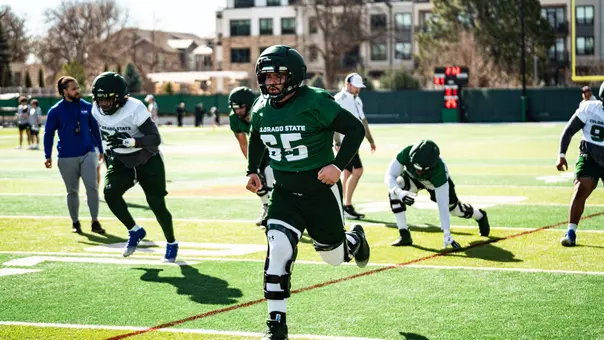
Players Mentioned
OL
/ FootballColorado State Football: K'saan Farrar - 2026 Spring Scrimmage #1
Saturday, March 28
Colorado State Football: Oumar Diomande - 2026 Spring Scrimmage #1
Saturday, March 28
Colorado State Football: Jim Mora - 2026 Spring Scrimmage #1
Saturday, March 28
Rams Live Exclusive - Spring Football Preview
Tuesday, February 24